
Habitat
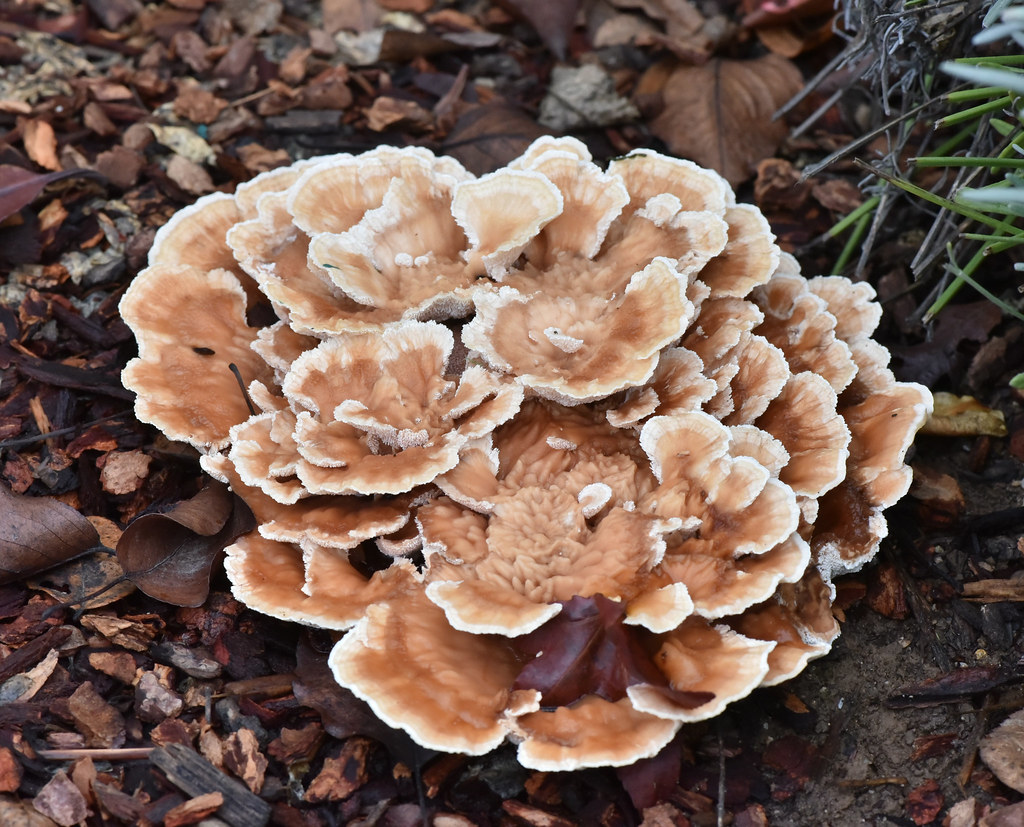
This species grows on the ground from buried dead wood, stumps, and roots of deciduous trees, though it is occasionally found in coniferous forests. It is common in urban environments such as lawns, gardens, and disturbed areas near dying trees, as well as on wood chips. It can be found solitary or in scattered, tufted clusters, sometimes engulfing grass or plant stems as it grows.
Photos
Appearance
- Fruit body
- Extremely variable, ranging from 3–20 cm across; forms irregular blobs, top-shaped structures, or rosette-like clusters. Surface is matted-tomentose or felty, often knobby, and may exude red droplets when young.
- Cap
- Whitish to pinkish, becoming reddish-brown with age, often with a paler margin; surface sometimes features patches of pores or is obscurely zoned.
- Pores
- Irregular and angular to maze-like; colored whitish to pale pinkish, bruising reddish to reddish-brown; 1–3 pores per mm.
- Tubes
- 2–6 mm long, white to greyish or beige, often decurrent.
- Stem
- Often absent; when present, it is stout, irregular, and rooting, ranging from 5–7 cm long; soft on the outside with a hard core.
- Flesh
- Fibrous and watery when young, becoming tough or hard; white, staining pinkish to reddish when cut or bruised.
- Spore print
- White to pale yellow.
Sporecast is better in the app
Plan ahead with 10-day forecasts, see what people are finding nearby, get photo IDs, and track your finds.
Edibility
The edibility of this species is commonly listed as unknown or non-edible. While the flavor is described as mild or sweet, the flesh is fibrous and watery, becoming tough in maturity. Young specimens producing red droplets are frequently mistaken for Hydnellum peckii, though that species has spines on the underside. Older fruitbodies can be confused with Bondarzewia occidentalis, which is larger and lacks the characteristic pinkish-red staining reaction when bruised or injured.
Misidentification can be fatal. Never eat a mushroom unless you're 100% sure. This information may be inaccurate. Always consult multiple sources.
Nutrient Source
facultativeIt gains nutrients as a saprobe, decomposing dead wood material from hardwood and coniferous trees, and can also act as a parasite, causing rot in living trees.
Common Names
- Basque
- Lur-ardagai, lur-ardagai
- Danish
- Rødgul pigsvamp, Rødmende pjalteporesvamp
- Dutch
- Toefige labyrintzwam
- English
- Blushing Rosette
- French
- Polypore bisannuel
- German
- Rötender Wirrling
- Norwegian Bokmål
- rødnende labyrintkjuke, klumpkjuke
- Norwegian Nynorsk
- klumpkjuke
- Swedish
- klumpticka
- Welsh
- Roséd Gwridog
Synonyms
- Abortiporus distortus
- Agaricus coriaceus
- Bjerkandera puberula
- Boletus biennis
- Boletus distortus
- Boletus rugosus
- Ceriomyces alveolatus
- Ceriomyces schnyderianus
- Ceriomyces terrestris
- Daedalea biennis
- Daedalea bonariensis
- Daedalea capitata
- Daedalea distorta
- Daedalea heteropora
- Daedalea incarnatoalbida
- Daedalea pampeana
- Daedalea polymorpha
- Daedalea puberula
- Daedalea rufescens
- Daedalea rufescens
- Daedalea sericella
- Daedalea sowerbei
- Fibrillaria subterranea
- Grifola biennis
- Heteroporus biennis
- Heteroporus distortus
- Hydnum bienne
- Hydnum bienne
- Hydnum rufescens
- Irpex hydniformis
- Irpex radicatus
- Irpicium ulmicola
- Lentinus bostonensis
- Lentinus coriaceus
- Lentinus hispidosus
- Lentinus lusitanicus
- Merisma heteroporum
- Phaeolus biennis
- Pocillaria coriacea
- Polyporus biennis
- Polyporus distortus
- Polyporus heteroporus
- Polyporus occultus
- Polyporus proteiporus
- Polyporus rufescens
- Polyporus rufescens
- Polyporus sericellus
- Polystictus rufescens
- Ptychogaster alveolatus
- Ptychogaster lindtneri
- Ptychogaster rufescens
- Sistotrema bienne
- Sistotrema lobatum
- Sistotrema notarisii
- Sistotrema rufescens
- Spongiosus rufescens
- Sporotrichopsis terrestris
- Striglia puberula
- Trametes rufescens
- Trametes rufescens