
Habitat
This species is found in a variety of environments, most frequently in grassy areas such as pastures, fields, meadows, lawns, and gardens. It also thrives in parklands, roadside verges, sand dunes, and nutrient-rich sites like compost heaps. While primarily associated with open ground, it occasionally appears in woodland glades, thickets, or forest openings. It typically grows in small groups or clusters and is known to form fairy rings.
Photos
Appearance
- Cap
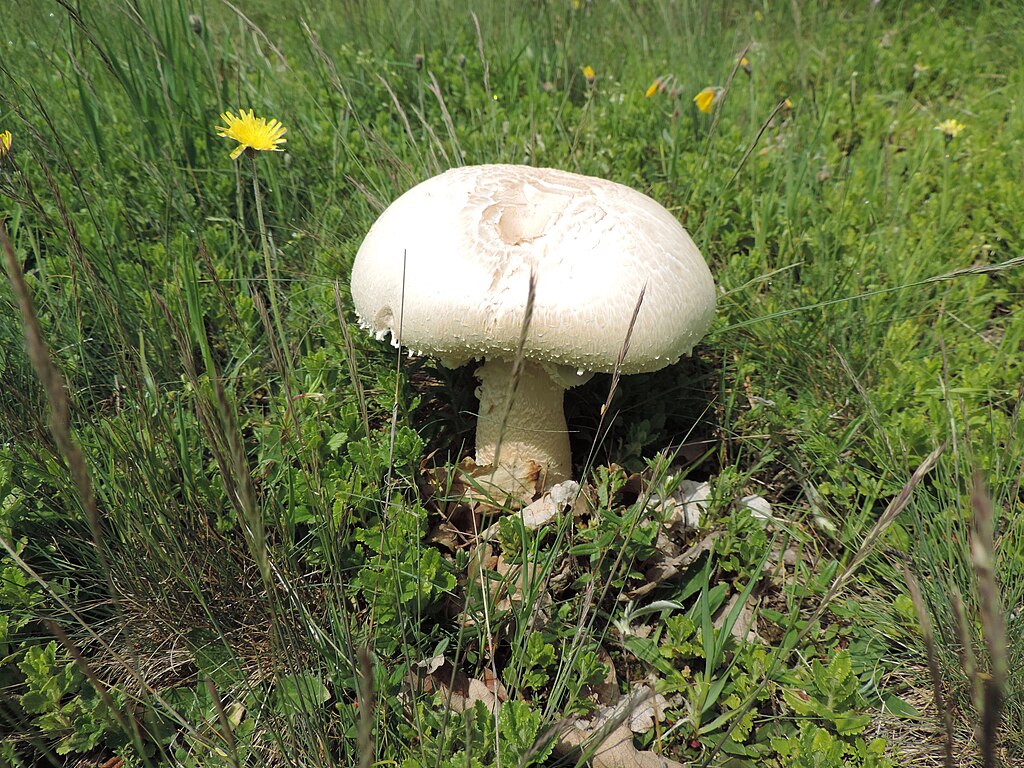
- Large and robust, measuring 7–20 cm across. It starts egg-shaped or ovoid before expanding to convex and eventually flattening. The surface is smooth to finely scaly, creamy white, and bruises slowly yellow when handled. Older specimens may crack into larger scales.
- Stem
- 8–15 cm tall and 1–3 cm thick, ranging from cylindrical to slightly bulbous or wider at the base. It is white but develops yellow tints with age. The interior is often stuffed with a cottony pith or becomes hollow.
- Ring
- A prominent, persistent membrane located near the top of the stem. It features a distinctive double-layered appearance with a star-shaped or 'cogwheel' pattern on the underside.
- Gills
- Free from the stem and crowded together. They are white or whitish when young, transitioning through greyish-pink to a final dark chocolate-brown or brown-black as the spores mature.
- Flesh
- Thick, firm, and white throughout, sometimes bruising slightly yellow locally. It possesses a pleasant smell of aniseed or bitter almonds and has a mild, mushroomy taste.
- Spore print
- Dark chocolate-brown to purple-brown.
Sporecast is better in the app
Plan ahead with 10-day forecasts, see what people are finding nearby, get photo IDs, and track your finds.
Edibility
The Horse Mushroom is a valued edible with a flavor and aroma of aniseed or almonds, though the scent can become musty or ammoniacal as it matures. Foraging requires caution to avoid the toxic Yellow Stainer, which bruises more vibrantly yellow and smells of phenol or ink, as well as deadly Amanita species that share similar gill colors in youth but possess a volva. This species can accumulate cadmium and contains phenyl-hydrazine derivatives, so consuming large quantities may pose a health risk; additionally, specimens from lawns or urban areas should be avoided if pesticides are present.
Misidentification can be fatal. Never eat a mushroom unless you're 100% sure. This information may be inaccurate. Always consult multiple sources.
Nutrient Source
SaprotrophicThis species obtains nutrients by breaking down dead organic matter in soil, litter, or dung.
Common Names
- Basque
- azpibeltz
- Catalan
- bola de neu
- Danish
- Sprukken champignon, Fnugfodet champignon, Ager-champignon
- Dutch
- vezelige anijschampignon, Vezelige anijschampignon, Gewone anijschampignon, wollige anijschampignon
- English
- Horse Mushroom
- Finnish
- peltoherkkusieni, piennarherkkusieni, villaherkkusieni
- French
- Psalliote à toison blanche, Psalliote des jachères, Agaric fissuré, Psalliote fissuré, Agaric des jachères, Agaric à toison blanche
- German
- Weißer Anis-Champignon, Rissigschuppiger Champignon
- Norwegian Bokmål
- åkersjampinjong, sprekksjampinjong
- Norwegian Nynorsk
- åkersjampinjong
- Scottish Gaelic
- balgain-bhuachair, balgan-buachair
- Spanish
- llanero, champiñón grande, Bola de nieve, bola de niev
- Swedish
- Snöbollschampinjon
- Welsh
- Caws Ceffyl
Synonyms
- Agaricus arvensis
- Agaricus exquisitus
- Agaricus fissuratus
- Agaricus leucotrichus
- Agaricus parkensis
- Agaricus vaporarius
- Fungus arvensis
- Pratella arvensis
- Psalliota arvensis
- Psalliota arvensis
- Psalliota fissurata
- Psalliota leucotricha