
Habitat
Agaricus augustus is found on the ground in a variety of environments, including woodlands, parklands, gardens, and along roadsides or trail edges. It has a strong preference for rich organic litter, deep leaf duff, and woody debris, particularly under western redcedar, redwood, cypress, and true cedar trees. The species is frequently found in disturbed areas such as campgrounds, mulched or composted flower beds, and calcareous sites. It often grows in large groups, clusters, or arcs, with its stem typically deeply embedded in the soil.
Photos
Appearance
- Cap
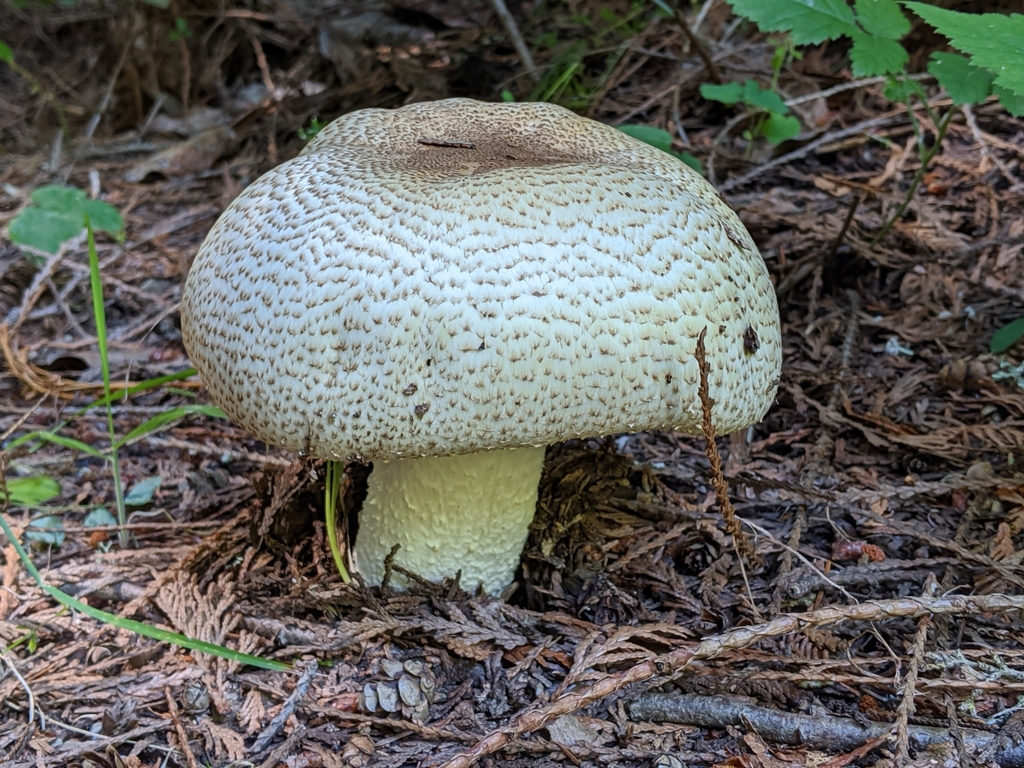
- Large (7–30 cm), initially hemispherical, square-topped, or ovoid, becoming broadly convex to flat. The surface is dry and covered in concentric rings of fibrous brown to tawny scales over a whitish to golden-yellow background. It bruises yellow to orange-brown when handled or age-worn.
- Stem
- Substantial (7–25 cm long), often tapering toward the top and sometimes deeply rooted in soil. It is white to creamy yellow, bruising yellow-orange. The surface is smooth above the ring and distinctly woolly or scaly below.
- Gills
- Free from the stem and crowded. They transition from very pale pink or greyish-white to reddish-pink, eventually turning dark chocolate brown or near black as they mature.
- Ring
- A large, persistent, and membranous double ring located high on the stem, often featuring cottony or scaly patches on the underside.
- Flesh
- Thick, firm, and white, sometimes bruising yellow or flushing pinkish-red, especially at the base of the stem.
- Spore print
- Dark chocolate brown.
- Odour
- Distinctive and strong, smelling of bitter almonds, marzipan, or anise.
- Taste
- Mushroomy and sweet, often with a clear hint of almonds.
Sporecast is better in the app
Plan ahead with 10-day forecasts, see what people are finding nearby, get photo IDs, and track your finds.
Edibility
Possesses a strong scent and flavour of bitter almonds, anise, or marzipan, which some find overbearing. While widely considered a high-quality edible, first-time eaters should only consume small amounts, as rare allergic reactions including itching, swollen lips, and vomiting have been reported. It is a known accumulator of heavy metals, so the safety of the collection site should be considered. To avoid confusion with toxic species that smell of phenol or creosote, ensure the specimen has a distinct almond odor; also distinguish from similar dapperlings which have white gills and an unpleasant smell.
Misidentification can be fatal. Never eat a mushroom unless you're 100% sure. This information may be inaccurate. Always consult multiple sources.
Nutrient Source
SaprotrophicIt obtains nutrients by breaking down dead organic matter in the soil. It is often found in soil rich in organic material like compost, manure, or decaying plant matter.
Common Names
- Basque
- aspibeltz almendrausaina
- Danish
- Prægtig champignon
- Dutch
- Reuzenchampignon
- English
- The Prince, Prince
- Finnish
- upeaherkkusieni
- French
- Psalliote impérial, Agaric impérial
- German
- Riesen-Champignon
- Norwegian Bokmål
- kongesjampinjong
- Norwegian Nynorsk
- kongesjampinjong
- Spanish
- agárico augustus
- Swedish
- kungschampinjon, blek kungschampinjon
- Ukrainian
- Печериця серпнева
- Welsh
- Caws Cennog y Coed
Synonyms
- Agaricus peronatus
- Agaricus perrarus
- Agaricus subrufescens
- Fungus augustus
- Fungus peronatus
- Orcella augusta
- Pratella augusta
- Psalliota augusta
- Psalliota perrara