
Habitat
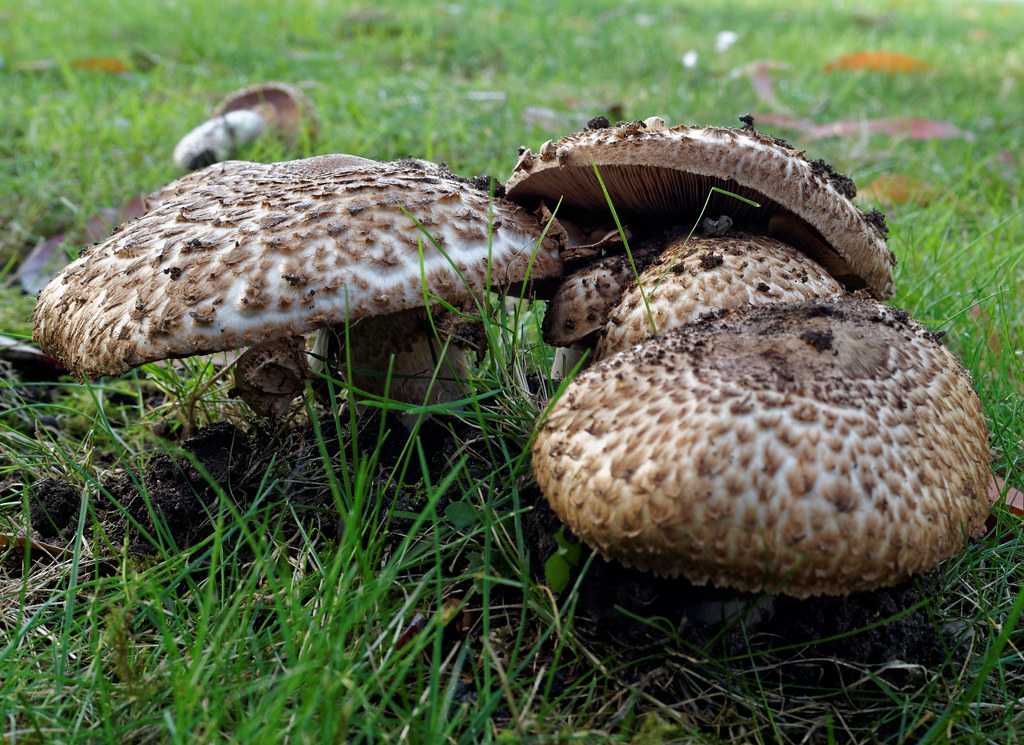
This mushroom typically grows in tufted clusters or small groups on soil. It is primarily found in open deciduous or broad-leaved woodlands, as well as parklands, grassy areas, and along roadsides.
Photos
Appearance
- Cap
- Measuring 6–20 cm across, initially spherical or hemispherical before flattening; the surface is covered in prominent, pointed, brown fibrous scales that are finer toward the center.
- Stem
- Stout and measuring 8–20 cm tall, often tapering or spindle-shaped toward the base; features a large, double-edged ring and may show faint scaly zones or a rooting base.
- Gills
- Crowded and free from the stem; color transitions from dirty white or pinkish to dark blackish-brown.
- Flesh
- White in the cap and more brownish in the stem; turns reddish or reddish-brown when sliced before eventually darkening to brown.
- Spore print
- Brown.
- Fruit body
- Initially enclosed in a prominent veil; typically grows in tufted clusters.
Sporecast is better in the app
Plan ahead with 10-day forecasts, see what people are finding nearby, get photo IDs, and track your finds.
Edibility
This mushroom has a pleasant, mild flavor and a standard mushroom-like taste. The flesh may turn reddish-brown when cut or bruised. It resembles the smaller Clustered Mushroom and the Medusa Brittlestem.
Misidentification can be fatal. Never eat a mushroom unless you're 100% sure. This information may be inaccurate. Always consult multiple sources.
Nutrient Source
SaprotrophicIt obtains nutrients by breaking down dead and decaying organic matter, such as leaf litter, found on the ground.
Common Names
- Danish
- Krumskællet champignon
- Dutch
- Spoelvoetchampignon
- English
- Medusa Mushroom
- French
- Psalliote à pied en fuseau, Agaric à pied en fuseau
- German
- Spindelfüßiger Champignon