
Habitat
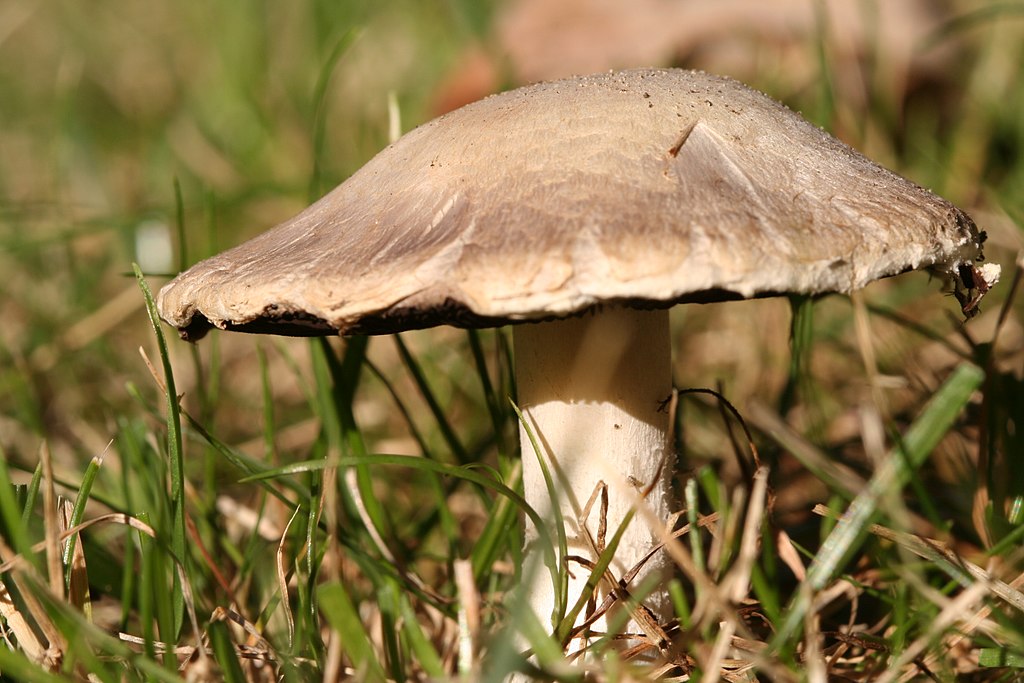
This common species is found on soil in various grassy environments, including meadows, pastures, lawns, churchyards, and golf courses. It frequently grows in areas grazed by horses or cows, particularly those enriched with manure. It functions as a decomposer of litter and humus, typically appearing in groups, arcs, or rings. While most common in open grassland, it can also be found in bare soil with sparse, weedy plants or in grassy clearings near the edges of woods.
Photos
Appearance
- Cap
- 3–10 cm wide; initially hemispherical or domed, slowly expanding to broadly convex or flat. The surface is dry and white to creamy white, sometimes becoming light brown or grayish with age. Texture ranges from smooth to finely downy, fibrillose, or scaly, often with a ragged margin of tissue that extends past the gills.
- Stem
- 2.5–10 cm long, 1–3 cm thick; cylindrical and typically tapering toward a pointed base. The surface is white, smooth above the ring and sometimes woolly or scaly below. It features a thin, white, fragile ring that is often indistinct and typically disappears quickly.
- Gills
- Free from the stem and crowded. Characteristically bright pink or rose-colored even when young, eventually maturing to a deep chocolate brown or blackish-brown.
- Flesh
- White, thin to thick, and firm; may bruise faintly pink when cut. It has a mild taste and a pleasant, earthy, mushroomy odor similar to store-bought button mushrooms.
- Spore print
- Dark chocolate brown.
Sporecast is better in the app
Plan ahead with 10-day forecasts, see what people are finding nearby, get photo IDs, and track your finds.
Edibility
A popular edible with a mild, pleasant mushroom flavor, though it is recommended to harvest younger fruitbodies while the flesh is still firm. Foragers must distinguish it from the poisonous Yellow Stainer, which has a chemical odor and stains yellow, and the deadly Amanita species, such as the Deathcap, which feature white gills and a volva at the stem base. It can also be confused with the Horse Mushroom, which smells of anise and stains yellow, or the White Parasol, which has white spores and gills. When gathering in grassy areas or lawns, verify that the site has not been treated with lawn care chemicals.
Misidentification can be fatal. Never eat a mushroom unless you're 100% sure. This information may be inaccurate. Always consult multiple sources.
Nutrient Source
SaprotrophicThis fungus obtains nutrients by decomposing dead organic matter in the soil, such as decaying leaves and other plant material.
Common Names
- Basque
- barrengorri
- Catalan
- Rovellol, seta de prau, Bolet, camperol
- Danish
- Mark-champignon
- Dutch
- Gewone weidechampignon
- English
- Field Mushroom, Meadow Mushroom
- Finnish
- nurmiherkkusieni
- French
- Psalliote champêtre, Rosé des prés, Agaric champêtre
- German
- Wiesen-Champignon
- Norwegian Bokmål
- beitesjampinjong
- Norwegian Nynorsk
- beitesjampinjong
- Spanish
- rovellol, champiñón silvestre, bola de nieve, hongo, jongo, seta, seta campestre, hongo negro el adulto, hongo bueno ó de comer, barren-gorri, rubiola
- Swedish
- Ängschampinjon
- Welsh
- Madarch y Maes
Synonyms
- Agaricus campester
- Agaricus campestris
- Agaricus campestris
- Agaricus setiger
- Agaricus villaticus
- Amanita campestris
- Fungus campestris
- Fungus setiger
- Fungus villaticus
- Hypophyllum campestre
- Pluteus campestris
- Pratella campestris
- Pratella pratensis
- Pratella setigera
- Pratella villatica
- Pratella villatica
- Psalliota campestris
- Psalliota campestris
- Psalliota campestris
- Psalliota flocculosa
- Psalliota villatica