
Habitat
This species is found growing on the ground in forested environments. It is most commonly associated with coniferous woods, but it also inhabits mixed and broad-leaved woodlands. It typically grows singly, in scattered clusters, or in small groups, sometimes appearing with the stem deeply inserted into the soil.
Photos
Appearance
- Cap
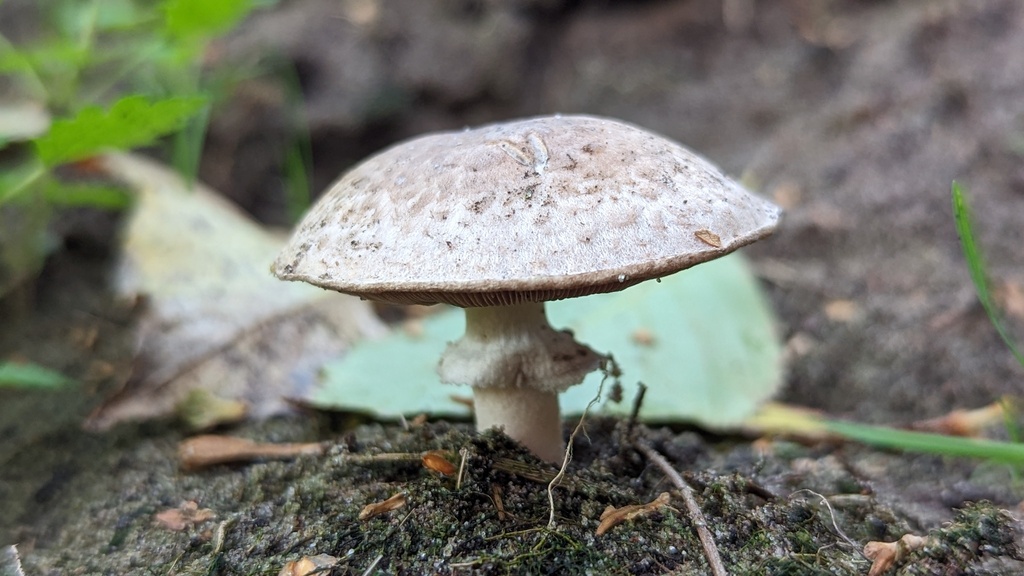
- Measuring 5–10 cm across, it transitions from spherical or convex to flattened, sometimes with a broad central bump. The surface is dry and covered in distinctive reddish-brown to dark brown fibrous scales over a white or tan background; the surface bruises red.
- Stem
- Reaching up to 10 cm tall and fairly slender, it is often equal in width or has a bulbous base. It is white but turns reddish or grayish when handled or cut; the surface is smooth to finely scaly below a high, persistent, membranous ring.
- Gills
- Crowded and free from the stem, they begin as rose-pink or pale pinkish-gray before maturing to dark chocolate brown. They have irregular whitish edges and bruise reddish when touched.
- Flesh
- Firm and white, it characteristically stains bright red, salmon, or reddish-brown almost immediately upon being cut or exposed to air, particularly at the top of the stem.
- Spore print
- Dark chocolate brown.
Sporecast is better in the app
Plan ahead with 10-day forecasts, see what people are finding nearby, get photo IDs, and track your finds.
Edibility
While considered edible, some individuals may experience gastric distress from consuming mushrooms in the Agaricus sylvaticus group. It is recommended to test a small portion first, and any specimens smelling of iodine should be avoided as they may cause illness and have an unpleasant flavor. This species shares the characteristic of rapidly staining red when cut with several other Agaricus species and may be confused with the Amanita rubescens group.
Misidentification can be fatal. Never eat a mushroom unless you're 100% sure. This information may be inaccurate. Always consult multiple sources.
Nutrient Source
SaprotrophicIt obtains nutrients by decomposing dead organic matter, such as fallen leaves and wood, in its environment.
Common Names
- Basque
- azpibeltz odoltsu, basoetako azpibeltz
- Catalan
- rubiol de sang
- Danish
- Lille blod-champignon
- Dutch
- Schubbige boschampignon
- English
- Scaly Wood Mushroom, Red Staining Mushroom, Pinew, Blushing Wood Mushroom
- Finnish
- tapionherkkusieni
- French
- Psalliote des forêts, Psalliote des bois, Agaric des forêts, Psalliote sanguinolent, Agaric sanguinolent
- German
- Wald-Champignon
- Norwegian Bokmål
- blodsjampinjong
- Norwegian Nynorsk
- blodsjampinjong
- Spanish
- agárico sanguinolento, champiñón de bosque
- Swedish
- Skogschampinjon
- Ukrainian
- Печериця темно-червона
- Welsh
- Madarch Gwridog y Coed
Synonyms
- Agaricus amethystina
- Agaricus haemarrhoidarius
- Agaricus haemorrhoidarius
- Agaricus sanguinarius
- Agaricus silvaticus
- Agaricus sylvaticus — Blushing Wood Mushroom
- Agaricus vinosobrunneus
- Fungus amethystinus
- Fungus haemorrhoidarius
- Fungus sanguinarius
- Fungus sylvaticus
- Pratella amethystina
- Pratella haemorrhoidaria
- Pratella sylvatica
- Psalliota amethystina
- Psalliota haemorrhoidaria
- Psalliota haemorrhoidaria
- Psalliota sanguinaria
- Psalliota silvatica
- Psalliota sylvatica