
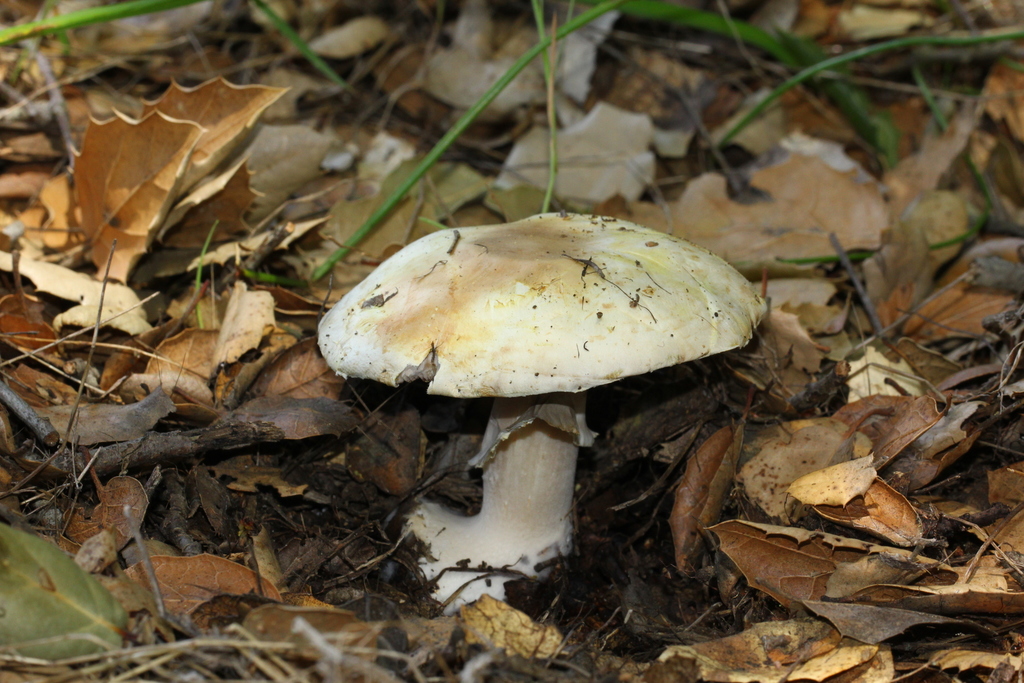
Habitat
This species is found in forest environments, specifically appearing on the ground within coniferous woods. It typically grows in soil duff or debris, especially in locations with an open understory. It may be found alone or in small, scattered groups.
Photos
Appearance
- Cap
- Measuring 4–10 cm wide; initially egg-shaped to convex, eventually flattening. The dry surface is smooth to satiny with minute scales, appearing white to creamy beige and bruising distinctly yellow when rubbed.
- Stem
- Reaches 4–10 cm tall and 1–3 cm thick; cylindrical and slender with an enlarged or abruptly bulbous base. The surface is white, smooth, and dry, occasionally showing woolly patches near the base; bruising yellow with age.
- Gills
- Free from the stem and crowded together; they begin white or pale tan, transitioning to pink and finally dark chocolate brown or blackish brown as they mature.
- Ring
- A thin, white, pendulous skirt-like veil located high on the stem; sometimes features a scaly or cogwheel-like pattern on the underside.
- Flesh
- Thick and firm, becoming softer with age; color is white to mottled tan, occasionally yellowing when exposed to air.
- Spore print
- Dark chocolate brown.
Sporecast is better in the app
Plan ahead with 10-day forecasts, see what people are finding nearby, get photo IDs, and track your finds.
Edibility
The woodland agaricus has a mild taste and faint almond or anise scent, though it can become musty and soft as it matures. Foragers should use caution to avoid the deadly Amanita phalloides (Death Cap), which may appear similar if its white spore print and basal volva are overlooked. It is also similar to the more robust Horse Mushroom, which typically grows in meadows rather than forests, and several other yellow-staining woodland species such as A. albolutescens and A. abruptibulbus.
Misidentification can be fatal. Never eat a mushroom unless you're 100% sure. This information may be inaccurate. Always consult multiple sources.
Nutrient Source
SaprotrophicIt obtains nutrients by decomposing dead organic matter in woodlands and forests. [first-nature.com](https://www.first-nature.com/fungi/agaricus-sylvicola.php)
Common Names
- Basque
- anis-azpibleltza, anis-azpibeltz
- Catalan
- bola de neu de bosc, bola de neu anisada, rubiol de bosc
- Danish
- Gulhvid champignon, Skiveknoldet champignon
- Dutch
- Klompvoetchampignon, Slanke anijschampignon
- English
- Wood Mushroom
- Finnish
- kuusiherkkusieni
- French
- Agaric à pied bulbeux, Psalliote anisé des bois, Psalliote à pied bulbeux, Agaric anisé, Agaric anisé des bois
- German
- Dünnfleischiger Anis-Champignon, Schiefknolliger Anischampignon
- Norwegian Bokmål
- søsterknollsjampinjong, snøballsjampinjong
- Spanish
- champiñón anillado, champiñón anisado, champiñón de bosque, sulso de bosque
- Swedish
- plattknölig snöbollschampinjon, knölchampinjon, liten snöbollschampinjon, lökfotad snöbollschampinjon, knölfotad snöbollschampinjon
- Ukrainian
- Печериця Уссета
- Welsh
- Madarch y Coed
Synonyms
- Agaricus essettei
- Agaricus flavescens
- Agaricus sylvicola — Wood Mushroom
- Fungus flavescens
- Fungus sylvicola
- Pratella flavescens
- Psalliota flavescens
- Psalliota silvicola
- Psalliota silvicola
- Psalliota silvicola
- Psalliota sylvicola