
Habitat
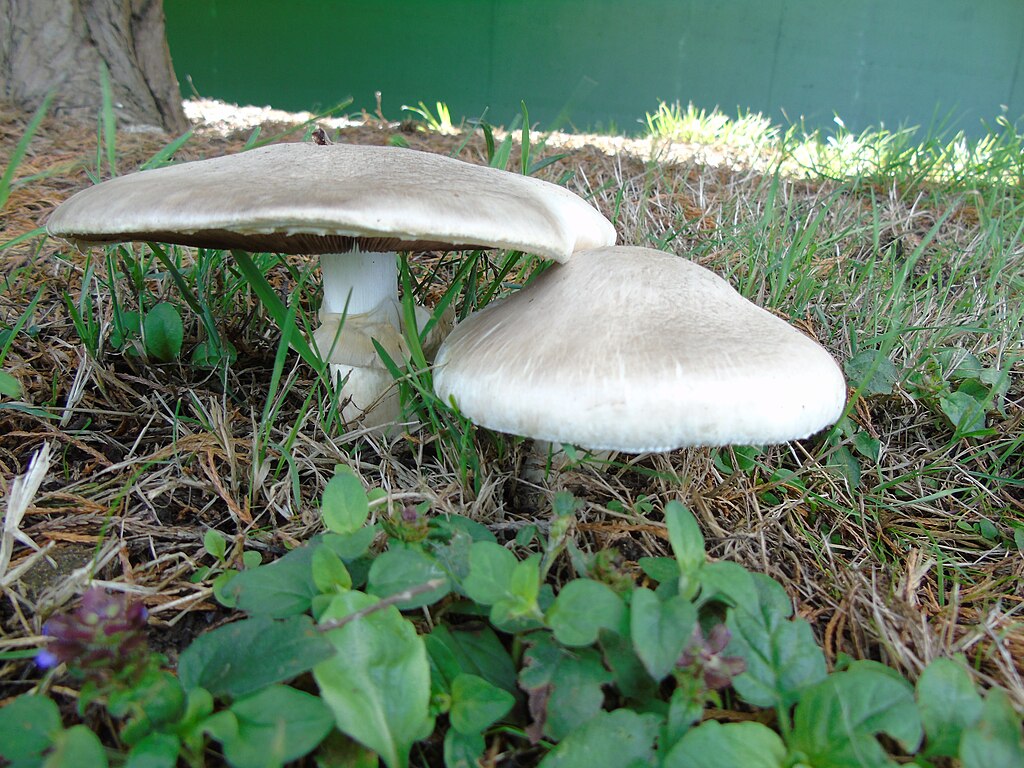
This mushroom is found in a variety of environments, including both broad-leaved and native woods, meadows, gardens, and grasslands. It frequently occurs in human-influenced or urban habitats such as lawns, roadsides, cemeteries, and wood chips. It can also be found in coastal dunes, riparian corridors, trailsides, and in deep leaf litter under specific landscape trees like the Sierra bigtree or in riparian sycamore duff. It typically grows on soil or in grassy areas, appearing as scattered individuals, small groups, or large clusters.
Photos
Appearance
- Cap
- 5–17 cm wide; initially spherical to hemispherical with a flattened top, later becoming convex to flat. Surface is dry and white, sometimes developing fine greyish-brown scales or cracks. It stains a bright chrome-yellow immediately when rubbed or scraped, especially near the margin.
- Stem
- 5–17 cm long and 1–4 cm thick; white and silky-smooth. It is usually equal in width but features a bulbous, sometimes crooked or lobed base. It stains bright yellow when damaged, particularly at the base.
- Gills
- Free from the stem and crowded. They start whitish or pale grey, transitioning to light pink, and finally becoming dark chocolate-brown to nearly black as they mature.
- Flesh
- Whitish, staining strikingly chrome-yellow when cut, most intensely in the base of the stem.
- Ring
- A prominent, white, membranous skirt-like structure on the upper stem; it is often thick with a double-layered or 'cogwheel' appearance on the underside.
- Spore print
- Purple-brown to dark chocolate brown.
- Odor
- Strong and unpleasant, reminiscent of ink, phenol, or cleaning products (like antiseptic or 'TCP'); the scent becomes more pronounced if the mushroom is heated.
Sporecast is better in the app
Plan ahead with 10-day forecasts, see what people are finding nearby, get photo IDs, and track your finds.
Edibility
This poisonous species is the most common cause of wild mushroom poisoning in some regions because it is frequently mistaken for edible Agaricus mushrooms. Consuming it typically results in rapid-onset gastric distress, severe stomach cramps, sweating, flushing, and headaches, though not all individuals are affected. It has a distinctive unpleasant odor of ink, phenol (like TCP), or burning plastic, which may be more noticeable when cooking, and it stains bright chrome-yellow particularly at the base of the stem. It can be distinguished from safe, yellow-staining, almond-scented species by its chemical smell and its bright lemon-yellow bruising that eventually fades to a dingy gray-brown.
Misidentification can be fatal. Never eat a mushroom unless you're 100% sure. This information may be inaccurate. Always consult multiple sources.
Nutrient Source
SaprotrophicIt obtains nutrients by breaking down dead organic matter, such as decaying plant material, in the soil.
Common Names
- Basque
- azpibeltz tintausain-argi, azpibeltz tintausain, azpibeltz tintausaina
- Catalan
- bola de neu pudent
- Danish
- Karbol-champignon
- Dutch
- Karbolchampignon
- English
- Yellow Stainer
- French
- Psalliote à peau jaune, Agaric jaunissant, Psalliote jaunissante, Agaric (psalliote) jaunissant, Agaric à peau jaune
- German
- Karbol-Champignon
- Norwegian Bokmål
- giftsjampinjong
- Norwegian Nynorsk
- giftsjampinjong
- Spanish
- champiñón amarillo, champiñón amarilleante, champiñon maloliente, champiñón maloliente, agárico amarilleante
- Swedish
- karbolchampinjon, giftchampinjon
- Welsh
- Cleisiwr Melyn
Synonyms
- Agaricus pearsonianus
- Agaricus pseudocretaceus
- Fungus xanthodermus
- Pratella xanthoderma
- Psalliota flavescens
- Psalliota grisea
- Psalliota xanthoderma