
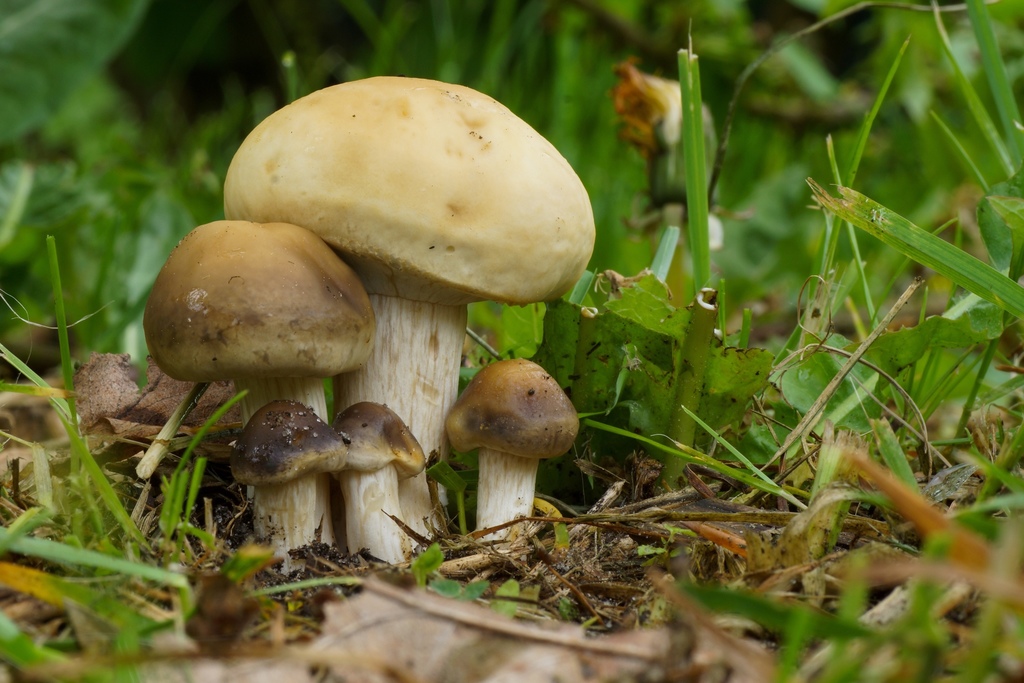
Habitat
This common species is found in a wide variety of environments, ranging from urban areas to natural woodlands. It frequently grows on the ground in grassy habitats such as lawns, fields, and gardens, as well as in shady copses, woodland edges, and open forests. It is particularly common in newly landscaped areas, where it grows on wood chips, mulch, flower beds, or humus. It may be found solitary, scattered, or in dense clusters and is often associated with disturbed soil or lowland forests.
Photos
Appearance
- Cap
- 1–10 (occasionally 15) cm wide, convex to flat, sometimes with a low umbo or central depression. Surface is smooth, dry, and ranges from light tan, cream, or yellowish-beige to ochraceous-brown. It frequently develops deep cracks or wrinkles in dry weather, and the margin may be incurved initially or decorated with torn veil fragments.
- Stem
- 4–12 cm long and 4–20 mm thick, cylindrical or slightly swollen at the base. It is whitish to tan, darkening or staining brown with age. The surface is dry, fibrous, or longitudinally lined, often featuring white mycelial cords (rhizomorphs) at the base.
- Gills
- Broadly attached (adnate) to notched, close or crowded. Initially whitish, buff, or pale clay-colored, becoming dark reddish-brown to purple-brown as spores mature.
- Ring
- A thin, membranous, skirt-like ring located high on the stem. It is white and superior, though it may be fragile and disappear or collapse into a band or ring zone in age.
- Flesh
- White to greyish-cream or pallid, thin to thick and firm, becoming fibrous in the stem.
- Spore print
- Brown, ranging from cigar-brown to dark rusty-brown or brown-purple.
- Odor
- Distinctly mealy (farinaceous), sometimes described as earthy or like stale chocolate.
- Taste
- Mealy and farinaceous, sometimes described as unpleasant or bitter.
Sporecast is better in the app
Plan ahead with 10-day forecasts, see what people are finding nearby, get photo IDs, and track your finds.
Edibility
The flavor is often described as mealy, earthy, or unpleasant, with a notably bitter taste frequently reported. Precise identification within this species group is difficult, warranting caution as multiple similar strains exist. It can be confused with the smaller Agrocybe pediades, the white-capped Agrocybe dura, and Cyclocybe erebia, which has a reddish brown, viscid cap.
Misidentification can be fatal. Never eat a mushroom unless you're 100% sure. This information may be inaccurate. Always consult multiple sources.
Nutrient Source
SaprotrophicIt obtains nutrients by decomposing dead organic matter, such as wood chips, garden compost, and other decaying plant material.
Common Names
- Basque
- landaburu goiztiar
- Danish
- Tidlig agerhat
- Dutch
- Vroege leemhoed
- English
- Spring Fieldcap
- Finnish
- kesäpiennarsieni
- French
- Pholiote précoce
- German
- Frühlings-Ackerling
- Norwegian Bokmål
- våråkersopp
- Norwegian Nynorsk
- våråkersopp
- Spanish
- agrocibe precoz, foliota precoz
- Swedish
- tidig marktofsskivling, tidig åkerskivling
- Welsh
- Cap Maes Cynnar
Synonyms
- Agaricus britzelmayrii
- Agaricus candicans
- Agaricus cereolus
- Agaricus gibberosus
- Agaricus mesodactylus
- Agaricus niveobrunneus
- Agaricus niveoflavens
- Agaricus praecox
- Agaricus sphaleromorphus
- Agaricus togularis
- Agaricus togularis
- Agrocybe gibberosa
- Agrocybe gibberosa
- Agrocybe sphaleromorpha
- Conocybe togularis
- Cyclopus praecox
- Dryophila praecox
- Dryophila sphaleromorpha
- Dryophila togularis
- Galera togularis
- Hylophila praecox
- Hylophila sphaleromorpha
- Hylophila togularis
- Hypholoma britzelmayrii
- Naucoria praecox
- Pholiota gibberosa
- Pholiota praecox
- Pholiota sphaleromorpha
- Pholiota togularis
- Pholiotella gibberosa
- Pholiotina togularis
- Pratella praecox
- Togaria praecox
- Togaria sphaleromorpha
- Togaria togularis