
Habitat
This mushroom typically grows in groups, clusters, or massed troops on bare or disturbed ground. Common locations include roadsides, gravel paths, trail edges, campsites, lawns, and gardens. It prefers hard-packed or sandy and clay-heavy soils, and is often found in woodland areas or on skid roads following logging activity. While usually found on bare earth, it can also appear among short grass or thin duff.
Photos
Appearance
- Fruit body
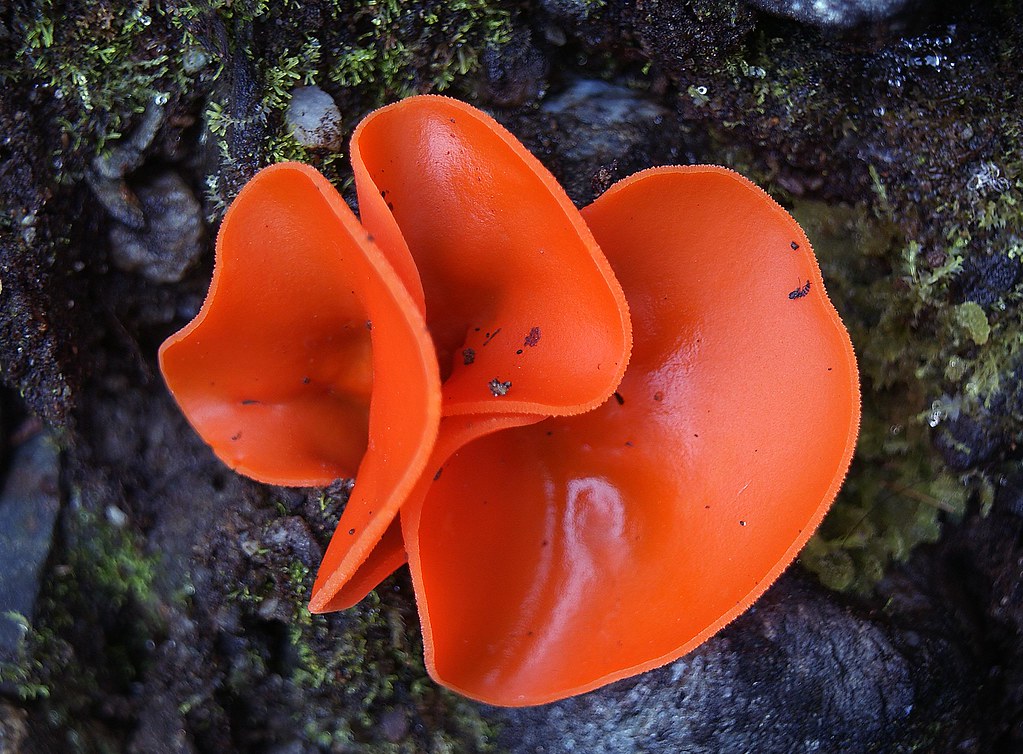
- Measures 1–10 cm across, initially cup-shaped or spherical before flattening into an irregular, wavy, or saucer-like form. Often occurs in dense, overlapping clusters and can resemble discarded orange peels.
- Inner surface
- Smooth and brilliant yellowish-orange to deep orange, sometimes fading slightly with age.
- Outer surface
- Palish orange to whitish, especially near the base. It features a finely downy, powdery, or mealy texture.
- Flesh
- Thin and very brittle or fragile; colored whitish to orange.
- Stem
- Usually absent; the fruit body is stemless (sessile).
- Odor
- Indistinct or not distinctive.
- Taste
- Indistinct and mild.
Sporecast is better in the app
Plan ahead with 10-day forecasts, see what people are finding nearby, get photo IDs, and track your finds.
Edibility
This fungus is noted for its delicate or indistinct flavor and thin, brittle texture. It can be eaten raw, cooked, or dried, and is often used to add vibrant color to dishes. While it has no seriously poisonous lookalikes, it may be confused with Caloscypha fulgens, which should be avoided as it has been linked to poisonings and can be distinguished by its blue or green staining. Other similar species include the stemmed Sowerbyella rhenana and various smaller orange-yellow cup fungi in the genera Otidea or Pseudaleuria.
Misidentification can be fatal. Never eat a mushroom unless you're 100% sure. This information may be inaccurate. Always consult multiple sources.
Nutrient Source
SaprotrophicIt obtains nutrients by decomposing dead organic matter in the soil.
Common Names
- Danish
- Almindelig orangebæger
- Dutch
- Grote oranje bekerzwam
- English
- Orange Peel Fungus, Orange-Peel Fungus
- Finnish
- oranssimaljakas
- French
- Pézize orangée
- German
- Gemeiner Orange-Becherling
- Norwegian Bokmål
- oransjebeger
- Norwegian Nynorsk
- oransjebeger
- Swedish
- mönjeröd skålsvamp, mönjeskål
- Welsh
- Croen Oren
Synonyms
- Helvella coccinea
- Otidea aurantia
- Otidea aurantia
- Peziza aurantia
- Peziza coccinea
- Peziza pseudoaurantia
- Scodellina aurantia