
Habitat
Amanita ceciliae is found in mixed, coniferous, and broad-leaved woodlands, appearing on soil or among duff. It specifically associates with trees such as oak and beech, and may also be found near isolated trees in parkland environments. It typically grows as a solitary mushroom or in small, scattered groups.
Photos
Appearance
- Cap
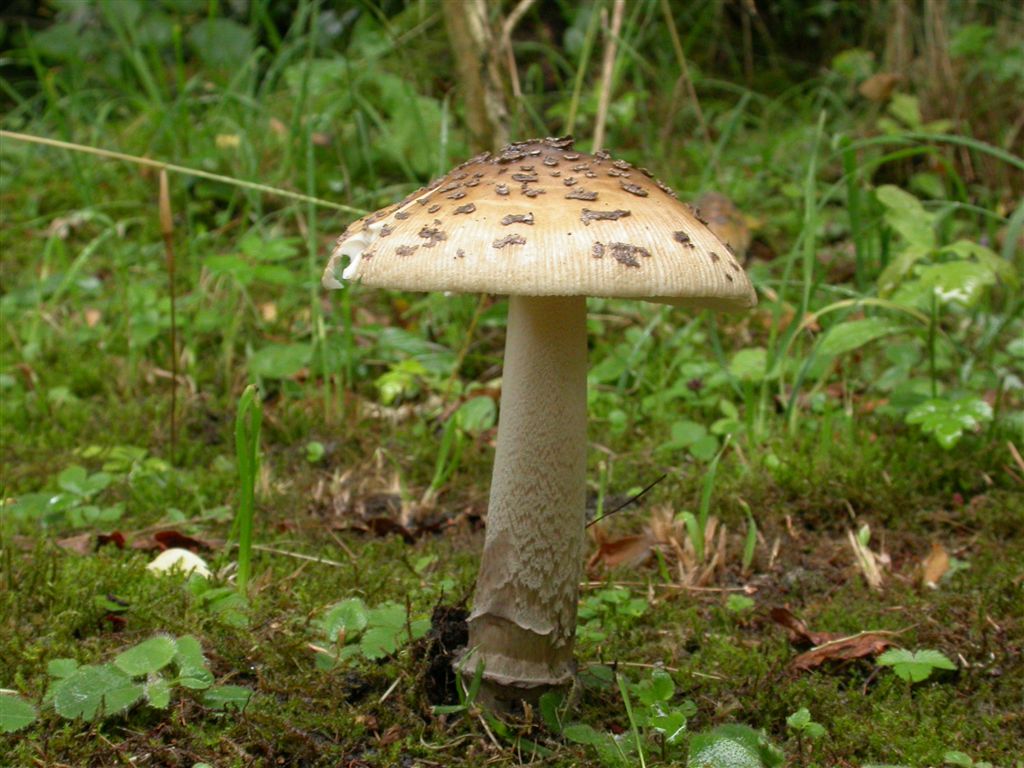
- Large, measuring 7 to 15 cm across. It starts ovoid or hemispherical, maturing to a convex or broadly bell-shaped profile. The surface is grey-brown, dark brown, or olive-tinged, featuring a distinctly grooved or lined margin. It is covered in large, dingy grey, shaggy, or cottony warty patches.
- Stem
- 8 to 20 cm long, tapering toward the top with a bulbous base. It lacks a ring and is decorated with white or pale grey-brown shaggy, horizontal bands of veil tissue. The base is encased in a loose, easily broken volva that often fragments into oblique ridges or a cottony cup edge.
- Gills
- White, crowded together, and free from the stem.
- Flesh
- White with a mild, nutty taste and a faint or indistinct odor.
- Spore print
- White.
Sporecast is better in the app
Plan ahead with 10-day forecasts, see what people are finding nearby, get photo IDs, and track your finds.
Edibility
Possessing a mild and nutty flavor, this species is considered edible by some but is possibly toxic when raw. Extreme caution is required as it can be confused with the deadly Death Cap (Amanita phalloides), which is distinguished by having a ring on the stem and lacking cap striations and veil remnants. It also resembles the smaller, rare Amanita submembranacea, while some guides list the species as potentially poisonous and advise avoiding it entirely.
Misidentification can be fatal. Never eat a mushroom unless you're 100% sure. This information may be inaccurate. Always consult multiple sources.
Nutrient Source
EctomycorrhizalIt forms a symbiotic relationship with trees, exchanging nutrients and water through its root system.
Common Names
- Basque
- kukumelo ezkatagris
- Danish
- Stor kam-fluesvamp
- Dutch
- Prachtamaniet
- English
- Snakeskin Grisette
- Finnish
- puistokärpässieni
- French
- Amanite impériale
- German
- Riesen-Scheidenstreifling
- Norwegian Bokmål
- stor kamfluesopp, stor ringløs fluesopp
- Norwegian Nynorsk
- stor ringlaus flugesopp, stor kamflugesopp
- Swedish
- jättekamskivling, parkflugsvamp
- Welsh
- Amanita Croen Neidr
Synonyms
- Agaricus ceciliae
- Amanita inaurata
- Amanita inaurata
- Amanita strangulata
- Amanitopsis ceciliae
- Amanitopsis inaurata
- Amanitopsis inaurata
- Vaginata inaurata
- Vaginata inaurata