
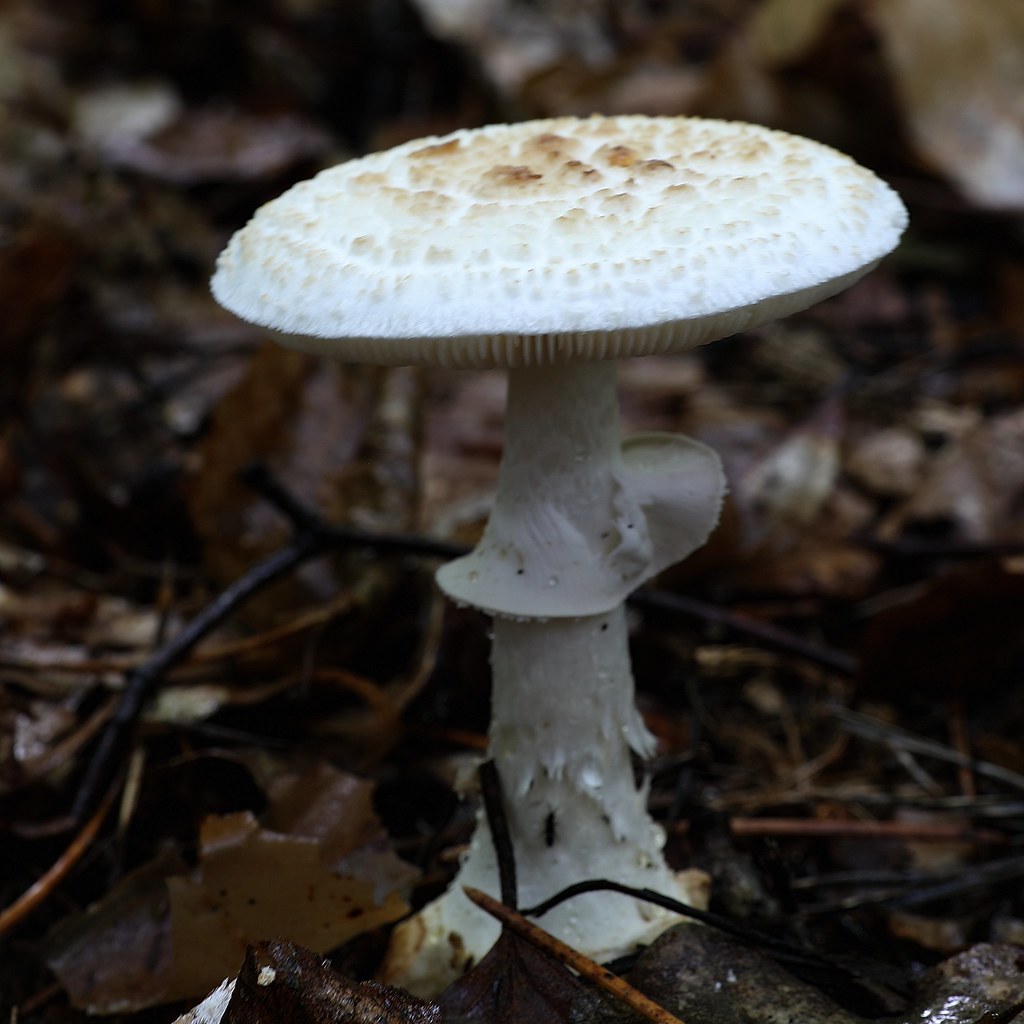
Habitat
This common species grows on the ground in various types of woodland, including deciduous, coniferous, and mixed pine-hardwood forests. It is frequently associated with beech and oak trees. It grows in single, scattered, or clustered patterns and is widely distributed across temperate zones.
Photos
Appearance
- Cap
- 4–10 cm wide; hemispherical becoming flat; color ranges from ivory or white to pale lemon or greenish-yellow, often darker toward the center; typically covered in persistent, coarse, off-white to ochre-brown veil patches.
- Stem
- 6–10 cm long, 8–12 mm thick; white to ivory; tapering toward the top and featuring a large, bulbous base encased in the remains of a volva that forms a distinct trough; becomes hollow with age.
- Ring
- A membranous, persistent ring that is white or pale lemon-yellow and often adheres to the stem.
- Gills
- Crowded and white; attachment ranges from free to adnexed.
- Flesh
- White throughout; possesses a strong, distinctive odor resembling raw potatoes and an unpleasant taste.
- Spore print
- White.
Sporecast is better in the app
Plan ahead with 10-day forecasts, see what people are finding nearby, get photo IDs, and track your finds.
Edibility
Consuming this species is strongly discouraged due to its similarity to the deadly Amanita phalloides and other toxic Amanitas. It possesses a disagreeable flavor and a potent scent resembling raw potatoes, though a white color variant exists that has a less pronounced odor. While some regard it as non-poisonous, its unpleasant taste and the risk of fatal misidentification make it of no culinary interest.
Misidentification can be fatal. Never eat a mushroom unless you're 100% sure. This information may be inaccurate. Always consult multiple sources.
Nutrient Source
EctomycorrhizalIt forms a symbiotic relationship with trees, exchanging nutrients from the soil for sugars produced by the tree.
Common Names
- Basque
- lanperna limoi, lanperna limoia
- Catalan
- reig bordoc
- Danish
- Kugleknoldet fluesvamp
- Dutch
- Gele knolamaniet
- English
- False Deathcap, False Death-cap
- Finnish
- keltakärpässieni
- French
- Amanite citrine
- German
- Gelber Knollenblätterpilz
- Norwegian Bokmål
- gul fluesopp
- Norwegian Nynorsk
- gul flugesopp
- Spanish
- Amanita citrina, amanita citrina, perreicuba
- Swedish
- vitgul flugsvamp
Synonyms
- Agaricus bulbosus
- Agaricus citrinus
- Agaricus mappa
- Agaricus mappa
- Agaricus olivaceus
- Amanita bulbosa
- Amanita citrina
- Amanita citrina
- Amanita mappa
- Amanita mappa
- Amanitina citrina
- Venenarius mappa