
Habitat
Amanita fulva is commonly found in broad-leaved, coniferous, or mixed woodland environments. It has a strong preference for acidic soils and is frequently associated with birch trees. It grows on the ground, often in mossy duff or heathlands, and can appear individually, scattered, or in small to large groups.
Photos
Appearance
- Cap
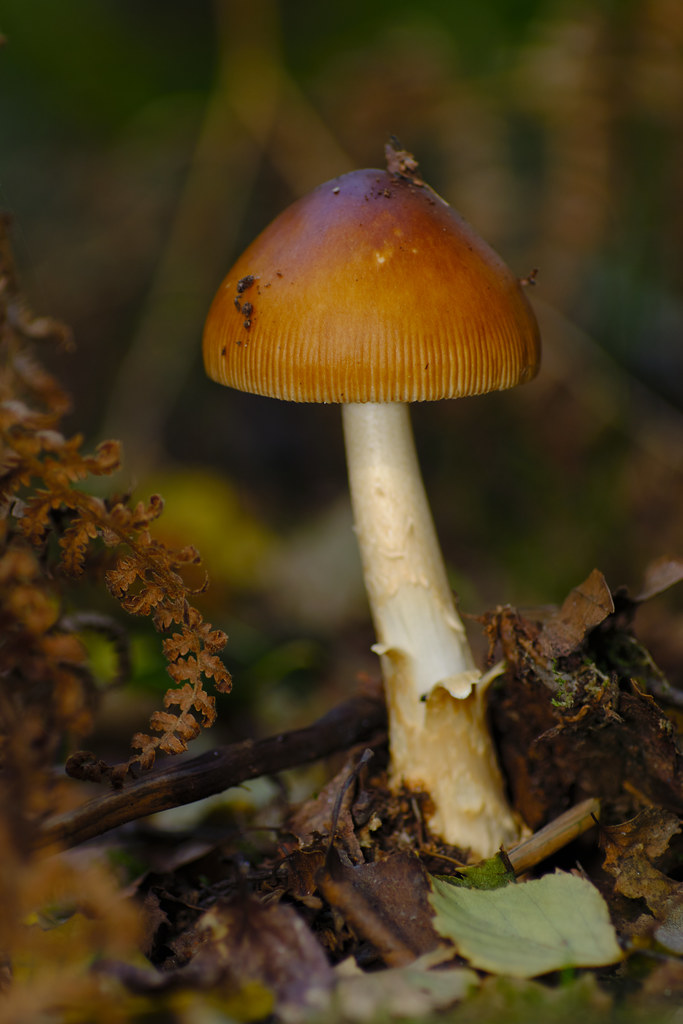
- 4–12 cm across, initially egg-shaped or conical then expanding to flat with a low central bump; orange-brown, tawny, or apricot-orange; surface is smooth and dry or slightly greasy when moist; margin is distinctly grooved or lined.
- Stem
- 7–15 cm long, 0.6–2 cm thick, white or tinged with the cap color, sometimes with fine scales or chevrons; tapering toward the top, non-bulbous, and becoming hollow.
- Volva
- A persistent, white, large bag-like or sac-like structure sheathing the base of the stem; may occasionally be present as a single patch on the cap; sometimes stains orange-brown.
- Gills
- Free from the stem, crowded, and white to pale cream.
- Partial veil
- Absent; this species does not have a ring on the stem.
- Flesh
- White, soft, and relatively thin.
- Spore print
- White.
Sporecast is better in the app
Plan ahead with 10-day forecasts, see what people are finding nearby, get photo IDs, and track your finds.
Edibility
This mushroom is toxic if consumed raw and must be cooked before eating. It is often confused with several rare grisettes with uncertain edibility, such as A. friabilis, A. lividopallescens, and A. submembranacea; the primary distinction is that A. fulva typically lacks veil remnants on its cap. In North America, the similar A. sinicoflavathat and A. velosa are notable lookalikes, with the latter featuring a pinkish cap and often growing near meadow edges. The flavor is described as faint, sweet, or smoky, while the odor ranges from pleasant to slightly fishy as it ages.
Misidentification can be fatal. Never eat a mushroom unless you're 100% sure. This information may be inaccurate. Always consult multiple sources.
Nutrient Source
EctomycorrhizalIt forms a symbiotic relationship with tree roots, exchanging nutrients with the tree for sugars produced during photosynthesis.
Common Names
- Basque
- kukumelo marroiska
- Catalan
- pentinella
- Danish
- Brun kam-fluesvamp
- English
- Tawny Grisette
- Finnish
- ruostekärpässieni
- French
- Amanite fauve
- German
- Rotbrauner Scheidenstreifling
- Norwegian Bokmål
- brun ringløs fluesopp, brun kamfluesopp
- Norwegian Nynorsk
- brun ringlaus flugesopp, brun kamflugesopp
- Spanish
- pentinella rojenca, amanita rojiza, amanita enfundada
- Swedish
- brun kamskivling, gulbrun kamskivling
- Welsh
- Amanita Winau
Synonyms
- Agaricus fulvus
- Amanitopsis fulva
- Amanitopsis fulva
- Vaginata fulva