
Habitat
Woodland
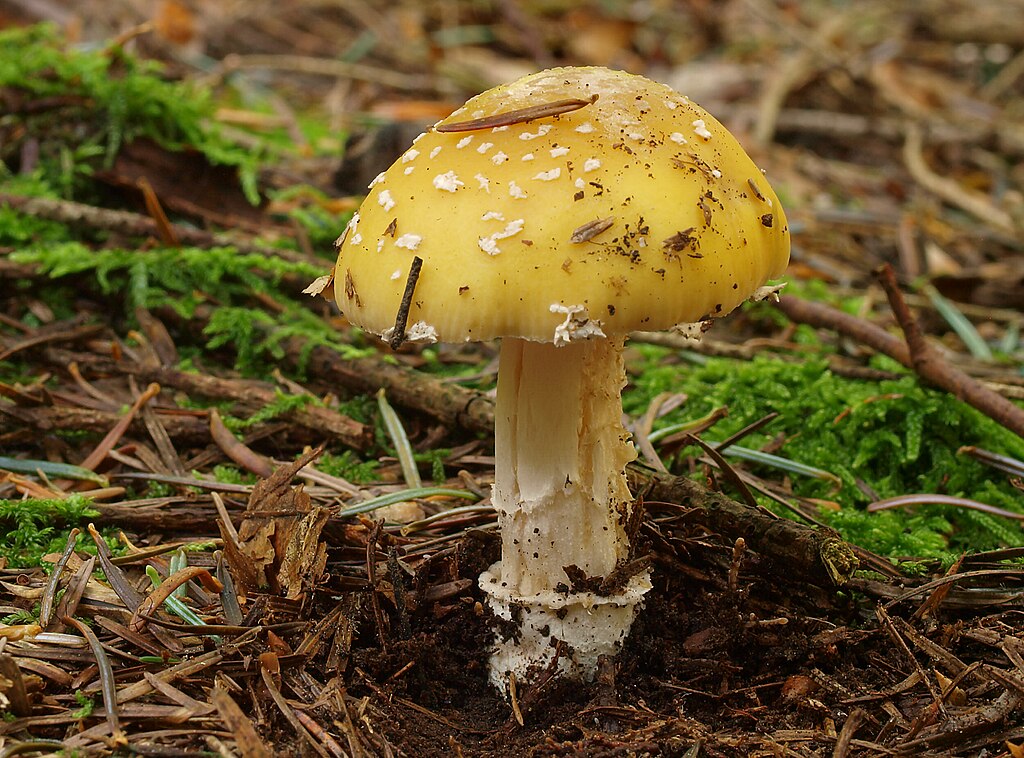
Found on the ground in coniferous or mixed woodlands, often on acidic soil. Frequent associates include pine, birch, fir, and live oak. It may also occur in open forests, adjacent fields, and urban areas. Specimens typically grow solitary, scattered, or in small groups.
Photos
Appearance
- Cap
- 5–12 cm across, initially rounded or hemispherical, becoming convex or flat with age. Color is variable, ranging from pale cream and yellowish beige to bright yellow or yellowish-orange. The surface is smooth and slightly viscid when moist, typically featuring white, felty patches or small warts of veil remnants that may easily wash or wipe off. The margin is faintly to finely lined.
- Gills
- White to pale cream, crowded, and range from free to narrowly attached (adnexed) to the stem.
- Stem
- 7–12 cm tall and 1–2 cm thick, widening toward a bulbous base. The surface is white to cream and can be smooth, woolly, or finely scaly below the ring.
- Partial veil
- A white to yellowish, membranous, skirt-like ring located on the upper stem. It is thin and often ephemeral, frequently disappearing or falling off as the mushroom matures.
- Volva
- A short, rimmed or collared membranous cup surrounding the bulbous stem base; sometimes fragments into cottony remnants.
- Flesh
- White, sometimes with a slight yellowish tint under the cap cuticle or in the stem.
- Spore print
- White.
- Smell
- Faint or indistinct.
- Taste
- Indistinct; however, the mushroom is poisonous and should not be tasted.
Sporecast is better in the app
Plan ahead with 10-day forecasts, see what people are finding nearby, get photo IDs, and track your finds.
Edibility
No
Contains psychoactive compounds. Possession is illegal in some jurisdictions. Follow all local laws.
Misidentification can be fatal. Never eat a mushroom unless you're 100% sure. This information may be inaccurate. Always consult multiple sources.
Nutrient Source
EctomycorrhizalIt forms a symbiotic relationship with the roots of trees, exchanging nutrients and carbon with the host plant.
Common Names
- Basque
- lanperna hori
- Danish
- Okkergul fluesvamp
- Dutch
- Narcisamaniet
- English
- Jewelled Amanita
- Finnish
- narsissikärpässieni
- French
- Amanite jonquille
- German
- Narzissengelber Wulstling
- Norwegian Bokmål
- løvefluesopp
- Norwegian Nynorsk
- løveflugesopp
- Spanish
- amanita gemmada, amanita junquillea
- Swedish
- gul flugsvamp
- Welsh
- Amanita Emog
Synonyms
- Agaricus adnatus
- Agaricus gemmatus
- Agaricus junquilleus
- Agaricus junquilleus
- Agaricus junquilleus
- Amanita adnata
- Amanita adnata
- Amanita amici
- Amanita gemmata
- Amanita godeyi
- Amanita junquillea — Jewelled Amanita
- Amanitaria gemmata
- Amanitopsis adnata
- Amanitopsis gemmata
- Amanitopsis godeyi
- Pseudofarinaceus gemmatus
- Pseudofarinaceus godeyi
- Vaginata gemmata
- Vaginata godeyi
- Venenarius gemmatus
- Venenarius junquilleus