
Habitat
This species is found in a diverse range of forested environments and is known to form mycorrhizal associations with a wide variety of trees. It is particularly common under birch, spruce (especially Norway spruce), and pines, but it also occurs with hardwood species such as poplar, oak, and black cottonwood. It has even been found associating with non-native ornamental trees like eucalyptus. These mushrooms grow on the ground, appearing as solitary specimens or in scattered groups, clusters, arcs, and large fairy rings. Its fruiting bodies are often found in the same areas as King Boletes (Boletus edulis) and Peppery Boletes (Chalciporus spp.).
Photos
Appearance
- Cap
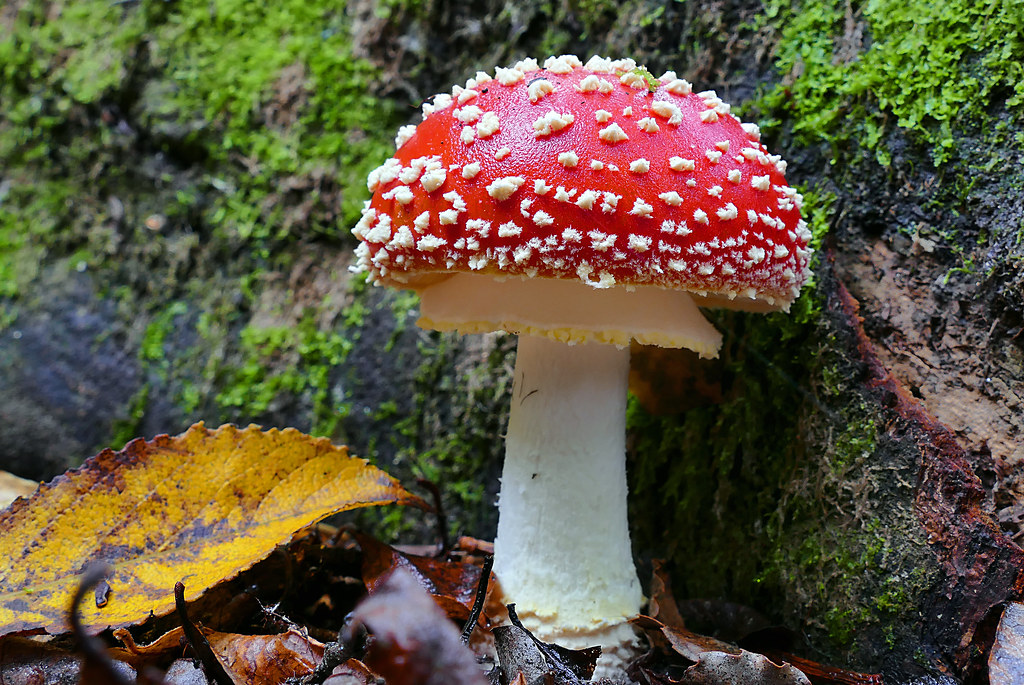
- 5-30 cm wide; initially spherical to hemispherical, becoming convex to flat or occasionally uplifted and wavy. Color is highly variable, most commonly bright scarlet to blood red, but also orange-yellow, pale yellow, or white. The surface is dry to slightly slippery and covered in white, cream, or yellowish warts that may wash off with rain. The margin is typically lined or bumpy in older specimens.
- Gills
- Free or finely attached to the stem, crowded, and white to pale cream or yellowish. Edges may have a fine, ragged or fuzzy appearance in young specimens.
- Stem
- 7-25 cm long and up to 4 cm thick; white to cream, straight, and cylindrical. The base features a prominent bulb that is egg-shaped or tapered, decorated with concentric rings of scales or bands of tissue.
- Ring
- A persistent, white to yellowish, membrane-like hanging skirt located near the top of the stem, often with yellow fragments on the edges.
- Flesh
- Firm to soft and white; sometimes features a layer of yellow-orange tissue just below the cap skin.
- Spore print
- White.
Sporecast is better in the app
Plan ahead with 10-day forecasts, see what people are finding nearby, get photo IDs, and track your finds.
Edibility
Contains psychoactive compounds. Possession is illegal in some jurisdictions. Follow all local laws.
Misidentification can be fatal. Never eat a mushroom unless you're 100% sure. This information may be inaccurate. Always consult multiple sources.
Nutrient Source
EctomycorrhizalIt forms a mutually beneficial relationship with trees, exchanging nutrients from the soil for sugars produced by the tree.
Common Names
- Basque
- kuleto faltsoa, kuleto falsoa, kuleto faltsua, kuleto paltsu, ilkor
- Catalan
- matamoscas, falsa oronja, reig bord, reig de fageda
- Danish
- Rød fluesvamp
- Dutch
- Vliegenzwam
- English
- Fly Agaric
- Finnish
- punakärpässieni
- French
- amanite tue-mouches, Fausse oronge, Amanite tue-mouches
- Galician
- brincabois
- German
- Fliegenpilz
- Northern Sami
- ruksescurotguoppar, gumpeguoppar, mirkoguoppar
- Norwegian
- fluesopp
- Norwegian Bokmål
- rød fluesopp
- Norwegian Nynorsk
- raud flugesopp
- Spanish
- mosquero, Falsa oronja, Matamoscas, agárico pintado, falso kuleto, cicuta verde, oronja falsa, agarico pintado, oronja verde, amanita faloidea, seta mortal
- Swedish
- röd flugsvamp
- Welsh
- Amanita'r Gwybed
Synonyms
- Agaricus aureolus
- Agaricus imperialis
- Agaricus muscarius
- Agaricus nobilis
- Agaricus pseudoaurantiacus
- Agaricus puellus
- Amanita aureola
- Amanita aureola
- Amanita circinnata
- Amanita formosa
- Amanita muscaria
- Amanita muscaria — Fly Agaric
- Amanita puella
- Amanitaria muscaria
- Hypophyllum muscarium
- Venenarius muscarius