
Habitat
Woodland
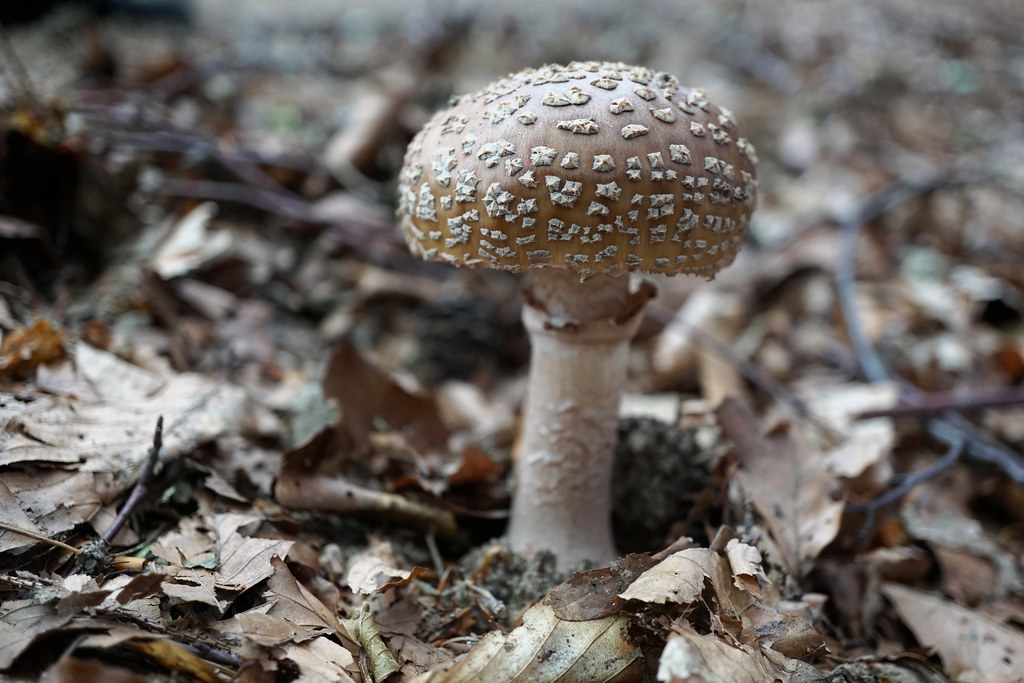
Amanita pantherina grows on soil in deciduous, coniferous, and mixed woodlands, showing a particular affinity for beech and oak trees. It is found in solitary form or in small groups. Beyond forest environments, it is also known to inhabit urban areas and landscaped settings.
Photos
Appearance
- Cap
- 6 to 15 cm wide; initially hemispherical or spherical, becoming convex to flat. Color varies from ochraceous-brown and dark brown to yellowish-tan or beige, often darker at the center. The surface is smooth or slightly sticky when moist and covered in small, white to buff, woolly or warty veil fragments that can wash away. The margin features fine radial lines or striations.
- Stem
- 5 to 13 cm long and 1 to 2 cm thick; white to pale cream. The surface is smooth, finely woolly, or scaly, becoming hollow with age. The base is bulbous and wrapped in a tight-fitting, white volva that forms a distinct free rim or collar. One or two woolly, belt-like rings are often present just above the basal bulb.
- Ring
- Pendant and skirt-like, located on the upper stem. It is white, sometimes with tan patches on the edges, and may appear tattered or ragged.
- Gills
- White to pale cream, sometimes bruising brown. They are crowded, closely spaced, and generally free from the stem, though occasionally narrowly attached.
- Flesh
- White and firm to soft in texture.
- Spore print
- White.
- Odor
- Ranges from indistinct or mild to faint and unpleasant, similar to radishes.
Sporecast is better in the app
Plan ahead with 10-day forecasts, see what people are finding nearby, get photo IDs, and track your finds.
Edibility
No
Contains psychoactive compounds. Possession is illegal in some jurisdictions. Follow all local laws.
Misidentification can be fatal. Never eat a mushroom unless you're 100% sure. This information may be inaccurate. Always consult multiple sources.
Nutrient Source
EctomycorrhizalIt forms a symbiotic relationship with tree roots, exchanging nutrients with them.
Common Names
- Basque
- lanperna pantera, lanperna txar
- Catalan
- oronja pantera, pixacá
- Danish
- Panter-fluesvamp
- Dutch
- Panteramaniet
- English
- Panther Cap, Panthercap
- Finnish
- pantterikärpässieni
- French
- Amanite panthère
- German
- Pantherpilz
- Norwegian Bokmål
- panterfluesopp
- Norwegian Nynorsk
- panterflugesopp
- Spanish
- falso galipierno, Amanita pantera
- Swedish
- panterflugsvamp
- Welsh
- Amanita Panther
Synonyms
- Agaricus herpeticus
- Agaricus pantherinus
- Agaricus ruderatus
- Amanita abietum
- Amanita pantherina
- Amanita pantherina
- Amanitaria pantherina
- Hypophyllum margaritiferum
- Venenarius pantherinus