
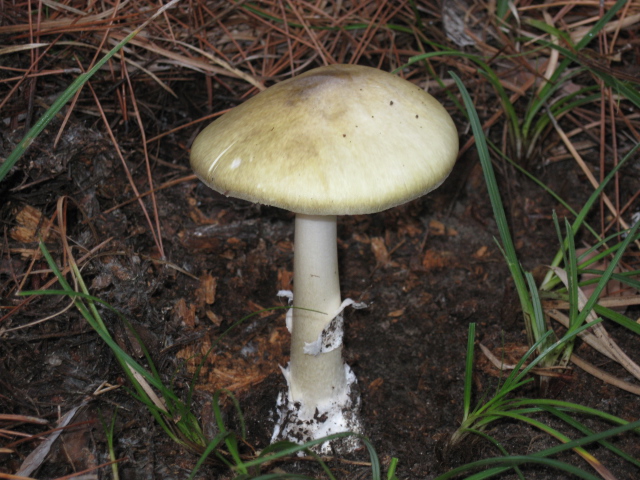
Habitat
Amanita phalloides grows on the ground, occurring singly, in scattered troops, or in large flushes. Originally introduced from Europe, it is found in woodland areas, urban gardens, boulevards, orchards, and natural forests. It is most commonly associated with broadleaf trees, particularly oak, beech, hornbeam, chestnut, linden (Tilia), and hazel. While it primarily grows with hardwoods, it is also found with various conifers, including pine, hemlock, and fir. In some regions, it is frequently found in irrigated areas and has successfully naturalized in native habitats.
Photos
Appearance
- Cap
- 3–15 cm wide; initially egg-shaped or spherical, becoming convex to flat. Color is highly variable, usually olive or greenish-yellow with radial fibrils or streaks, but ranging from dingy grey-green to brownish-yellow or white. The surface is smooth, slightly sticky when wet, and can have a metallic luster when dry. The margin is usually not lined.
- Gills
- White to creamy white, sometimes with faint yellow or green tints; crowded and free or only narrowly attached to the stem.
- Stem
- 5–15 cm long, often tapering upwards from a prominent, bulbous base. It is white or pale yellowish-green, often featuring darker chevron-like patterns or small scales.
- Partial veil
- Forms a thin, membranous, white to pale cream skirt-like ring high on the stem, which can sometimes disappear with age.
- Volva
- A conspicuous, white, bag-like or sac-like universal veil remnant that encases the bulbous base of the stem.
- Flesh
- Firm and white, sometimes showing yellowish-green tints directly beneath the cap skin; the stem is solid.
- Spore print
- White.
- Odor
- Initially mild or faint, becoming sickly sweet, musty, or like rotting potatoes as it ages, eventually becoming quite unpleasant.
Sporecast is better in the app
Plan ahead with 10-day forecasts, see what people are finding nearby, get photo IDs, and track your finds.
Edibility
The world's most dangerous fungus, this species contains lethal amatoxins that cause severe liver and kidney damage. Symptoms are often delayed for 6 to 24 hours, followed by a false period of recovery where the victim feels better while organ failure progresses. It is easily confused with edible Agaricus species, Paddy Straw mushrooms, and green or grey Brittlegills; young specimens may also be mistaken for puffballs. While reported to have a pleasant taste and smell when young, the odor eventually becomes sickly sweet or like rotting potatoes.
Misidentification can be fatal. Never eat a mushroom unless you're 100% sure. This information may be inaccurate. Always consult multiple sources.
Nutrient Source
EctomycorrhizalIt forms a symbiotic relationship with trees, exchanging nutrients with them.
Common Names
- Basque
- ilkor, hiltzaile berde, hiltzaile berdea
- Catalan
- farinot, farinera bor, farinera borda
- Dutch
- Groene knolamaniet
- English
- The Death Cap, Death Cap, Deathcap
- Finnish
- kavalakärpässieni
- French
- Oronge verte, Amanite phalloïde, Agaric bulbeux, Calice de la mort, Oronge ciguë
- German
- Grüner Knollenblätterpilz
- Norwegian Bokmål
- grønn fluesopp
- Norwegian Nynorsk
- grøn flugesopp
- Scottish Gaelic
- cupannan bàis, cupa bàis
- Spanish
- Cicuta verde, oronja verde, Oronja verde, cicuta verde, oronja verd, amanita mortal, seta mortal, oronja mortal
- Swedish
- lömsk flugsvamp
- Welsh
- Cap Marwol
Synonyms
- Agaricus insidiosus
- Agaricus phalloides
- Agaricus phalloides
- Agaricus virosus
- Amanita andaryi
- Amanita insidiosa
- Amanita ochroleuca
- Amanita phalloides — Deathcap
- Amanita viridis
- Amanitaria phalloides
- Amanitina phalloides
- Amanitopsis insidiosa
- Fungus phalloides
- Venenarius phalloides