
Habitat
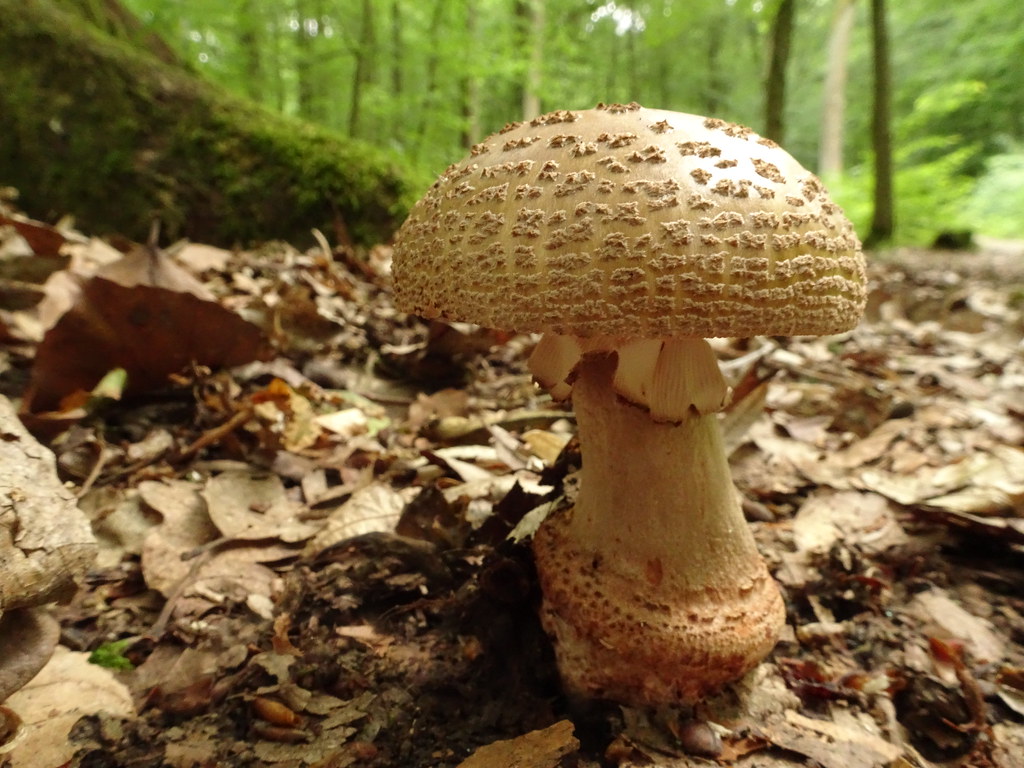
This common and widespread species is found in various environments, including deciduous, coniferous, and mixed hardwood forests, as well as on heaths. It grows on the ground, forming mycorrhizal relationships with a variety of trees such as oak, pine, and fir. It typically appears as solitary specimens, in scattered groups, or occasionally in troops and rings.
Photos
Appearance
- Cap
- Large, 4–20 cm across, ranging in color from rosy-pink and reddish-brown to bronze-brown or brass-yellow. The surface is covered with woolly remnants or small warts that vary from white and grey-pink to olive-gray or yellowish. It is hemispherical then flat, sometimes showing faint striations at the margin.
- Stem
- 60–200 mm long, featuring a bulbous base usually lacking a distinct volva. The surface is white and striate above the ring, becoming flushed with reddish or grey-pink tones below. The base sometimes exhibits scaly patches.
- Gills
- Crowded and free from the stem. Initially white, they develop pink or reddish spots or stains as they age or where they have been damaged.
- Ring
- Membranous, fragile, and skirt-like, located near the top of the stem. It is typically white and marked with fine vertical grooves (striations), though sometimes tinged with pale yellow.
- Flesh
- White, characterized by a slow change to pink, wine-red, or reddish-brown when bruised, sliced, or damaged by insects. The smell is faint or non-distinctive, while the raw taste starts mild or sweet before becoming slightly acrid.
- Spore print
- White.
Sporecast is better in the app
Plan ahead with 10-day forecasts, see what people are finding nearby, get photo IDs, and track your finds.
Edibility
This mushroom is edible only when thoroughly cooked; it is poisonous if eaten raw because it contains toxins that cause a form of anemia and only break down at temperatures above 80°C. Foragers must ensure identification by the characteristic slow pink or reddish-brown staining of the flesh when bruised or cut, especially at the base. It is easily confused with the poisonous Panthercap (Amanita pantherina), which never stains pink, has a smooth rather than striate ring, and features a different stem base with clear woolly bands. Other lookalikes include the Grey Spotted Amanita and Amanita flavorubescens, which stains more slowly. For safety, the water used for cooking should be discarded.
Misidentification can be fatal. Never eat a mushroom unless you're 100% sure. This information may be inaccurate. Always consult multiple sources.
Nutrient Source
EctomycorrhizalIt forms a symbiotic relationship with trees, where it helps the trees absorb nutrients from the soil in exchange for sugars.
Common Names
- Basque
- lamperna ardotsua, ardotsu, galdakao lanperna, galakao lanperna
- Catalan
- cua de cavall, oronja vinosa
- Danish
- Rødmende fluesvamp
- Dutch
- Parelamaniet
- English
- Blusher
- Finnish
- rusokärpässieni
- French
- Oronge vineuse, Amanite rougissante
- Norwegian Bokmål
- rødnende fluesopp
- Norwegian Nynorsk
- raudnande flugesopp
- Spanish
- oronja vinosa, gurumelo, amanita rojiza, Amanita vinosa, mantecoso
- Swedish
- rodnande flugsvamp
- Welsh
- Amanita Wridog
Synonyms
- Agaricus magnificus
- Agaricus rubens
- Agaricus rubescens
- Agaricus verrucosus
- Amanita annulosulfurea
- Amanita annulosulphurea
- Amanita magnifica
- Amanita rubens
- Amanita rubescens
- Amanita verrucosa
- Amplariella rubescens
- Lepiota magnifica
- Limacium rubescens