
Habitat
This species occurs in association with broad-leaved trees, typically near deciduous woodland. It shows a strong preference for alkaline or calcareous soils and may be found growing solitarily or in small groups.
Photos
Appearance
- Cap
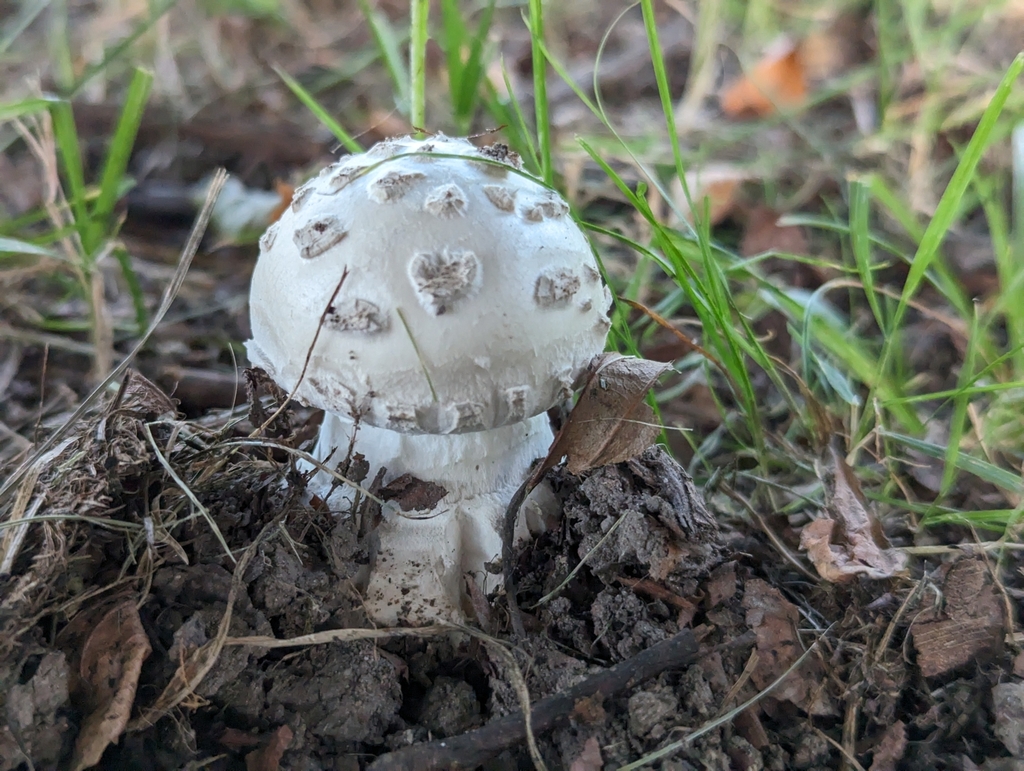
- Measuring 6 to 20 cm wide, the surface is white and heavily covered with thick, flat, greyish, shaggy scales. It begins hemispherical and flattens with age, often featuring delicate veil fragments hanging from the margin.
- Stem
- 6 to 15 cm long and up to 14 mm thick, tapering upwards from a large, bulbous, subterranean base covered in volval fragments. The surface is shaggy with white, mealy scales.
- Ring
- White, thin, and pendulous with a fragile, mealy texture; it is often ephemeral and disappears quickly.
- Gills
- Crowded and free from the stem, colored solid white.
- Flesh
- White throughout, though it may appear slightly cream-colored in the base of the stem. It has a mild, faint odor and taste.
- Spore print
- White.
Sporecast is better in the app
Plan ahead with 10-day forecasts, see what people are finding nearby, get photo IDs, and track your finds.
Edibility
This species has a mild taste and scent but is easily confused with deadly poisonous relatives. It also bears a strong resemblance to Amanita echinocephala, making identification difficult and consumption risky.
Misidentification can be fatal. Never eat a mushroom unless you're 100% sure. This information may be inaccurate. Always consult multiple sources.
Nutrient Source
EctomycorrhizalIt forms a symbiotic relationship with trees, exchanging nutrients from the soil for sugars produced by the tree.
Common Names
- Dutch
- Franjeamaniet
- English
- Warted Amanita
- French
- Amanite solitaire
- German
- Fransiger Wulstling
- Swedish
- flockflugsvamp
- Welsh
- Amanita Ddafadennog
Synonyms
- Agaricus farinaceus
- Agaricus farinosus
- Agaricus strobiliformis
- Agaricus strobiliformis
- Amanita pellita
- Amanita strobiliformis
- Armillaria strobiliformis
- Hypophyllum strobiliforme
- Lepidella strobiliformis
- Lepiota strobiliformis