
Habitat
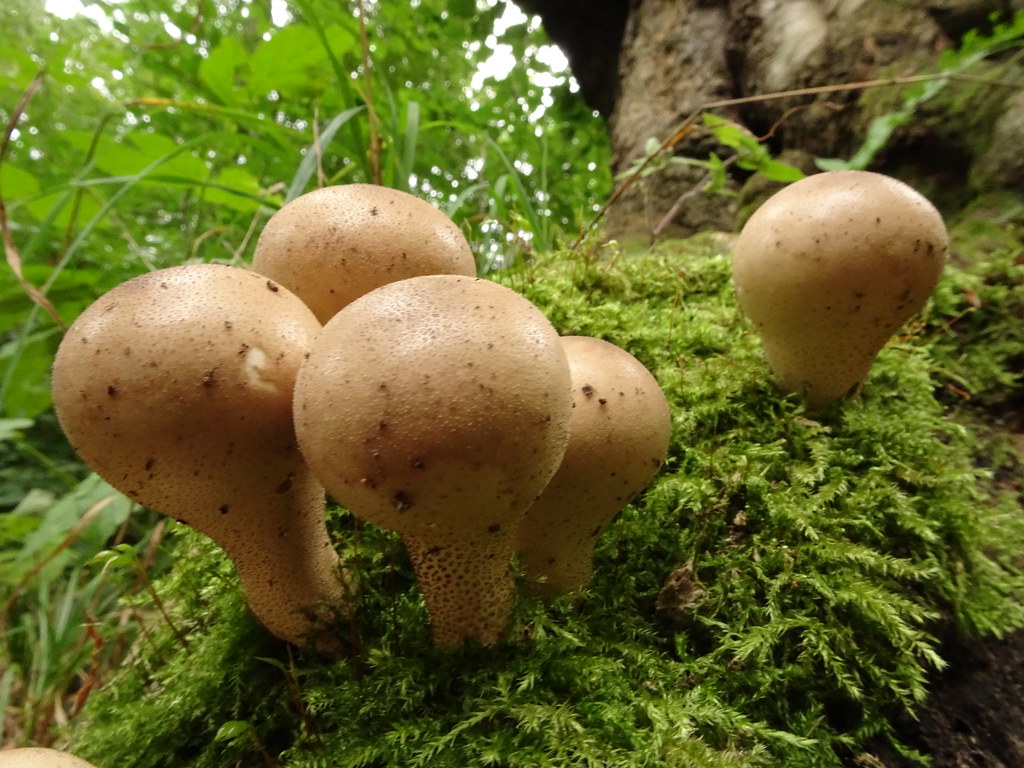
This species is unique among its relatives for fruiting almost exclusively on wood. It grows in dense clusters, swarms, or tufted groups on decaying logs, stumps, and woody debris of both broad-leaved and coniferous trees. While it occasionally appears to be growing from soil or wood chips, it is typically attached to buried wood by prominent white mycelial cords or rhizomorphs. It is found in hardwood, conifer, and mixedwood forests.
Photos
Appearance
- Fruit body
- 1 to 5 cm wide and up to 6 cm tall, typically shaped like an inverted pear, club, or subglobose sphere. It often features a pinched or pleated base area attached to the substrate by conspicuous white mycelial cords or rhizomorphs.
- Outer surface
- Initially white to creamy beige, maturing to yellowish-brown, tan, or chestnut brown. The texture starts with fine granular warts, scurfy spines, or granules that often wear off to leave a smooth, papery inner wall. It may develop a dark apical 'nipple' or small pore-like opening at the top for spore release.
- Interior
- Known as the gleba; initially firm and pure white, becoming soft, mushy, and yellow-brown before turning into a powdery, olive-brown spore mass. The sterile base at the bottom is spongy and persistent, filled with small chambers.
- Spore print
- Olive-brown to dark brown.
- Odor
- Varyingly described as indistinct, fungal, or a strong gas-like smell.
Sporecast is better in the app
Plan ahead with 10-day forecasts, see what people are finding nearby, get photo IDs, and track your finds.
Edibility
The species is only edible when young, small, and pure white throughout the interior. It becomes inedibly tough before the spores ripen and may cause gastrointestinal illness once the interior begins to turn yellowish or olive. The taste is mild when young, though some specimens have a strong or gasoline-like odor. Lookalikes include Lycoperdon perlatum, which has pyramidal warts, and Lycoperdon subincarnatum.
Misidentification can be fatal. Never eat a mushroom unless you're 100% sure. This information may be inaccurate. Always consult multiple sources.
Nutrient Source
SaprotrophicIt obtains nutrients by breaking down dead organic matter, such as decaying wood and woody debris.
Common Names
- Basque
- Astaputz udarekara
- Danish
- Pære-støvbold
- Dutch
- Peervormige stuifzwam
- English
- Pear-shaped Puffball, Stump Puffball
- Finnish
- ryhmätuhkelo
- French
- Vesse de loup en poire
- German
- Birnenstäubling
- Norwegian Bokmål
- pærerøyksopp
- Norwegian Nynorsk
- pærerøyksopp
- Spanish
- Bejín piriforme, Bejin piriforme
- Swedish
- gyttrad röksvamp
- Welsh
- Coden Fwg Berffurf
Synonyms
- Lycoperdon betulinum
- Lycoperdon oviforme
- Lycoperdon pyriforme
- Lycoperdon pyriforme — Stump Puffball
- Lycoperdon saccatum
- Lycoperdon serotinum
- Morganella pyriformis
- Utraria pyriformis