
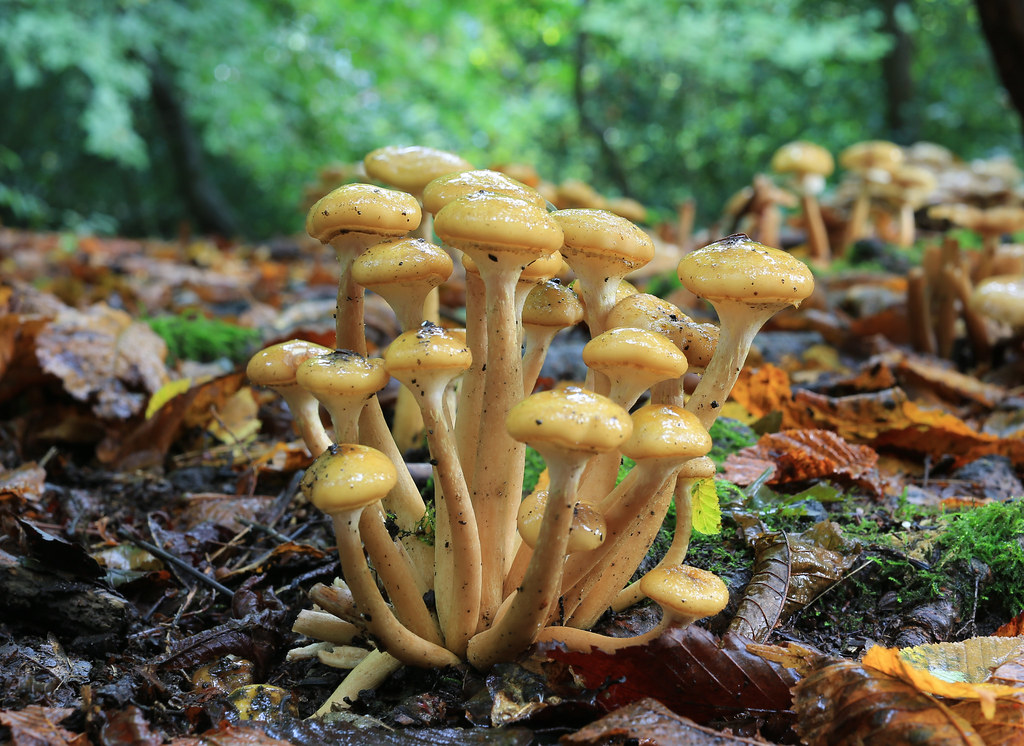
Habitat
A widespread and very common species that functions as both a virulent pathogen and a saprobe. It is found in large, dense clusters on living or dead trees and shrubs, particularly hardwoods like oak, tanoak, and madrone, though it occasionally occurs on conifers and herbaceous plants. It commonly fruits at the base of trees, on stumps, or on the ground arising from submerged roots. The fungus can extend up the trunk of its host, and its dark, stringy rhizomorphs can often be found beneath the bark of occupied wood.
Photos
Appearance
- Cap
- 2–25 cm wide; initially convex or domed with an inrolled margin, becoming flat, depressed, or wavy with age, often with a broad central bump. Color ranges from honey-yellow and golden-brown to pinkish-brown or beige, typically darker at the center and paler toward the translucent-striate edges. Localized dark, fibrous, or hair-like scales are common, especially near the center.
- Stem
- 4–30 cm long and 0.5–6 cm thick; cylindrical and often tapered or pointed at the base, especially when growing in fused clusters. Colors range from white or pale yellow to pinkish-brown or rusty-cinnamon, often darkening toward the base. Texture is tough, fibrous, and may have woolly or yellowish fuzz near the bottom.
- Ring
- A persistent, prominent, white, membranous ring is located high on the stem, often featuring a yellowish margin or small brown scales.
- Gills
- Crowded and broadly attached to the stem, sometimes extending slightly down it. Initially white or cream, maturing to yellow, yellow-brown, or pinkish-tan, occasionally developing reddish-brown spots with age.
- Flesh
- Firm and white; the stem has a tougher, stringy, and fibrous interior.
- Spore print
- White to pale cream.
- Smell
- Strong and distinct, described variously as acrid, like Camembert cheese, or indistinct.
Sporecast is better in the app
Plan ahead with 10-day forecasts, see what people are finding nearby, get photo IDs, and track your finds.
Edibility
While considered a delicacy by some, honey mushrooms must be cooked thoroughly as they are a frequent cause of gastric upset. Only the caps of young specimens should be used since the stems are tough and fibrous. The flavor is mild or mushroomy but can be acrid or unpleasant when raw. This species is easily confused with the nearly identical Ringless Honey Fungus (Armillaria tabescens), which lacks a ring on the stem.
Misidentification can be fatal. Never eat a mushroom unless you're 100% sure. This information may be inaccurate. Always consult multiple sources.
Nutrient Source
facultativeIt obtains nutrients by both decomposing dead plant material and by attacking living trees.
Common Names
- Danish
- Ægte honningsvamp
- Dutch
- Echte honingzwam
- English
- Honey Fungus, Honey Mushroom
- French
- Armillaire des feuillus, Armillaire couleur de miel
- German
- Honiggelber Hallimasch
- Norwegian Bokmål
- ekte honningsopp
- Norwegian Nynorsk
- ekte honningsopp
- Swedish
- sydlig honungsskivling
- Welsh
- Ffwng Melog
Synonyms
- Agaricites melleus
- Agaricus annularis
- Agaricus annularius
- Agaricus melleus
- Agaricus sulphureus
- Agaricus versicolor
- Armillariella cerasi
- Armillariella mellea
- Armillariella mellea
- Armillariella nigritula
- Clitocybe mellea
- Fungus versicolor
- Geophila versicolor
- Lepiota mellea
- Mastoleucomyces melleus
- Omphalia mellea
- Polymyces melleus
- Stropharia versicolor