
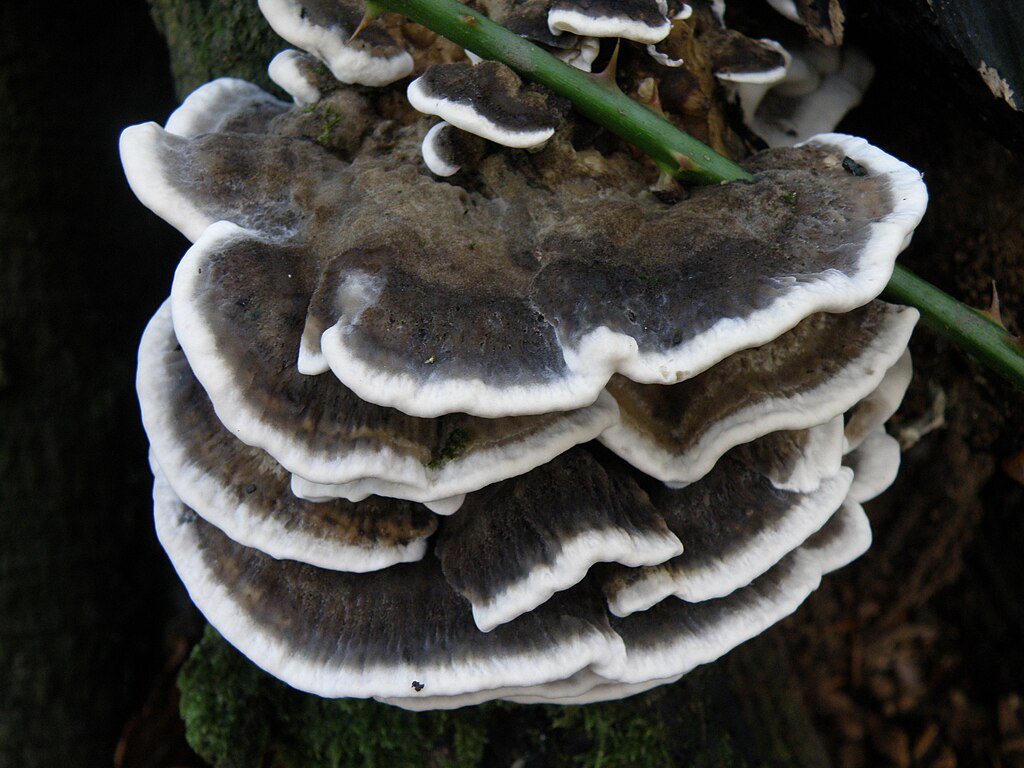
Habitat
This common species grows on dead or moribund wood of broad-leaved trees, particularly beech and alder. It is found on both fallen logs and standing hardwoods. Occasionally, it can be found on dead conifer wood. The fruitbodies typically develop in fused masses or overlapping shelves, forming spreading or crust-like patches.
Photos
Appearance
- Bracket
- Approximately 2 to 6 cm wide, semicircular, fan-shaped, or forming spreading crust-like patches. The surface ranges from ocher and tan to brown, often with a paler whitish margin; it is initially finely velvety or matted-hairy before becoming smoother or warty.
- Pores
- Small and rounded to angular, colored pale smoky gray to near black. The pore surface typically bruises or stains blackish when damaged.
- Tubes
- Very thin layer, reaching 1 to 2 mm deep, colored dark gray to black.
- Flesh
- Tough, fibrous, and leathery; white to grayish in color. Note the sharp color contrast between the white flesh and the dark tube layer.
- Spore print
- White.
- Stem
- Absent.
Sporecast is better in the app
Plan ahead with 10-day forecasts, see what people are finding nearby, get photo IDs, and track your finds.
Edibility
The texture is described as tough, fibrous, and leathery, with a mealy or mushroomy odor. The taste ranges from mild to sour or unpleasant. While it can be confused with Trametes species, those have white to creamy pores, whereas Cerrena unicolor has a fuzier cap and maze-like pores.
Misidentification can be fatal. Never eat a mushroom unless you're 100% sure. This information may be inaccurate. Always consult multiple sources.
Nutrient Source
SaprotrophicIt obtains nutrients by decomposing dead wood, primarily from broadleaved trees, breaking down the complex organic matter into simpler compounds.
Common Names
- Basque
- larrubera errea
- Danish
- Sveden sodporesvamp
- Dutch
- Grijze buisjeszwam
- English
- Smoky Bracket, Smoky Polypore
- Finnish
- tuhkakääpä
- French
- Tramète brûlée
- German
- Angebrannter Rauchporling
- Norwegian Bokmål
- båndkjuke, svartrandkjuke
- Norwegian Nynorsk
- svartrandkjuke, bandkjuke
- Spanish
- yesquero quemado, tremela anaranjada, parásito facultativo
- Swedish
- svedticka
- Welsh
- Ysgwydd Fyglyd
Synonyms
- Agaricus crispus
- Bjerkandera isabellina
- Bjerkandera scanica
- Boletus adustus
- Boletus carpineus
- Boletus carpineus
- Boletus concentricus
- Boletus crispus
- Boletus fuscoporus
- Boletus isabellinus
- Boletus pelleporus
- Boletus pelloporus
- Boletus pelloporus
- Ceriporiopsis niger
- Coriolus alabamensis
- Daedalea fennica
- Daedalea solubilis
- Geotrichopsis mycoparasitica
- Gloeoporus adustus
- Gloeoporus adustus
- Gloeoporus crispus
- Grifola adusta
- Leptoporus adustus
- Leptoporus adustus
- Leptoporus crispus
- Leptoporus nigrellus
- Microporus gloeoporoides
- Microporus lindheimeri
- Polyporus adustus
- Polyporus amesii
- Polyporus atropileus
- Polyporus burtii
- Polyporus carpineus
- Polyporus cinerascens
- Polyporus crispus
- Polyporus curreyanus
- Polyporus curreyanus
- Polyporus digitalis
- Polyporus dissitus
- Polyporus excavatus
- Polyporus fumosogriseus
- Polyporus halesiae
- Polyporus isabellinus
- Polyporus lindheimeri
- Polyporus macrosporus
- Polyporus murinus
- Polyporus nigrellus
- Polyporus ochraceocinereus
- Polyporus scanicus
- Polyporus secernibilis
- Polyporus solubilis
- Polyporus subcinereus
- Polyporus tegumentosus
- Polyporus tristis
- Polystictus adustus
- Polystictus alabamensis
- Polystictus carpineus
- Polystictus gloeoporoides
- Polystictus lindheimeri
- Polystictus puberulus
- Poria argentea
- Poria carnosa
- Poria carnosa
- Poria curreyana
- Poria luteogrisea
- Trametes tristis
- Tyromyces adustus