
Habitat
Boletus edulis is found on the ground in a wide variety of both deciduous and coniferous woodlands. It shows a preference for associating with beech, oak, pine, and spruce (especially Norway and Sitka spruce). Frequent in temperate areas and mountainous regions, it often grows in drier sites and is commonly found along habitat edges such as trail sides, roads, meadows, and forest openings. Fruitbodies can occur solitarily, in pairs, or scattered in larger groups, arcs, and troops. They are often initially buried beneath thick forest duff.
Photos
Appearance
- Cap
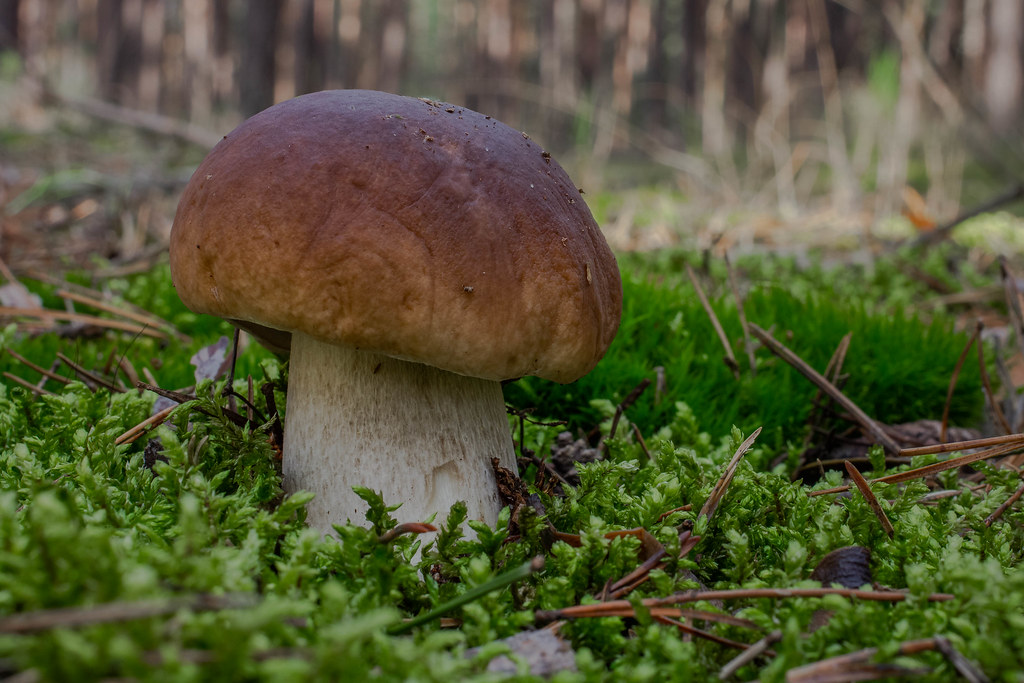
- Large and variable, ranging from 8–30 cm (occasionally much larger). Initially hemispherical, it becomes convex to flat or shallowly domed with age. The surface is smooth to wrinkled, dry to greasy or slightly sticky when wet. Colors range from creamy beige and tan to cinnamon-brown or rich reddish-brown, often with a paler margin.
- Stem
- Stout and bulky, measuring 3–25 cm long and up to 7 cm thick. It is often bulbous or club-shaped, especially when young. The surface is white to light brown and is covered in a characteristic fine, raised network of white lines (reticulation), which is most prominent on the upper half.
- Tubes
- Initially white and appearing 'stuffed' with cottony tissue when young, later becoming yellow-green to olive-brown. They are typically sunken or depressed around the stem attachment.
- Pores
- Small and round. Like the tubes, they begin white and mature to yellow, greenish-yellow, or olive-brown. They do not typically bruise blue.
- Flesh
- Thick, firm, and white. It does not change color when sliced or bruised, though it may occasionally show a slight reddish tint just under the cap skin.
- Spore print
- Olive-brown to olive-green.
Sporecast is better in the app
Plan ahead with 10-day forecasts, see what people are finding nearby, get photo IDs, and track your finds.
Edibility
Boletus edulis is a highly prized edible species with a nutty, sweet, and pleasant flavor and firm texture. While generally safe, the tubes of older specimens can become soft and gelatinous, and large mature caps are often infested with maggots or damaged by slugs. It can be confused with the extremely bitter Tylopilus felleus, which is distinguished by its pinkish pores and spores and a dark network on the stem. Other lookalikes include various related edible boletes, but collectors should avoid any boletes with red or pink tones or those that stain blue unless they can be positively identified, as most poisonous relatives exhibit these traits.
Misidentification can be fatal. Never eat a mushroom unless you're 100% sure. This information may be inaccurate. Always consult multiple sources.
Nutrient Source
EctomycorrhizalThis mushroom forms a symbiotic relationship with trees, where it exchanges nutrients it extracts from the soil for sugars produced by the tree through photosynthesis. This mutually beneficial relationship is called ectomycorrhizal. [mykoweb.eu](https://www.mykoweb.eu/fungi/boletus-edulis), [wikipedia.org](https://en.wikipedia.org/wiki/Boletus_edulis)
Common Names
- Basque
- onddo ona, omtozuri, onto-zuri, ontozuri, ondo, Onto Zuri, udazkeneko, onyo-zuriya, onto-zuriya, ziza lis, ondoak, onduak, onto zuri, ziza arrizcoa, zizabal
- Catalan
- siuró, ciureny, mullerol, ciurenc, cep, bolets de bou, Suroy, siurenys, pinotell, pinatell, bolet de fay, surenc, Siureny, sureny
- Danish
- Spiselig rørhat/karl johan
- Dutch
- Gewoon eekhoorntjesbrood
- English
- King Bolete, Cep, Penny Bun
- Finnish
- herkkutatti, koivunherkkutatti, keltaherkkutatti
- French
- Cèpe de Bordeaux, Cèpe citron, Cèpe des bouleaux, Cèpe, Cèpe blanc, Cèpe du Périgord
- Galician
- andoa, madeirudo
- German
- Gelber Steinpilz, Birken-Steinpilz, Steinpilz
- Italian
- Porcini
- Northern Sami
- herskogusaguoppar
- Norwegian
- ku-sop, bu-sop
- Norwegian Bokmål
- steinsopp
- Norwegian Nynorsk
- steinsopp
- Spanish
- pan de sapo, onyo-zuriya, hongo, hongo calabaza, seta de Burdeos, boleto comestible, faisán, sigro, frongo, matute, pan de risquillu, hongo blanco, Calabaza, Hongo calabaza, calabaza, hongo rubio
- Swedish
- karljohan, Stensopp, Karljohans svamp, karljohanssvamp, Karjohanssvamp
- Welsh
- Wicsen Gron
Synonyms
- Boletus betulicola
- Boletus bulbosus
- Boletus citrinus
- Boletus clavipes
- Boletus edulis
- Boletus elephantinus
- Boletus esculentus
- Boletus filiae
- Boletus persoonii
- Boletus quercicola
- Boletus slovenicus
- Boletus solidus
- Boletus venturii
- Ceriomyces crassus
- Dictyopus edulis
- Dictyopus edulis
- Gyrodon filiae
- Leccinum edule
- Leccinum elephantinum
- Suillus citrinus
- Suillus edulis
- Suillus esculentus
- Tubiporus edulis