
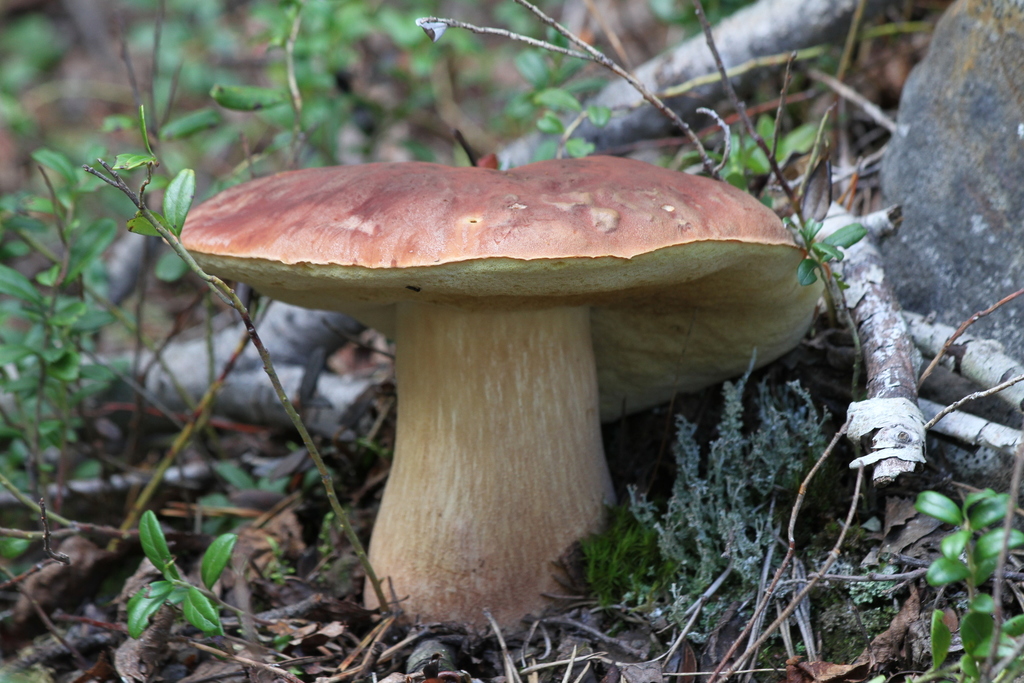
Habitat
This species typically grows in acidic soil within coniferous forests, showing a strong preference for native Scots pine. It occurs solitarily or in small groups and is frequently found in mountainous regions or northern pine woods.
Photos
Appearance
- Cap
- Large, 8–30 cm in diameter; initially hemispherical and later convex; colored reddish-brown to chestnut, often with a paler or white margin; texture is greasy when young, becoming dry, wrinkled, or slightly downy as it matures.
- Stem
- Very robust and stout, ranging from barrel-shaped to club-shaped; measuring 4–13 cm long and often thicker towards the base; brownish color that darkens at the bottom; covered in a fine white to purple-brown network that turns reddish when bruised.
- Pores
- Small and round; starting out white, then changing to greenish-yellow and eventually olive-brown.
- Tubes
- Initially white, maturing to a greenish-yellow color; depressed around the stem.
- Flesh
- White and firm; when cut, the area just beneath the cap skin turns a deep wine-red or purple color; possesses a pleasant, earthy smell and taste.
- Spore print
- Olive-green to walnut-brown.
Sporecast is better in the app
Plan ahead with 10-day forecasts, see what people are finding nearby, get photo IDs, and track your finds.
Edibility
Considered a delicacy, this bolete has a pleasant, strong, and earthy flavor with firm flesh. It is very similar to the Penny Bun in appearance, but foragers should avoid harvesting it from polluted environments as it can accumulate mercury.
Misidentification can be fatal. Never eat a mushroom unless you're 100% sure. This information may be inaccurate. Always consult multiple sources.
Nutrient Source
EctomycorrhizalIt forms symbiotic associations with living trees, exchanging nutrients in exchange for sugars produced by the tree.
Common Names
- Basque
- kaskabeltz, onto gorri
- Czech
- Hřib Borový
- Danish
- Rødbrun rørhat
- Dutch
- Denne-eekhoorntjesbrood, Denneneekhoorntjesbrood
- English
- Pine Bolete
- Finnish
- männynherkkutatti
- French
- Cèpe des pins
- German
- Kiefern Steinpilz, Kiefern-Steinpilz
- Northern Sami
- beahcegusaguoppar
- Norwegian Bokmål
- rødbrun steinsopp
- Norwegian Nynorsk
- raudbrun steinsopp
- Spanish
- boleto de pino, boleto del pino, Boleto del pino
- Swedish
- kopparröd stensopp, Rödbrun Stensopp, purpurstensopp
- Welsh
- Cap Tyllog Pinwydd
Synonyms
- Boletus fuscoruber
- Boletus pinicola
- Boletus pinicola