
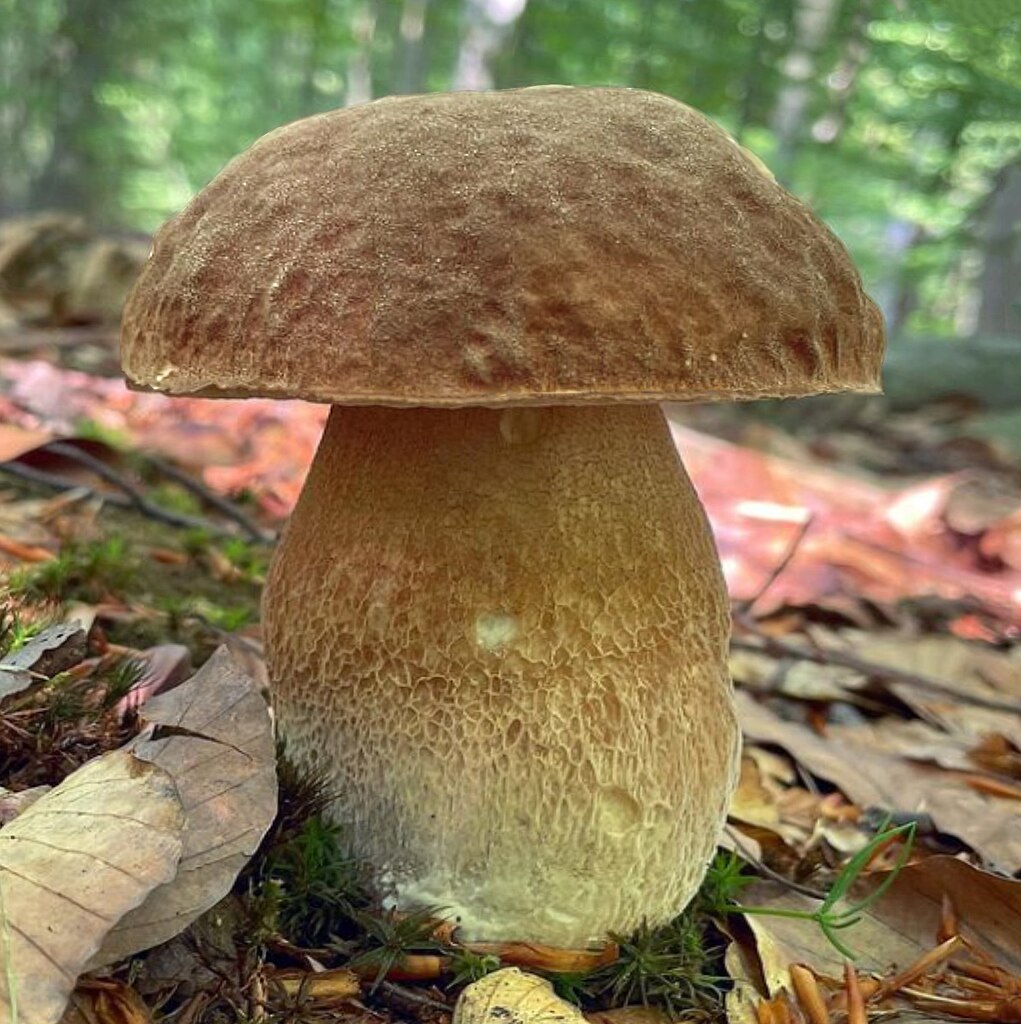
Habitat
This species is found on soil in broad-leaved woodlands and parklands. It typically grows solitarily or in small groups in association with deciduous trees, most commonly beech, oak, and sweet chestnut.
Photos
Appearance
- Cap
- 7 to 20 cm in diameter; ranging in color from pale straw to chestnut or walnut brown; the dry surface is initially smooth but soon becomes rough, often cracking into small scales particularly toward the center.
- Stem
- 5 to 16 cm long and 2 to 5 cm thick; robust and often bulbous or swollen at the base; characterized by a dense, prominent network of white or brown reticulations that frequently extend well down the stalk.
- Pores and Tubes
- Small, round pores that are white when young, becoming greenish-yellow or greyish-yellow with age; tubes are depressed around the stem.
- Flesh
- Firm and typically white or pale cream, though sometimes showing yellowish tinges or a slight red-purple hue when cut; possesses a strong, pleasant, and slightly sweet smell and taste.
- Spore print
- Olive-green to walnut-brown.
Sporecast is better in the app
Plan ahead with 10-day forecasts, see what people are finding nearby, get photo IDs, and track your finds.
Edibility
This mushroom has a strong, pleasant, and slightly sweet flavor with a firm texture that is a bit softer than its relatives. It can be distinguished from the Penny Bun by its dry cap that frequently cracks into small scales, particularly at the center. Some flesh may turn slightly red-purple when cut, though it is often described as unchanging white or pale cream.
Misidentification can be fatal. Never eat a mushroom unless you're 100% sure. This information may be inaccurate. Always consult multiple sources.
Nutrient Source
EctomycorrhizalIt forms a symbiotic relationship with trees, exchanging nutrients with their root systems.
Common Names
- Basque
- udako onddozuri, Onto Zuri
- Catalan
- cep, Sureny
- Danish
- Sommer-rørhat
- English
- Summer cep, Summer Bolete
- Finnish
- tammenherkkutatti
- French
- Cèpe d'été
- Norwegian Bokmål
- bleklodden steinsopp
- Norwegian Nynorsk
- bleiklòden steinsopp
- Spanish
- boleto comestible, boleto reticulado, boleto reticulado de verano, hongo de primavera, boletus rubio
- Swedish
- sämsksopp, Finluden Stensopp
- Welsh
- Cap Tyllog yr Haf
Synonyms
- Boletus aestivalis
- Boletus carpinaceus
- Boletus mutabilis
- Boletus reticulatus
- Dictyopus aestivalis
- Suillus aestivalis
- Suillus reticulatus
- Tubiporus aestivalis
- Versipellis aestivalis
- Xerocomus reticulatus