
Habitat
This mushroom grows on soil in mixed and broad-leaved woodlands, showing a strong preference for associations with beech and oak, though it is occasionally found with conifers. It typically favors slightly acidic sites and may appear as solitary specimens or in small groups.
Photos
Appearance
- Cap
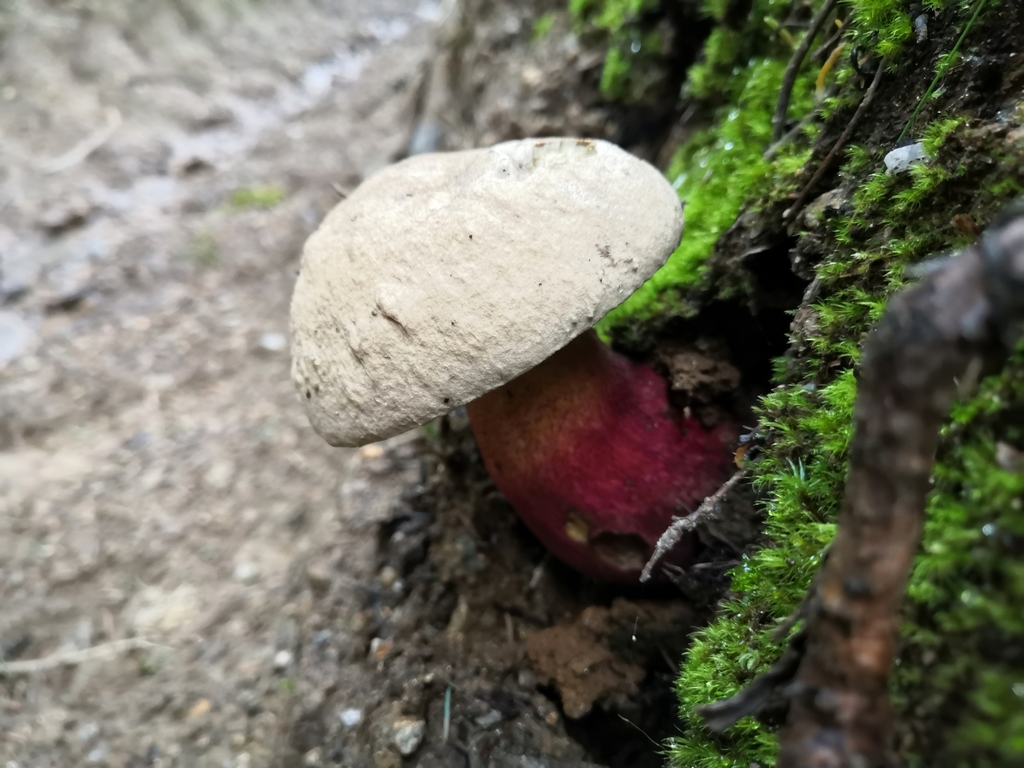
- Measuring 5 to 15 cm wide, the surface is pale greyish to smoky-olive or light brown. It transitions from downy to smooth and often develops cracks or scales near the center with age, featuring a slightly overhanging margin.
- Stem
- Robust and often swollen at the base, typically 5 to 12 cm tall. It is lemon-yellow at the top and red below, often becoming brown at the base. The surface is covered with a distinct white, straw, or pinkish network and bruises blue.
- Tubes
- Dirty sulphur-yellow in color, becoming depressed and turning bluish or green when bruised.
- Pores
- Medium-sized and round, matching the tube color and bruising bluish-green.
- Flesh
- Firm and pale cream to lemon-yellow. It instantly turns blue when cut, though some areas in the stem base may appear reddish or brownish.
- Spore print
- Olive-brown to olive-green.
Sporecast is better in the app
Plan ahead with 10-day forecasts, see what people are finding nearby, get photo IDs, and track your finds.
Edibility
This mushroom is inedible due to its very bitter flavor and an unpleasant smell. It may be confused with poisonous boletes in the genus Rubroboletus. The flesh and stem turn blue when cut or bruised.
Misidentification can be fatal. Never eat a mushroom unless you're 100% sure. This information may be inaccurate. Always consult multiple sources.
Nutrient Source
EctomycorrhizalIt forms a symbiotic relationship with the roots of trees, exchanging nutrients with them.
Common Names
- Basque
- onto hankaederra, errementeri-ontea, onddo hankaeder, errementi onto, errementeri-ontoa
- Catalan
- mataparent amarg, mataparent
- Danish
- Skønfodet rørhat
- Dutch
- Pronksteelboleet
- English
- Bitter Beech Bolete
- Finnish
- kaunojalkatatti
- French
- Bolet à beau pied
- German
- Schönfuß-Röhrling
- Norwegian Bokmål
- besk rørsopp
- Norwegian Nynorsk
- beisk røyrsopp
- Spanish
- boleto de pie rojo amargo, hongo de pié hermoso, hongo de pié rojo amargo, Pie rojo amargo, Hongo de pie hermoso
- Swedish
- bittersopp, skönfotad sopp, skönsopp
- Welsh
- Cap Tyllog Chwerw
Synonyms
- Boletus calopus
- Boletus calopus
- Boletus calopus — Bitter Beech Bolete
- Boletus lapidum
- Boletus olivaceus
- Boletus olivaceus
- Boletus terreus
- Dictyopus calopus
- Dictyopus olivaceus
- Suillus calopus
- Suillus olivaceus
- Tubiporus calopus
- Tubiporus olivaceus