
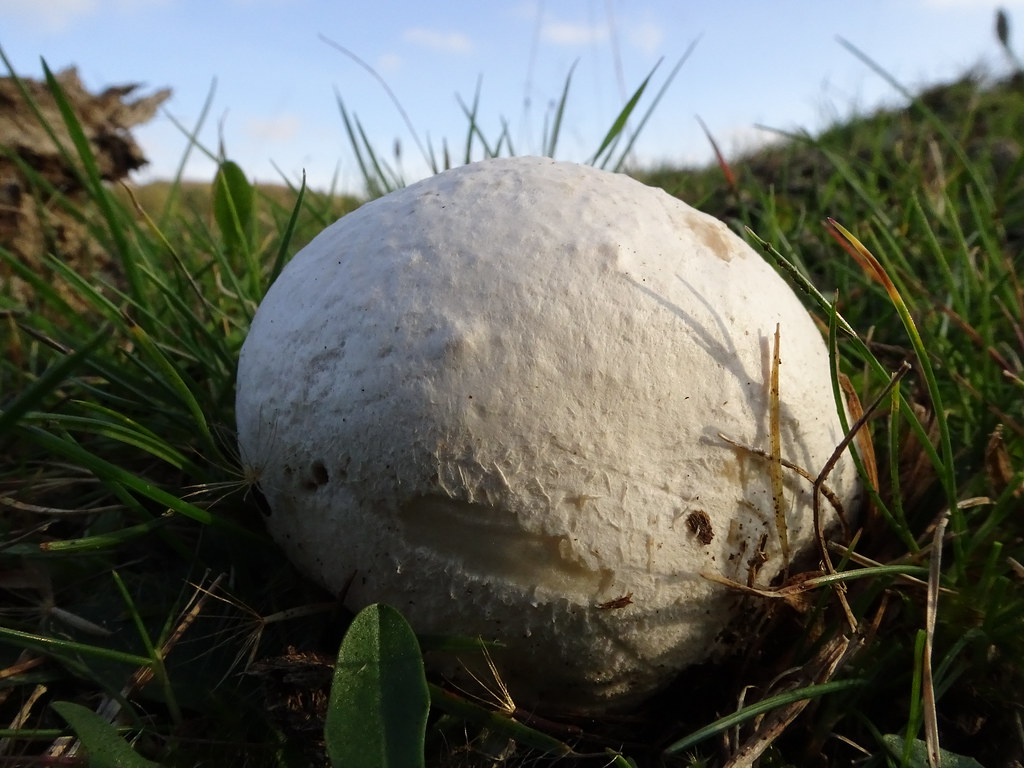
Habitat
Found on the ground in various nutrient-rich environments, including gardens, pastures, fields, parks, golf courses, and grassy roadsides. It is particularly common in phosphate-rich soils, often indicated by the presence of stinging nettles. It also grows along the edges of woods, in open or sparsely wooded areas, and under brushy vegetation. Fruit bodies may appear individually, in small groups, or in large arcs and circles, and they are loosely attached to the substrate by root-like mycelial cords.
Photos
Appearance
- Fruit body
- Massive and roughly spherical, measuring 7 to 80 centimeters across (rarely up to 150 centimeters). It is initially white, becoming yellowish and eventually dark brown at maturity.
- Outer wall
- The surface is smooth with a soft, leathery feel. It eventually flakes or breaks away in irregular pieces to expose the inner layers and spore mass.
- Flesh
- Known as the gleba, it is initially white and firm with a texture similar to tofu or cheese. As it matures, it turns yellow, then olive, and finally becomes an olive-brown powdery mass.
- Stem
- Usually absent or rudimentary; the body is loosely attached to the ground by a root-like cord of mycelium that often breaks at maturity.
- Spore print
- Olive-brown to tawny brown.
Sporecast is better in the app
Plan ahead with 10-day forecasts, see what people are finding nearby, get photo IDs, and track your finds.
Edibility
The flesh must be purely white and firm to be suitable for consumption; once it begins to turn yellowish or olive-brown, the flavor is poor. No other puffball species reaches even half the size of this mushroom at maturity, and its texture has been compared to cheese or tofu. It can be prepared by slicing thickly and frying, roasting whole, stewing, or drying in thin slices.
Misidentification can be fatal. Never eat a mushroom unless you're 100% sure. This information may be inaccurate. Always consult multiple sources.
Nutrient Source
facultativeIt obtains nutrients by decomposing dead organic matter and also by forming a symbiotic relationship with the roots of plants, where it exchanges sugars for water and minerals. [mushroom-appreciation.com](https://www.mushroom-appreciation.com/puffball-mushroom-identification.html), [microbewiki.kenyon.edu](https://microbewiki.kenyon.edu/index.php/Calvatia_gigantea)
Common Names
- Basque
- astaputz erraldoi
- Catalan
- esclatabufa geganta
- Danish
- Kæmpestøvbold
- Dutch
- Reuzenbovist
- English
- Giant Puffball
- Finnish
- jättikuukunen
- French
- Vesse de loup géante
- German
- Riesenbovist
- Norwegian Bokmål
- kjemperøyksopp
- Norwegian Nynorsk
- kjemperøyksopp
- Spanish
- pedo de lobo gigante, bejín gigante
- Swedish
- jätteröksvamp
- Ukrainian
- Лангерманія гігантська
- Welsh
- Coden Fwg Enfawr
Synonyms
- Bovista gigantea
- Bovista gigantea
- Bovistaria gigantea
- Calvatia gigantea
- Globaria gigantea
- Langermannia gigantea — Giant Puffball
- Langermannia gigantia
- Lasiosphaera gigantea
- Lycoperdon giganteum