
Habitat
This common species is found in urban areas and forests, typically growing in clusters, clumps, or troops. It frequently occurs on or around deciduous stumps, rotting hardwood roots, and buried wood in locations such as lawns, gardens, pastures, and disturbed, nutrient-rich soil. It also inhabits old-cut timber, including tubs, barrels, and stumps.
Photos
Appearance
- Cap
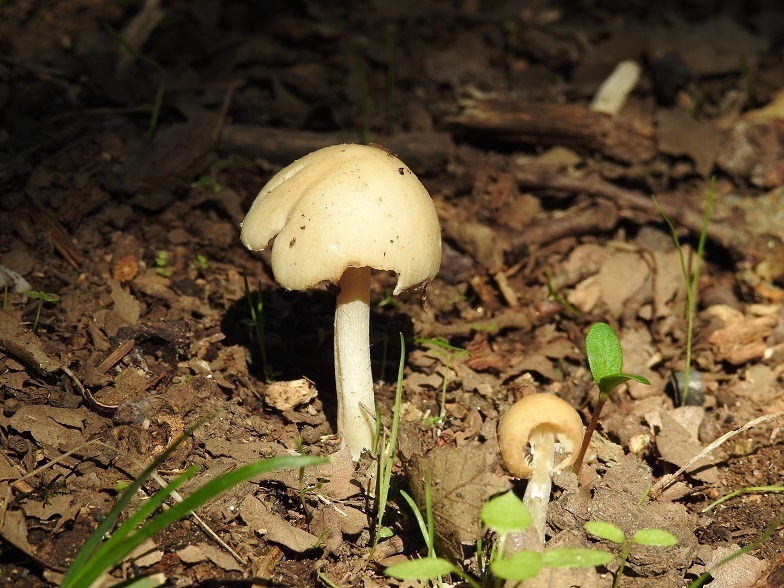
- 1.5–7 cm wide; initially bell-shaped, hemispheric, or ovoid, becoming convex to flat or even slightly concave with age. The surface is smooth and dry, sometimes appearing floury or glistening when dry. Color is hygrophanous, starting caramel-brown, pale honey, or ochraceous-tan and fading significantly to yellowish-beige or nearly white. The margin is often wavy, frequently splitting, and typically decorated with hanging, white, tooth-like fragments of the partial veil.
- Stem
- 2–10 cm long and 3–9 mm thick; white, slender, and fragile, snapping easily. It is cylindrical, hollow, and may be smooth, silky-fibrillose, or slightly scurfy (flaky). It sometimes features a faint ring zone from the veil but lacks a true permanent ring.
- Gills
- Crowded and narrowly to broadly attached to the stem. They begin white or pale grayish-beige, develop a lilac or grayish-lilac tint, and eventually mature to dark chocolate-brown or purplish-brown. The gill edges often remain paler or whitish.
- Flesh
- White and very thin (up to 2 mm); extremely fragile and prone to breaking.
- Spore print
- Dark brown, purplish-brown, or nearly black.
- Odor and Taste
- Smell is indistinct or mild and earthy-mushroomy; taste is not distinctive.
Sporecast is better in the app
Plan ahead with 10-day forecasts, see what people are finding nearby, get photo IDs, and track your finds.
Edibility
While considered edible and sometimes described as having a good flavor, this mushroom is thin-fleshed, extremely fragile, and difficult to identify with confidence. It belongs to a complex of similar species and may contain psilocybin or psilocin. Caution is advised as it can be confused with potentially toxic species; identification relies on seeing young specimens with pale honey or caramel-tan caps and hanging white veil fragments.
Misidentification can be fatal. Never eat a mushroom unless you're 100% sure. This information may be inaccurate. Always consult multiple sources.
Nutrient Source
SaprotrophicIt obtains nutrients by decomposing dead organic matter, such as dead trees, roots, and leaf litter.
Common Names
- Danish
- Candolles mørkhat
- Dutch
- Bleke franjehoed
- English
- Pale Brittlestem
- Finnish
- kalvashaprakas
- French
- Hypholome de De Candolle
- German
- Behangener Faserling
- Norwegian Bokmål
- hvit sprøsopp
- Norwegian Nynorsk
- kvit sprøsopp
- Swedish
- vitspröding, vit slöjskivling, vit sprödskivling
- Welsh
- Coesyn Brau Gwelw
Synonyms
- Agaricus appendiculatus
- Agaricus candolleanus
- Agaricus catarius
- Agaricus coronatus
- Agaricus egenulus
- Agaricus felinus
- Agaricus vinosus
- Agaricus violaceolamellatus
- Drosophila appendiculata
- Drosophila candolleana
- Drosophila candolleana
- Drosophila cataria
- Hypholoma appendiculatum
- Hypholoma appendiculatum
- Hypholoma candolleanum
- Hypholoma catarium
- Hypholoma egenulum
- Hypholoma felinum
- Hypholomopsis appendiculatum
- Psathyra appendiculata
- Psathyra candolleana
- Psathyra tuberosa
- Psathyrella appendiculata
- Psathyrella appendiculata
- Psathyrella candolleana — Pale Brittlestem
- Psathyrella candolliana
- Psathyrella egenula
- Psathyrella egenula
- Psathyrella elegans
- Psathyrella microlepidota
- Psathyrella proxima