
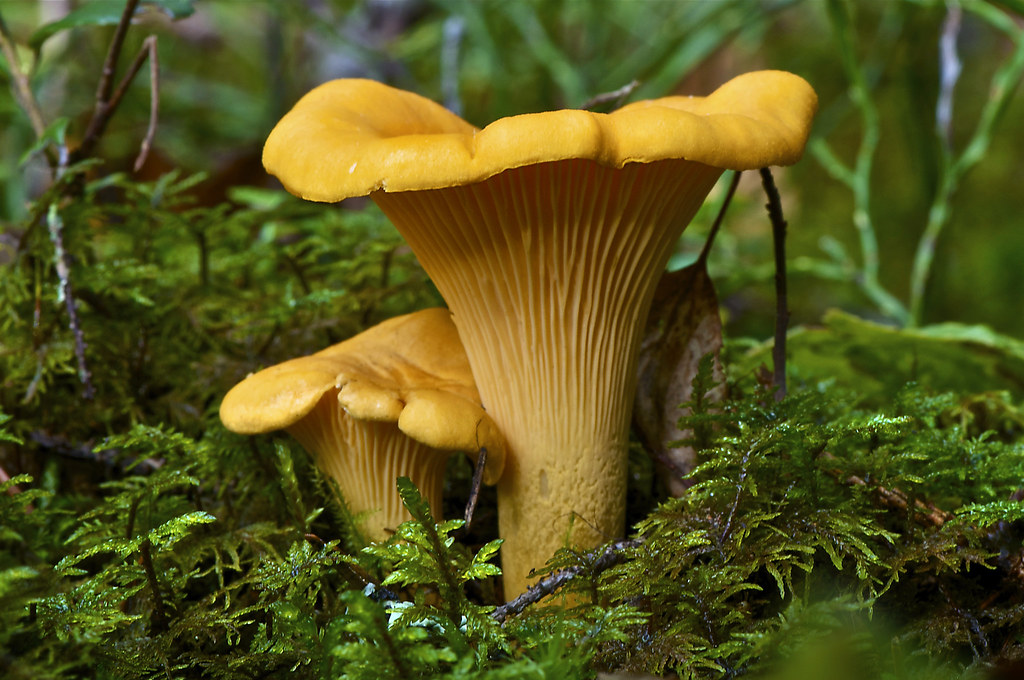
Habitat
Found on the ground growing in soil and leaf litter. This species forms mycorrhizal associations with trees in both broad-leaf and coniferous forests, showing a particular preference for oak. It typically appears in widely dispersed groups, scattered clusters, or tufted formations, and is frequently found on sloped terrain.
Photos
Appearance
- Cap
- 2.5–10 cm wide, bright yellow, egg-yolk yellow, or orange, becoming paler with age. Initially convex but soon becoming funnel-shaped with a depressed center. The surface is smooth and the margin is characteristically wavy or irregular.
- Stem
- 2–8 cm long and 0.3–2.5 cm wide, tapering toward the base and fairly stout. It is colored similarly to the cap, ranging from pale to dark orange-yellow, with a smooth or finely velvety texture.
- Spore-bearing surface
- Consists of decurrent, gill-like ridges or thick, blunt-edged folds rather than true gills. These are ochraceous yellow to pale orange, and are frequently branched or multiply forked.
- Flesh
- Yellowish, often fading to white.
- Spore print
- Pale yellow to pale ochraceous.
- Taste
- Initially mild or faint, developing a slightly peppery or hot quality when raw.
- Smell
- Distinctly fruity, often compared to apricots, though sometimes faint or absent.
Sporecast is better in the app
Plan ahead with 10-day forecasts, see what people are finding nearby, get photo IDs, and track your finds.
Edibility
Possesses a faint fruity or apricot scent and a mild flavor that can turn peppery or slightly hot when raw. It may be confused with the False Chanterelle, which is floppier and lacks the fruity odor, or the poisonous Jack O'Lantern, which grows on wood and has true, non-forking gills and darker flesh. Caution is required to avoid the potentially deadly Brown Rollrim, which is brown and has gills that detach easily from the cap in a single mass.
Misidentification can be fatal. Never eat a mushroom unless you're 100% sure. This information may be inaccurate. Always consult multiple sources.
Nutrient Source
EctomycorrhizalIt forms symbiotic associations with trees, exchanging nutrients with the tree's roots.
Common Names
- Basque
- ziza ori, izahori, saltxaperretxiko, saltzaperretxiko, susa, zizahori
- Catalan
- rossinyol, Russinyol
- Danish
- Almindelig kantarel
- Dutch
- Hanenkam, Hanekam
- English
- Chanterelle, Golden Chanterelle
- Finnish
- keltavahvero
- French
- Girolle
- Galician
- pan de cabra, cantarela
- German
- Pfifferling, Eierschwamm
- Northern Sami
- kantarealla
- Norwegian
- krett-sopp
- Norwegian Bokmål
- kantarell
- Norwegian Nynorsk
- kantarell
- Spanish
- girola, seta de brezo, seta amarilla, membrillo, cabrilla, cantarela, platera, rebozuelo
- Swedish
- kantarell
- Welsh
- Siantrel
Synonyms
- Agaricus alectorolophoides
- Agaricus cantharellus
- Agaricus chantarellus
- Agaricus chantarellus
- Agaricus chanterellus
- Alectorolophoides cibarius
- Cantharellus carneoalbus
- Cantharellus edulis
- Cantharellus edulis
- Cantharellus flavescens
- Cantharellus luteus
- Cantharellus neglectus
- Cantharellus rufipes
- Cantharellus vulgaris
- Chanterel alectorolophoides
- Chanterel cantharellus
- Chanterel chantarellus
- Craterellus cibarius
- Hyponevris cantharella
- Merulius alectorolophoides
- Merulius cantharellus
- Merulius chantarellus
- Merulius cibarius