
Habitat
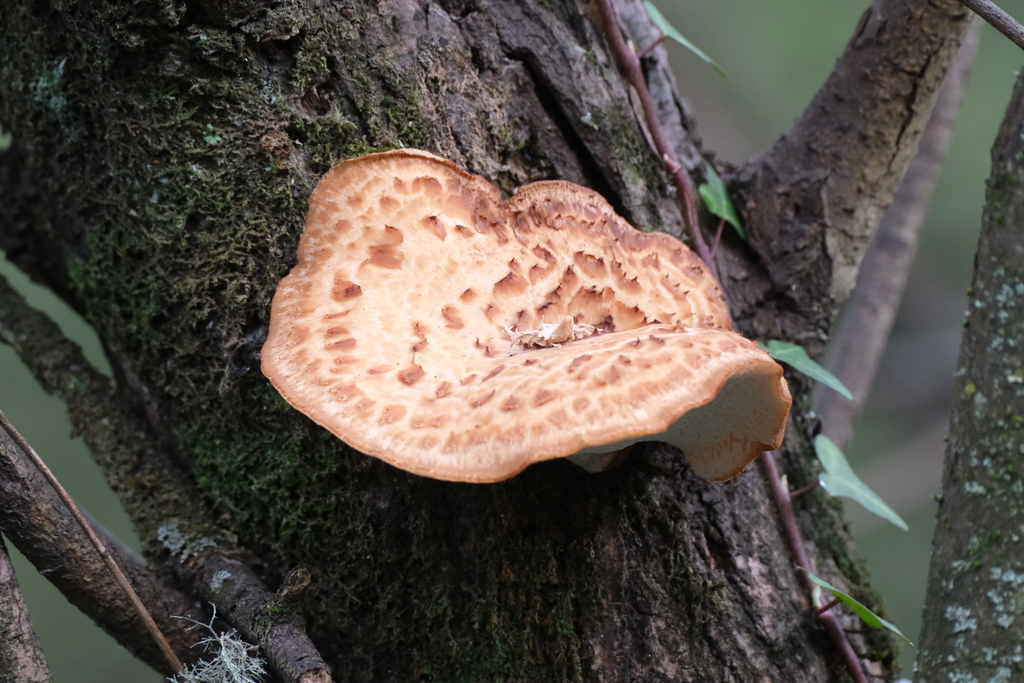
This common and widespread species is found globally, particularly on broad-leaved trees and hardwood logs. It functions as both a parasite, entering living trees through wounds, and a saprobe on stumps or fallen wood. It is most frequently associated with sycamore, horse chestnut, and elm, though it also occurs on tulip poplar, maple, willow, birch, and oak; it is only rarely found on conifers. It grows as solitary brackets or in overlapping clusters on standing trees and decomposing wood.
Photos
Appearance
- Cap
- Large, measuring 5-60 cm across; fan-shaped, kidney-shaped, or semicircular. The surface is tan, yellow, or creamy with dark brown to black flattened scales arranged in concentric or radial patterns. The margin is initially inrolled.
- Stem
- Short and stout, measuring 2-10 cm long; typically positioned off-center or to the side. The base is smooth and distinctly dark brown to black.
- Pores
- Large and angular, measuring 1-3 per mm. They are white to creamy yellow, often becoming irregular or toothed with age, and extend down the stem.
- Tubes
- Up to 10 mm deep, white to cream in color, and deeply decurrent.
- Flesh
- White to cream; initially soft and succulent but becoming thick, tough, and leathery as the fungus matures. It has a distinct scent reminiscent of flour or melon.
- Spore print
- White.
Sporecast is better in the app
Plan ahead with 10-day forecasts, see what people are finding nearby, get photo IDs, and track your finds.
Edibility
The texture of this fungus is traditionally leathery and tough, though young specimens or the soft outer margins of older caps are tender enough to eat. It is often described as having a flavor and aroma reminiscent of melons or flour. While it may be confused with the edible Tuberous Polypore or other bracket fungi, it is considered safe for consumption as long as the flesh can be easily sliced with a knife.
Misidentification can be fatal. Never eat a mushroom unless you're 100% sure. This information may be inaccurate. Always consult multiple sources.
Nutrient Source
facultativeThis fungus can obtain nutrients by living on dead or decaying wood as a saprotroph, or by infecting and feeding on living hardwood trees as a parasite.
Common Names
- Basque
- onto-ardagai ezkatatsua
- Catalan
- bolet de noguer, gírbola de xop
- Danish
- Skællet stilkporesvamp
- Dutch
- Zadelzwam
- English
- Dryad's Saddle
- Finnish
- suomukääpä
- French
- Polypore écailleux
- Norwegian Bokmål
- skjellkjuke
- Norwegian Nynorsk
- skjelkjuke
- Portuguese
- Fígado-de-Anta
- Spanish
- parásito facultativo, poliporo escamoso, Políporo escamoso
- Swedish
- fjällticka
- Welsh
- Cyfrwy Cennog
Synonyms
- Agarico-pulpa ulmi
- Boletus cellulosus
- Boletus juglandis
- Boletus maximus
- Boletus michelii
- Boletus platyporus
- Boletus polymorphus
- Boletus squamosus
- Boletus testaceus
- Bresadolia caucasica
- Bresadolia paradoxa
- Bresadolia squamosa
- Cerioporus michelii
- Cerioporus rostkowii
- Favolus squamosus
- Leucoporus lepidus
- Melanopus squamosus
- Polyporellus rostkowii
- Polyporellus squamatus
- Polyporellus squamosus
- Polyporus alpinus
- Polyporus clusianus
- Polyporus dissectus
- Polyporus flabelliformis
- Polyporus infundibiliformis
- Polyporus infundibuliformis
- Polyporus juglandis
- Polyporus michelii
- Polyporus pallidus
- Polyporus retirugis
- Polyporus retirugus
- Polyporus rostkowii
- Polyporus squamatus
- Polyporus squamosus — Dryad's Saddle
- Polyporus tigrinus
- Polyporus ulmi
- Polyporus westii
- Scenidium pallidum
- Trametes retirugis
- Trametes retirugus