
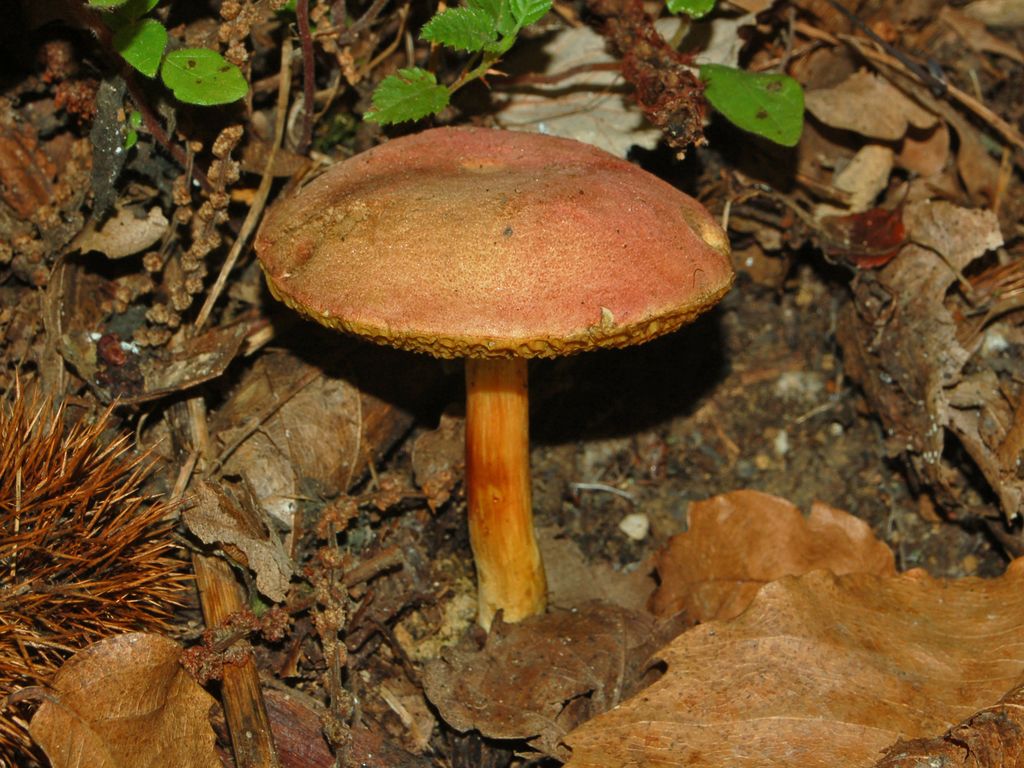
Habitat
This species occurs on soil, duff, or moss in a variety of environments, including broad-leaved, mixed, and coniferous forests, as well as plantations. It is particularly associated with birch scrub and mixed pine-birch habitats on sandy soil. It often grows solitarily or in small clusters. Evidence suggests it may be a parasite on the mycelia of other fungi, as it is frequently found in close proximity to Amanita muscaria (and occasionally A. gemmata or A. pantherina) or the Penny Bun (Boletus edulis).
Photos
Appearance
- Cap
- 2–9 cm wide; ranging from cinnamon and ochre-brown to brick red or pinkish tan, often fading or becoming beige with age. The shape is initially convex to rounded-conical, flattening out and sometimes becoming wavy or cracked. The surface is smooth and shiny or slightly fibrous, feeling sticky or greasy when wet but dry when mature.
- Stem
- 2–10 cm long, 0.5–2 cm thick; slender and often tapering toward the base or occasionally slightly enlarged at the bottom. The surface is colored similarly to the cap, but the base is characterized by brilliant lemon-yellow or chrome-colored mycelium.
- Pores
- Large and angular; coppery, rusty-red, or cinnamon-brown. They may darken or stain slightly reddish-brown when bruised.
- Tubes
- Cinnamon to reddish-yellow, becoming rusty with age; attachment is adnate to slightly decurrent (running down the stem).
- Flesh
- Thin and soft; pale yellow to pinkish-buff, often flushed with red or vinaceous tones just beneath the cap skin and above the tubes. The flesh in the stem base is distinctly bright lemon-yellow.
- Spore print
- Varies from walnut-brown and cinnamon-brown to olive-brown.
- Taste
- Intensely hot and peppery.
- Odor
- Not distinctive.
Sporecast is better in the app
Plan ahead with 10-day forecasts, see what people are finding nearby, get photo IDs, and track your finds.
Edibility
Characterized by an intense, acrid, and peppery taste, this species is often used sparingly as a spicy flavoring or as a substitute for chilies, and is frequently dried for this purpose. While some consider it edible, others recommend avoiding it due to possible toxicity when raw. It may be confused with the blue-staining Chalciporus piperatoides, the edible C. hypochryseus and C. amarellus, or small Xerocomus species, and beginners should take care not to confuse it with Red-cracked or Red-pored boletes.
Misidentification can be fatal. Never eat a mushroom unless you're 100% sure. This information may be inaccurate. Always consult multiple sources.
Nutrient Source
facultativeThis fungus has been described as parasitic, specifically on other mycorrhizal fungi, but it has also been observed to associate with trees, suggesting it may obtain nutrients directly from tree roots or from decaying organic matter.
Common Names
- Basque
- piper-ontoa, piper-onddo
- Catalan
- pebreta, molleric pebrer
- Danish
- Peberrørhat
- Dutch
- Peperboleet
- English
- Peppery Bolete
- Finnish
- äikätatti
- French
- Bolet nain, Bolet presque doré, Bolet poivré
- German
- Pfefferröhrling, Bitterlicher Röhrling
- Norwegian Bokmål
- pepperrørsopp
- Norwegian Nynorsk
- peparrøyrsopp
- Spanish
- hongo picante, boleto picante
- Swedish
- pepparsopp
- Welsh
- Cap Tyllog Poeth
Synonyms
- Boletus amarellus
- Boletus ferruginatus
- Boletus fuligineospermus
- Boletus hypochryseus
- Boletus piperatus
- Boletus piperatus
- Ceriomyces piperatus
- Chalciporus amarellus
- Chalciporus hypochryseus
- Ixocomus amarellus
- Ixocomus piperatus
- Leccinum piperatum
- Suillus amarellus
- Suillus piperatus
- Suillus piperatus
- Suillus piperatus
- Suillus piperatus
- Versipellis amarella
- Viscipellis piperata
- Xerocomus amarellus
- Xerocomus piperatus