
Habitat
This species grows in diverse habitats including woodlands, shrubberies, and shaded areas under hedges. It is frequently associated with conifers, cedars, and alders, often appearing at woodland edges, glades, or along roadsides. It prefers rich humus, nutrient-dense soil, and compost heaps, and can also be found in grassy areas, parks, urban gardens, and thick duff. It typically fruits solitary, in small groups, or in larger troops and rings.
Photos
Appearance
- Cap
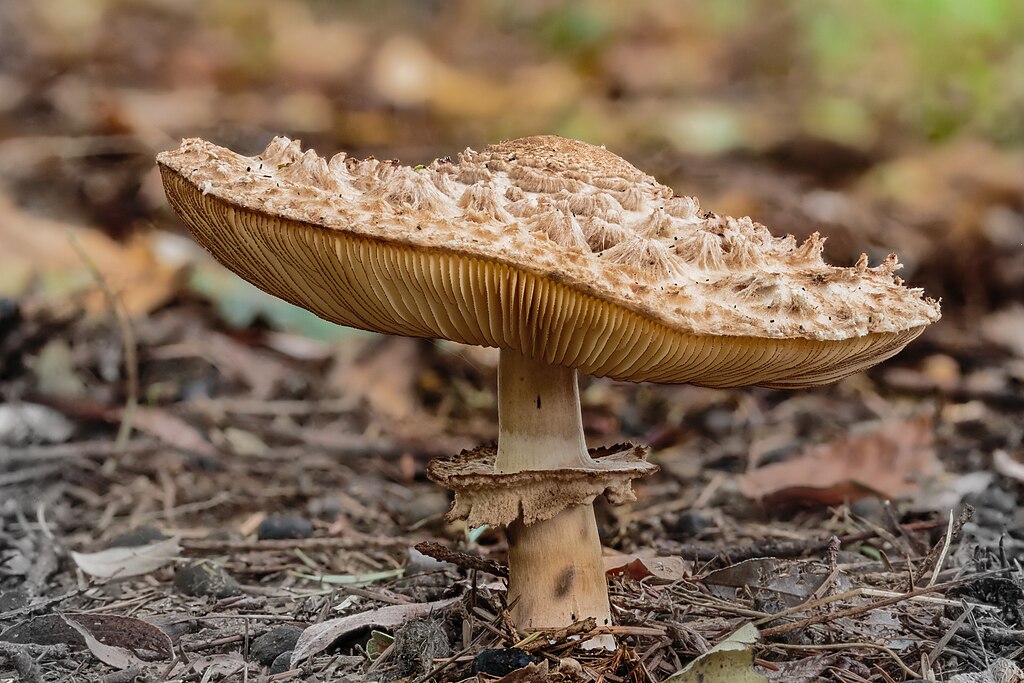
- 5–20 cm wide; initially ovoid or rounded, expanding to a flat-convex or nearly flat shape, sometimes with a broad central bump. The dry surface is covered in large, cinnamon-brown to dark brown fibrous scales that pull apart to reveal a pale, shaggy background, while the center remains solid brown.
- Stem
- 10–25 cm long and 1–3 cm thick; cylindrical and broadening toward a bulbous base. The surface is smooth and lacks the 'snakeskin' pattern of similar species. It is whitish to tan, bruising orange, reddish-brown, or dingy red when scraped or handled.
- Ring
- A prominent, thick, double-edged, membranous ring that can be moved up and down the stem.
- Gills
- Crowded and free from the stem; white to creamy, maturing to brownish-beige and staining reddish or orange-brown when bruised.
- Flesh
- White and soft, quickly turning orange or carmine-red when cut, eventually fading to a dull brown.
- Spore print
- White.
Sporecast is better in the app
Plan ahead with 10-day forecasts, see what people are finding nearby, get photo IDs, and track your finds.
Edibility
While considered a delicacy, this mushroom must be thoroughly cooked and should only be consumed in small quantities when fresh. It is known to cause severe gastrointestinal distress in some individuals, including those who have previously eaten it without issue, and some people may have an allergy to the entire genus. It can be confused with the poisonous green-gilled Chlorophyllum molybdites, as well as several similar edible and inedible species like Chlorophyllum brunneum, which features a more abrupt bulbous base.
Misidentification can be fatal. Never eat a mushroom unless you're 100% sure. This information may be inaccurate. Always consult multiple sources.
Nutrient Source
SaprotrophicIt obtains nutrients by decomposing dead organic matter found in the soil.
Common Names
- Catalan
- apagallums de cama blanca, galanpern, galanperna
- Danish
- Ægte rabarberhat
- Dutch
- Knolparasolzwam, Gewone knolparasolzwam
- English
- Shaggy Parasol
- French
- Lépiote déguenillée
- Norwegian Bokmål
- rødnende parasollsopp
- Norwegian Nynorsk
- raudnande parasollsopp
- Spanish
- parasol de carne rojiza, Apagador menor, apagallums de cama blanc, lepiota de carne enrojeciente, lepiota de carne enrojedida, paloma petita
- Swedish
- rodnande fjällskivling
Synonyms
- Agaricus rhacodes
- Lepiota rhacodes
- Lepiota rhacodes
- Lepiotophyllum rhacodes
- Leucocoprinus rhacodes
- Macrolepiota rhacodes