
Habitat
Found in leaf litter, mossy areas, and grass, most commonly beneath deciduous trees or in mixed evergreen forests. It frequently grows in rich redwood duff and occasionally on wood chip mulch. It appears on the ground, occurring either solitarily, in small groups, or in scattered troops.
Photos
Appearance
- Cap
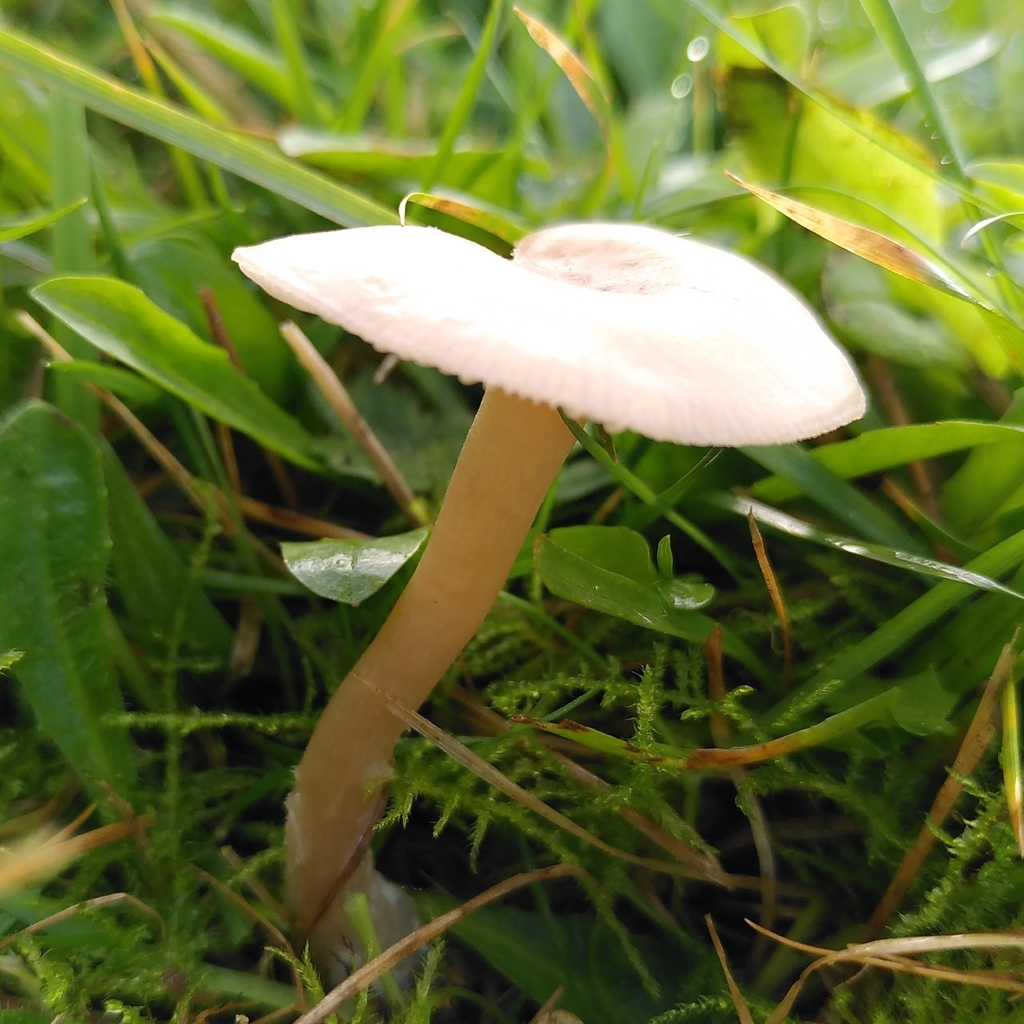
- 1.2–7 cm wide, convex to flattened, often developing a shallow central depression with age; the margin can be wavy, ruffled, or translucent-striate. The surface is smooth and slightly greasy to dry. It is hygrophanous, appearing pale yellowish-brown, tan, or pinkish-buff when moist and fading to whitish-cream when dry, often retaining a darker center.
- Stem
- 2–7.5 cm long and 2–8 mm thick, cylindrical and sometimes curved or slightly woolly at the base. The surface is smooth, slightly silky, or finely fibrillose. Color is similar to the cap or slightly paler, ranging from whitish to beige-tan.
- Gills
- Crowded to moderately spaced; attachment varies from adnexed or adnate to slightly decurrent. Color ranges from white to watery beige or pinkish-buff.
- Flesh
- Thin and watery, colored whitish to buff.
- Odor
- Strong and distinctive with a sweet, aniseed, or licorice-like fragrance.
- Taste
- Mild to slightly sweet.
- Spore print
- White, sometimes described with a slight pinkish or buff tint.
Sporecast is better in the app
Plan ahead with 10-day forecasts, see what people are finding nearby, get photo IDs, and track your finds.
Edibility
This mushroom is edible and sometimes used as a flavoring agent, though it is often advised to avoid it because it is easily confused with poisonous species or those of unknown edibility. It possesses a strong, sweet smell of aniseed or licorice, although this fragrance and the slightly sweet flavor do not appear to be retained after cooking. It is structurally similar to several other drab-colored mushrooms that lack the anise odor, and it is related to the larger, thicker-fleshed Clitocybe odora, which typically has blue-green or bluish tones.
Misidentification can be fatal. Never eat a mushroom unless you're 100% sure. This information may be inaccurate. Always consult multiple sources.
Nutrient Source
SaprotrophicIt is a saprotrophic fungus, meaning it obtains nutrients by decomposing dead organic matter, such as leaf litter and wood, found in its environment.
Common Names
- Dutch
- Slanke anijstrechterzwam
- English
- Fragrant Funnel
- Finnish
- anismalikka
- French
- Clitocybe anisé strié
- German
- Duft-Trichterling
- Norwegian Bokmål
- hvit anistraktsopp
- Norwegian Nynorsk
- kvit anistrektsopp
- Swedish
- dofttrattskivling
- Welsh
- Twmffat/Twndish Peraroglus
Synonyms
- Agaricus fragrans
- Agaricus fragrans
- Agaricus obsoletus
- Clitocybe deceptiva
- Clitocybe depauperata
- Clitocybe fragrans
- Lepista fragrans
- Omphalia fragrans
- Pseudolyophyllum fragrans