
Habitat
This common and widespread mushroom grows on the ground in soil, leaf litter, and forest duff. It is found in both deciduous and coniferous woodlands, including redwood forests and low-elevation maple-alder-cedar stands. The species typically grows in small groups, troops, large rings, or arcs, and is occasionally found solitary.
Photos
Appearance
- Cap
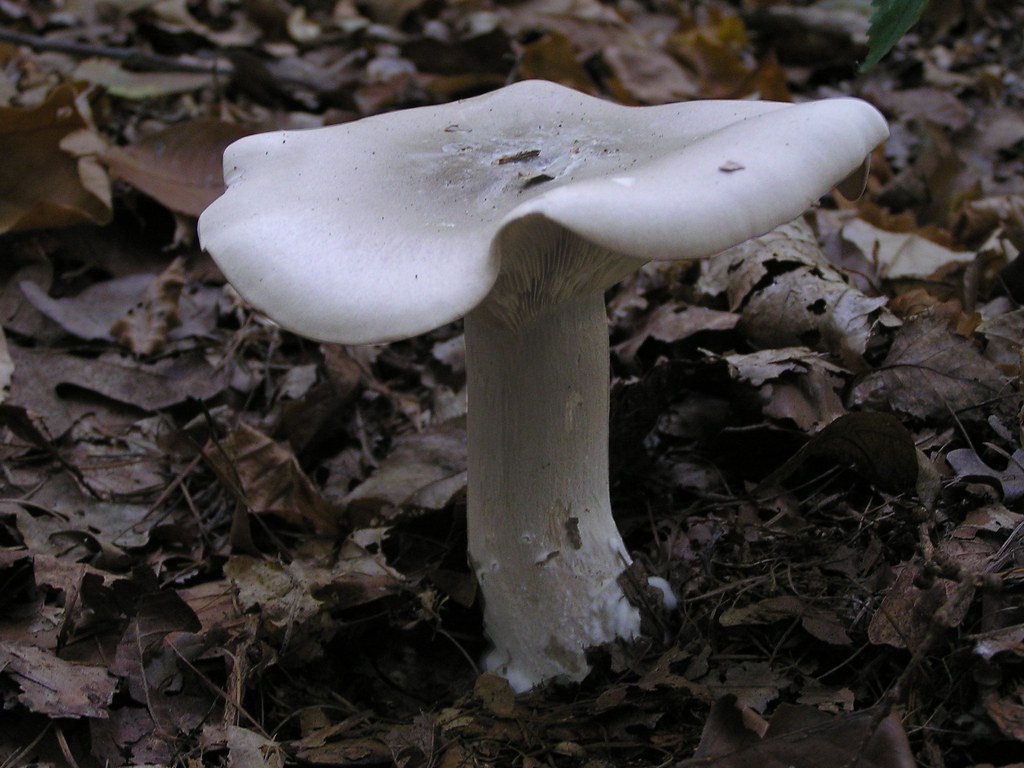
- 5–20 cm across; initially convex with an inrolled margin, becoming flattened, slightly depressed, or occasionally wavy and uplifted with age. Surface is cloudy grey, brownish-grey, or greyish-white, often covered in a fine white bloom or moldy-looking fuzz. May feature dark greyish spots or streaks near the margin.
- Stem
- 50–150 mm long by 15–40 mm thick; stout and fibrous, often tapering upwards or swollen/bulbous at the base. Color is white to pale grey or tan, sometimes with darker scales at the top and white woolly mycelium at the base. Becomes hollow and brittle with age.
- Gills
- Crowded to moderately spaced; attached to slightly decurrent. Color ranges from white to pale cream, maturing to a dingy beige, tan, or yellowish-grey.
- Flesh
- Thick, white, and unchanging; fibrous-fleshy in texture.
- Odor
- Strong and highly distinctive; described variously as sweet and fruity, cheesy (like ripe Brie), or unpleasant and musky (resembling skunk, swamp gas, or rancid flour).
- Spore print
- White to pale cream or pale yellow.
Sporecast is better in the app
Plan ahead with 10-day forecasts, see what people are finding nearby, get photo IDs, and track your finds.
Edibility
The edibility of this mushroom is disputed; while some rate it as good when young, it is known to cause gastric upset in many people and allergic reactions in others. It contains an adenosine-like compound called nebularin, which may contribute to its inconsistent reputation for safety. The flavor and odor are strong and distinctive, variously described as sweet, fruity, and cheesy like Brie, or more unpleasantly as musty, skunky, or rancid. It can be confused with the poisonous Livid Pinkgill (Entoloma sinuatum), though that lookalike has pinkish gills and spores and lacks the decurrent gill attachment.
Misidentification can be fatal. Never eat a mushroom unless you're 100% sure. This information may be inaccurate. Always consult multiple sources.
Nutrient Source
SaprotrophicIt obtains nutrients by breaking down dead organic matter in the soil, such as fallen leaves and twigs.
Common Names
- Danish
- Tåge-tragthat
- Dutch
- Nevelzwam
- English
- Clouded Funnel, Clouded Agaric
- Finnish
- härmämalikka
- French
- Clitocybe nébuleux
- German
- Graukappe, Nebeltrichterling
- Norwegian Bokmål
- puddertraktsopp
- Norwegian Nynorsk
- puddertrektsopp
- Swedish
- pudrad trattskivling
- Welsh
- Twmffat/Twndish Niwl
Synonyms
- Agaricus nebularis
- Clitocybe alba
- Clitocybe nebularis
- Clitocybe stenophylla
- Gymnopus nebularis
- Lepista nebularis
- Omphalia nebularis