
Habitat
This mushroom is typically found in woodland leaf litter or soil, appearing in small groups, troops, or arcs. It is most commonly associated with broad-leaved trees such as beech, oak, tanoak, and birch, though it occasionally occurs under conifers. The species thrives in deep, moist duff and is widespread in temperate regions.
Photos
Appearance
- Cap
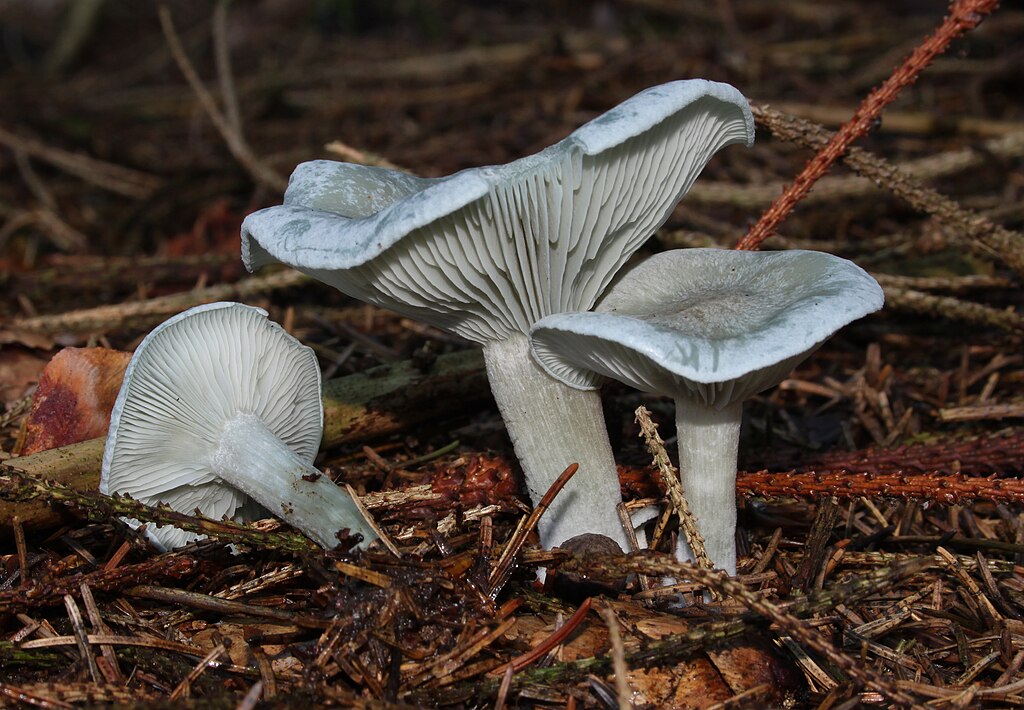
- 2–10 cm across; initially convex with an inrolled margin, expanding to become flat, irregular, or slightly depressed with a wavy edge. Color ranges from shades of blue-green, turquoise, and sky blue to grayish or olive-gray, sometimes fading to tan or whitish.
- Stem
- 2.5–7 cm long and 5–20 mm thick; cylindrical or slightly swollen at the base. Color is whitish or flushed with the cap color (pale blue or gray), often with a white, woolly base and silky texture.
- Gills
- Adnate to slightly decurrent; off-white, pale gray, or tinged with the blue-green cap color. Spacing can be crowded to somewhat distant.
- Flesh
- White, pale tan, or light grayish-blue; thin to moderately thick and sometimes tough.
- Spore print
- White to creamy off-white.
- Odor and Taste
- Strongly aromatic, smelling and tasting of aniseed or fennel, though the scent may fade after picking.
Sporecast is better in the app
Plan ahead with 10-day forecasts, see what people are finding nearby, get photo IDs, and track your finds.
Edibility
Possessing a potent aniseed aroma that fades after harvest, this mushroom is often used as a powdered flavoring or sauce ingredient rather than a primary dish. While generally considered edible, some European references list it as toxic without clear cause, and its floury or sweet scent may not persist through cooking. Potential lookalikes include the slimy blue Stropharia species, several rare anise-scented funnels, and the white Fragrant Funnel (Clitocybe fragrans).
Misidentification can be fatal. Never eat a mushroom unless you're 100% sure. This information may be inaccurate. Always consult multiple sources.
Nutrient Source
SaprotrophicIt obtains nutrients by decomposing dead plant material, such as leaf litter found on the ground.
Common Names
- Dutch
- Groene anijstrechterzwam
- English
- Aniseed Funnel, Aniseed Toadstool
- Finnish
- vihertuoksumalikka
- French
- Clitocybe odorant
- German
- Grüner Anis-Trichterling
- Norwegian Bokmål
- grønn anistraktsopp
- Norwegian Nynorsk
- grøn anistrektsopp
- Swedish
- grön trattskivling
- Ukrainian
- Говорушка анісова
- Welsh
- Twmffat/Twndish Anis
Synonyms
- Agaricus anisatus
- Agaricus moschatus
- Agaricus odorus
- Agaricus trogii
- Agaricus virens
- Agaricus viridis
- Clitocybe trogii
- Clitocybe virens
- Clitocybe viridis
- Gymnopus anisatus
- Gymnopus odorus
- Lepista odora
- Mycena virens
- Omphalia viridis
- Rubeolarius odorus