
Habitat
This species is found on the ground in forest duff, humus, or grassy areas within open woodlands and forests. It inhabits both hardwood and coniferous settings, including coastal pine, fir-hemlock, and spruce stands. It frequently fruits in close proximity to or directly in the same spot as boletes, particularly King Boletes (Porcini), and is suspected of having a parasitic or symbiotic relationship with them. While typically found in wooded areas, it can also occur in grass near trees, though it does not grow in rings.
Photos
Appearance
- Cap
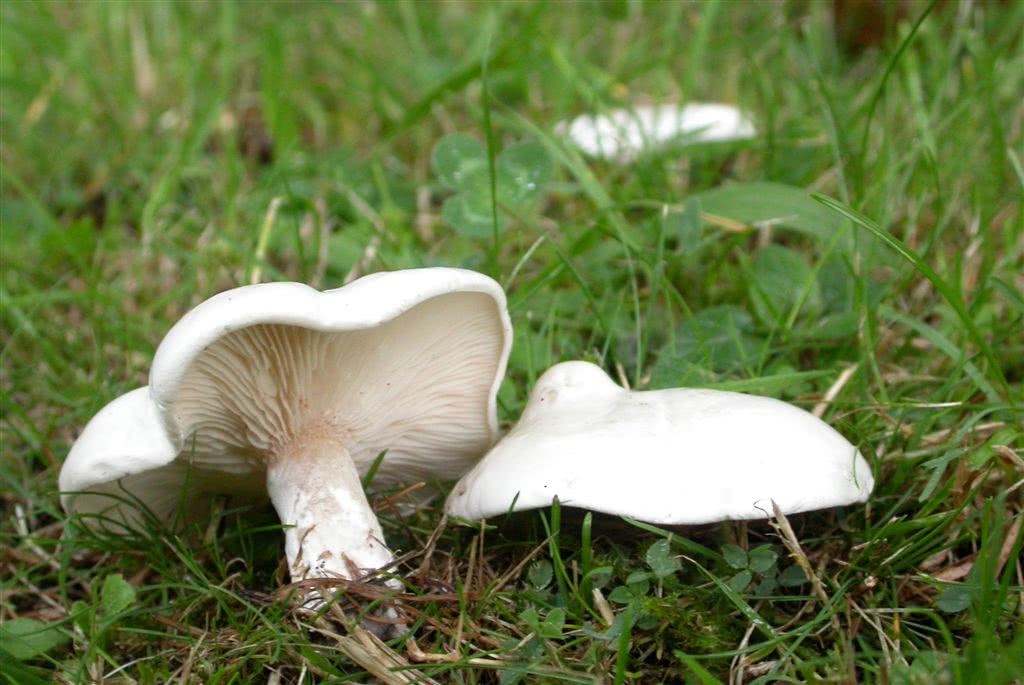
- 3–10 cm wide; first convex, then flattening or becoming irregularly depressed and wavy; typically white to pale gray, grayish tan, or cream; dry, with a distinctive texture like soft kid leather or chamois cloth; often covered in a dusty white bloom when young.
- Stem
- 2–8 cm long, 0.4–2 cm thick; often positioned off-center; white to dingy gray, matching the cap; equal or tapering toward the base; surface may be smooth or finely downy, sometimes with a white fuzzy base.
- Gills
- Decurrent and crowded; initially white or pallid, gradually maturing to a fleshy pink or pinkish tan.
- Flesh
- White and unchanging; soft, fragile, and fibrillose.
- Spore print
- Pink, salmon-pink, or dingy pinkish tan.
- Odor and Taste
- Strongly farinaceous, resembling the smell of fresh flour, wet dough, or cucumber rind.
Sporecast is better in the app
Plan ahead with 10-day forecasts, see what people are finding nearby, get photo IDs, and track your finds.
Edibility
Extreme caution is required as this mushroom is easily confused with the deadly Fool's Funnel (Clitocybe rivulosa/dealbata), which also has a mealy smell but produces a white or pale buff spore print and typically grows in rings on grass. Other toxic lookalikes include the Frosty Funnel, the White Fibrecap, and Livid Pinkgills. It is distinguished by its strong mealy scent resembling wet flour or cucumber, its fragile texture, and its longitudinally ridged pink spores. This species is often found near King Boletes and retains its mealy flavor and firm texture when cooked, though the odor diminishes during preparation.
Misidentification can be fatal. Never eat a mushroom unless you're 100% sure. This information may be inaccurate. Always consult multiple sources.
Nutrient Source
SaprotrophicIt obtains nutrients by breaking down dead organic matter in soil and leaf litter.
Common Names
- Basque
- errotari, moixernó blanc
- Catalan
- moixernó blanc
- Dutch
- Grote molenaar
- English
- The Miller, Miller
- Finnish
- jauhosieni
- French
- Garde-cèpe, Langue de carpe, Clitopile pruineux, Clitopile petite prune, Meunier, Mère de cèpe
- German
- Mehlräsling
- Norwegian Bokmål
- melsopp
- Norwegian Nynorsk
- mjølsopp
- Spanish
- harinera, Molinera, mojardon, mucerón, mojardón, bujardón
- Swedish
- gråvit mjölskivling, Mjölskivling
- Welsh
- Cap Melinydd
Synonyms
- Agaricus orcella
- Agaricus prunulus
- Clitopilus orcella
- Hexajuga orcella
- Hexajuga prunula
- Hyporrhodius orcella
- Hyporrhodius prunulus
- Omphalia prunula
- Orcella prunulus
- Paxillopsis prunulus
- Paxillus prunulus
- Paxillus prunulus
- Paxillus prunulus
- Pleuropus orcellus
- Pleuropus prunulus
- Pleurotus prunulus
- Rhodosporus prunulus