
Habitat
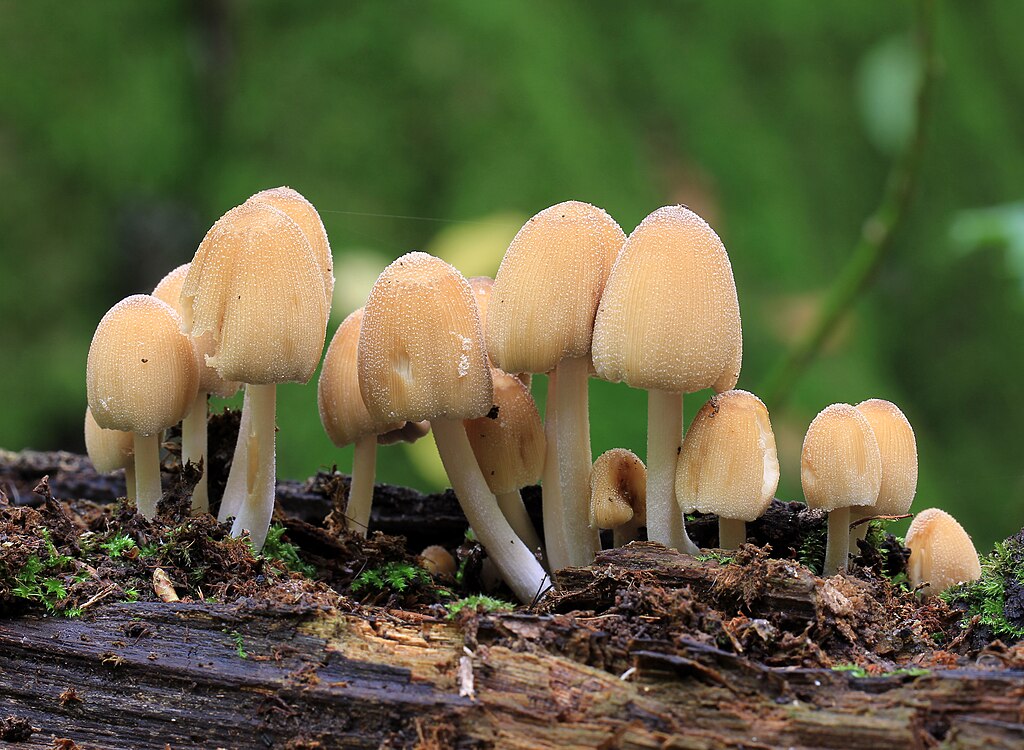
This common wood-decomposing species is typically found in dense clusters or large tufts on or around stumps, rotted logs, and standing dead or dying trees. It is most frequently associated with broad-leaved (hardwood) trees, though it occasionally occurs with conifers. It often appears to grow directly from the ground when emerging from buried roots or woody debris. Its habitat include both natural forests and urban environments, such as lawns and areas rich in bark mulch. It has also been identified as an endophyte living within the wood of living trees like paper mulberry and common hackberry.
Photos
Appearance
- Cap
- 1–5 cm wide and up to 4 cm high; initially egg-shaped or oval, expanding to bell-shaped or convex. The surface is ochraceous, honey-brown, or cinnamon, often paling toward the margin and turning gray or black with age. It is deeply grooved or pleated from the margin toward the center. When young, it is covered in fine, glistening, mica-like white granules that can be washed away by rain.
- Stem
- 3–10 cm long and 2–6 mm thick; white to pale buff, sometimes discoloring toward the base. It is fragile, hollow, and slender. The surface is initially covered in fine bristles or hairs but usually becomes smooth and shiny with age.
- Gills
- Crowded and narrowly attached to the stem or nearly free. Initially white or creamy buff, they transition through date-brown or purple-brown to black before deliquescing into an inky liquid.
- Flesh
- Very thin, soft, and fragile; white to pale yellow-brown with no distinctive smell or taste.
- Spore print
- Black or very dark date-brown.
Sporecast is better in the app
Plan ahead with 10-day forecasts, see what people are finding nearby, get photo IDs, and track your finds.
Edibility
This mushroom is edible but extremely fragile and practically fleshless; it often turns into a mush when cooked and is better suited for gravies or sauces. While it can be eaten raw, it is best harvested when young and the gills are still white before they deliquesce into black ink. It is a known bioaccumulator of heavy metals, so avoid picking in contaminated areas. It can be confused with the larger Common Inkcap (Coprinopsis atramentaria), but unlike that species, it does not cause adverse reactions with alcohol.
Misidentification can be fatal. Never eat a mushroom unless you're 100% sure. This information may be inaccurate. Always consult multiple sources.
Nutrient Source
SaprotrophicIt obtains nutrients by breaking down and absorbing dead organic matter, such as decaying wood or roots from trees and other plants.
Common Names
- Basque
- urbeltz mikadun, urbeltz mikaduna
- Catalan
- pixacà micaci, pixacá micaci, bolet de fermer micaci
- Danish
- Glimmer-blækhat
- Dutch
- gewone glimmerinktzwam, Gewone glimmerinktzwam
- English
- Mica Cap, Glistening Ink-Cap, Glistening Inkcap
- Finnish
- kiillemustesieni
- French
- Coprin micacé
- German
- Glimmertintling
- Norwegian Bokmål
- glimmerblekksopp
- Norwegian Nynorsk
- glimmerblekksopp
- Spanish
- coprino micado, Coprino micáceo
- Swedish
- glitterbläcksvamp
- Welsh
- Cap Inc Gloyw
Synonyms
- Agaricus micaceus
- Agaricus micaceus
- Coprinopsis micaceus
- Coprinus micaceus — Glistening Inkcap