
Habitat
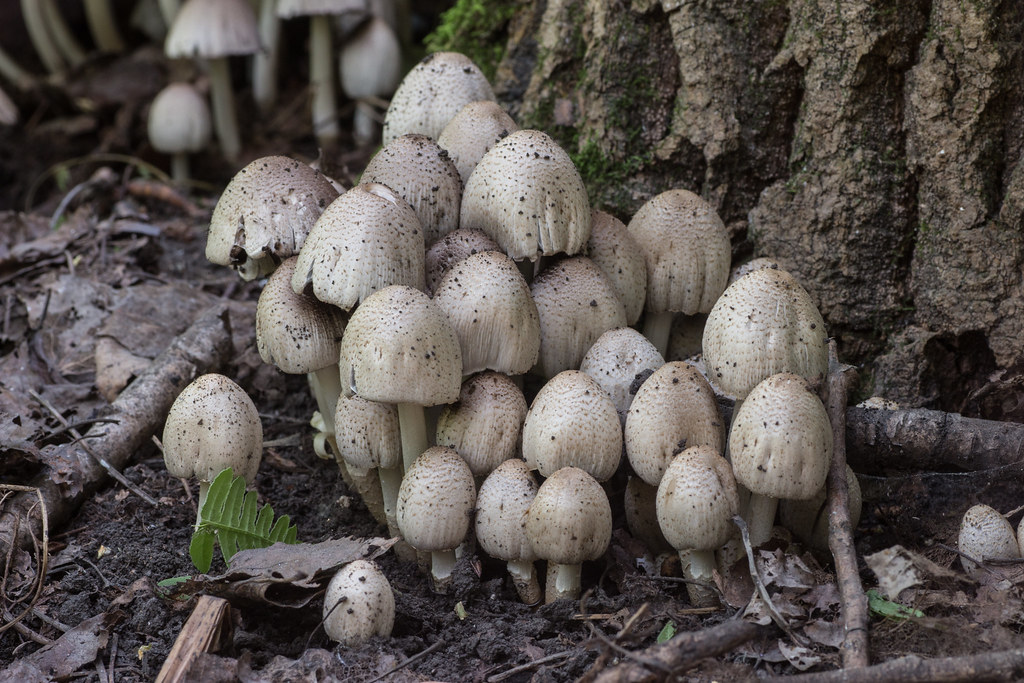
This wood-decomposing species is typically found on or near broad-leaved trees, stumps, and dead roots. It frequently appears to be growing directly from the soil or in grassy lawns, but it is actually associated with buried woody debris or twigs. It is widespread across natural and disturbed environments, commonly occurring in urban settings such as gardens, parks, roadsides, and mulched areas. Growth is usually clustered in dense groups or tufts, though it occasionally appears singly.
Photos
Appearance
- Cap
- 3–8 cm across; initially egg-shaped or ovoid, maturing to conical or bell-shaped, and eventually flattening with an upturned or split edge. The surface is silvery-gray to gray-brown, smooth to finely silky or wrinkled, often with small brownish scales at the center. The margin is frequently ribbed or pleated and liquefies into black ink as it matures.
- Gills
- Crowded and free from the stem; initially white, turning gray, then black, before dissolving into a black liquid.
- Stem
- 7–18 cm long and 0.3–2 cm thick; cylindrical and hollow. The surface is dry, white, and smooth, often featuring a small fibrous ridge or ring-like mark near the base, which may have brownish scales.
- Flesh
- Thin, fragile, and white to grayish; the stem flesh is white.
- Spore print
- Black to brownish-black.
- Odor and Taste
- Indistinct or pleasant.
Sporecast is better in the app
Plan ahead with 10-day forecasts, see what people are finding nearby, get photo IDs, and track your finds.
Edibility
Eating this mushroom while or within several days of consuming alcohol causes coprine poisoning, characterized by intense headaches, nausea, flushing, sweating, light-headedness, and tingling in the extremities; severe cases may involve low blood pressure or fainting. To ensure quality, specimens should be collected while immature before the white gills begin to liquefy into black ink. It has a mild, pleasant, or rich mushroomy flavor, though some recent research suggests it may contain carcinogens or impact male fertility. Lookalikes include the larger, shaggier Coprinus comatus, while smaller similar inkcaps such as Coprinopsis alopecius, C. acuminata, and C. romagnesiana should be treated with the same caution regarding alcohol.
Misidentification can be fatal. Never eat a mushroom unless you're 100% sure. This information may be inaccurate. Always consult multiple sources.
Nutrient Source
SaprotrophicIt obtains nutrients by breaking down dead organic material, such as decaying wood or leaf litter.
Common Names
- Basque
- urbeltz gorritzaile, ur beltz, urbeltz
- Catalan
- pixacà negre, pixacá negre, bolet de femer
- Danish
- Almindelig blækhat
- Dutch
- Grote kale inktzwam, grote kale inktzwam
- English
- Common Ink Cap, Common Ink-Cap, Common Inkcap
- Finnish
- harmaamustesieni
- French
- Coprin noir d'encre
- German
- Faltentintling
- Northern Sami
- leahkkaguoppar
- Norwegian Bokmål
- grå blekksopp
- Norwegian Nynorsk
- grå blekksopp
- Spanish
- Coprino entintado, mataparientes, coprino estintad, Coprino antialcohólico
- Swedish
- grå bläcksvamp
- Welsh
- Cap Inc
Synonyms
- Agaricus atramentarius
- Agaricus atramentarius
- Agaricus fuscescens
- Agaricus luridus
- Agaricus plicatus
- Agaricus sobolifer
- Coprinus atramentarius — Common Inkcap
- Coprinus fuscescens
- Coprinus luridus
- Coprinus plicatus
- Coprinus plicatus
- Coprinus sobolifer
- Coprinus soboliferus
- Hypophyllum atramentarium
- Pselliophora atramentaria
- Pselliophora atramentaria
- Pselliophora sobolifera