
Habitat
This common decomposer is most frequently found in areas of human activity and recently disturbed soil. It prefers grassy areas such as lawns and pastures, as well as roadsides, path edges, gravel parking lots, and garden beds. It also frequently grows in wood chips, mulch, and compost heaps. While most common in urban and suburban environments, it is occasionally found in open forests. It typically fruits in groups, dense troops, or fairy rings.
Photos
Appearance
- Cap
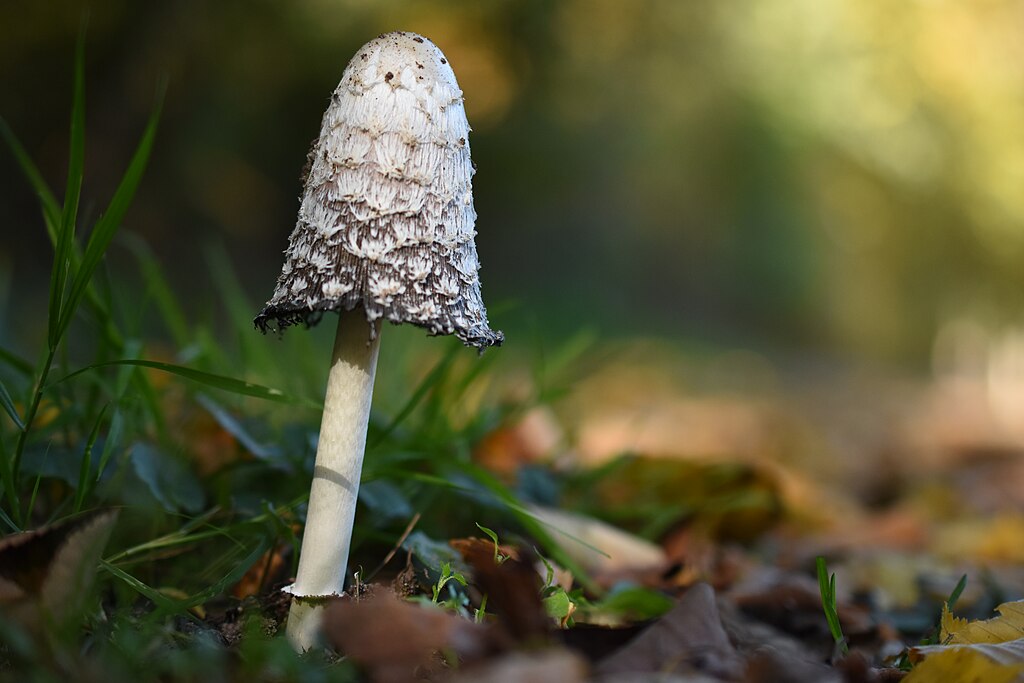
- 5–15 cm high; initially egg-shaped or cylindrical, expanding to conical or bell-shaped with an upturned, ragged margin. The surface is white with a tan or brownish center, covered in coarse, shaggy, brownish-tipped scales that do not easily brush off. The edges eventually dissolve into a black, inky liquid.
- Stem
- 10–40 cm long, 1–2.5 cm thick; tall, white, and cylindrical with a slightly bulbous or rooting base. It is hollow and contains a distinct, string-like fiber running through the center.
- Gills
- Free from the stem and extremely crowded. They start white, change to pink or vinaceous, then turn black and liquefy (deliquesce) from the bottom edge upward.
- Flesh
- Thin, soft, and white with a stringy texture. It has a faint, pleasant smell and a mild taste.
- Ring
- White, thin, and membranous; it is loose and often slides down the stem to rest near the base or falls off entirely.
- Spore print
- Blackish-brown to sooty black.
Sporecast is better in the app
Plan ahead with 10-day forecasts, see what people are finding nearby, get photo IDs, and track your finds.
Edibility
Gather this mushroom when young while the gills are still white; once the gills turn pink or black and begin to liquefy, it is past its prime, though the resulting black ink is sometimes used as a food colorant. Because it is a known bioaccumulator of heavy metals and pesticides, specimens should only be collected from areas free of pollutants. To prevent the mushroom from quickly dissolving after harvest, cook it the same day or store it in salt water and refrigerate. While unique in appearance, it should be distinguished from Coprinopsis atramentaria, which has a smoother gray cap and causes illness when consumed with alcohol.
Misidentification can be fatal. Never eat a mushroom unless you're 100% sure. This information may be inaccurate. Always consult multiple sources.
Nutrient Source
SaprotrophicThis species obtains nutrients by decomposing dead organic matter, such as grass and decaying plant material, in soil and leaf litter.
Common Names
- Basque
- urbeltz, urbeltz galparduna, urbeltz galpardun
- Catalan
- pixacà barbut, pixac barbut, bolet de tinta
- Danish
- Stor parykhat
- Dutch
- Geschubde inktzwam
- English
- Shaggy Ink Cap, Shaggy Ink-Cap, Lawyer's Wig, Shaggy Inkcap, Shaggy Mane
- Finnish
- suomumustesieni
- French
- Coprin chevelu
- German
- Schopftintling
- Norwegian Bokmål
- matblekksopp
- Norwegian Nynorsk
- matblekksopp
- Spanish
- Barbuda, matacandil, coprino barbudo, apagador
- Swedish
- Fjällig Bläcksvamp
- Welsh
- Cap Inc Aflêr
Synonyms
- Agaricus comatus
- Agaricus comatus
- Agaricus cylindricus
- Agaricus cylindricus
- Agaricus fimetarius
- Agaricus ovatus
- Agaricus ovatus
- Coprinus clavatus
- Coprinus comatus
- Coprinus ovatus
- Oncopus comatus
- Pselliophora comata
- Pselliophora ovata