
Habitat
This species grows in moist, cool coniferous and mixed forests, particularly on acidic or sandy soils. It is frequently found among mosses (including sphagnum), heather, and bilberry, often appearing near pine or spruce. It develops on the ground in duff or moss, but occasionally fruits on moss-covered decaying logs and stumps. It typically grows solo, in small groups, or in tufted clusters.
Photos
Appearance
- Cap
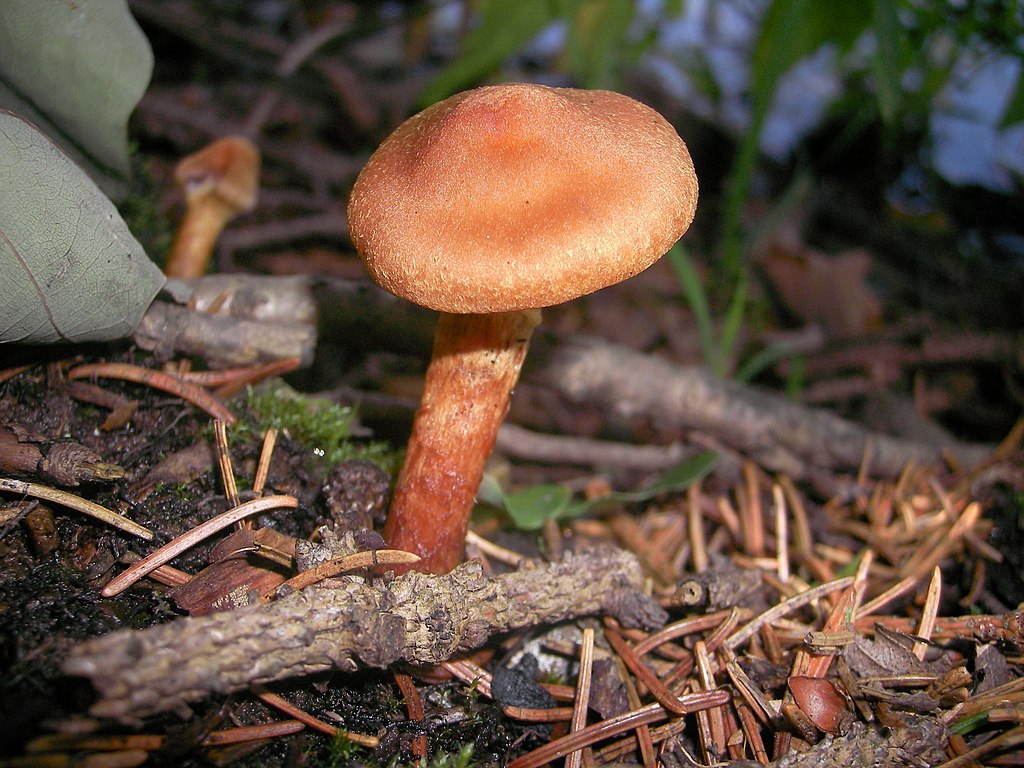
- 2.5–8 cm across; initially conical or bell-shaped, maturing to convex or flat with a prominent central bump; surface is dry, finely velvety to scaly, and reddish-brown to orange-brown.
- Stem
- 3–10 cm long and 1–1.8 cm thick; cylindrical to spindle-shaped, sometimes tapering to a point at the base; surface is fibrous, pale ocher to orange-brown, and may feature yellowish woolly patches or bands from the veil.
- Gills
- Fairly distant and well-spaced; attached to the stem with a notch; color progresses from yellowish-ochre to reddish-brown or rusty brown as spores mature.
- Flesh
- Yellowish-ochre to pale tan; thin in the cap and fibrous in the stem; may develop rusty stains with age.
- Spore print
- Rusty brown to reddish-brown.
- Smell
- Distinctly radish-like.
Sporecast is better in the app
Plan ahead with 10-day forecasts, see what people are finding nearby, get photo IDs, and track your finds.
Edibility
This species is remarkably dangerous and potentially fatal due to the presence of orellanine, a toxin that causes kidney failure. Symptoms like vomiting, stomach pain, muscle aches, and headaches are slow to develop, appearing anywhere from 2 to 14 days after consumption. It can be confused with various similar-looking webcaps such as Cortinarius gentilis, C. kroegeri, C. infucatus, or C. limonius.
Misidentification can be fatal. Never eat a mushroom unless you're 100% sure. This information may be inaccurate. Always consult multiple sources.
Nutrient Source
EctomycorrhizalThis mushroom forms a symbiotic relationship with trees, exchanging nutrients with their root systems.
Common Names
- Danish
- spidspuklet gift-slørhat, Puklet gift-slørhat
- Dutch
- fraaie gifgordijnzwam, Fraaie gifgordijnzwam
- English
- Deadly Webcap
- Finnish
- suippumyrkkyseitikki
- French
- Cortinaire roux
- German
- Spitzgebuckelter Rauhkopf
- Norwegian Bokmål
- spiss giftslørsopp
- Norwegian Nynorsk
- spiss giftslørsopp
- Swedish
- toppig spindelskivling, toppig giftspindelskivling, toppig giftspindling
- Welsh
- Cap Gweog Marwol
Synonyms
- Cortinarius orellanoides
- Cortinarius speciosissimus — Deadly Webcap
- Cortinarius speciosus
- Dermocybe orellanoides
- Telamonia rubella
- Telamonia rubella