
Habitat
Woodland
This species grows in soil within broad-leaved woodlands, showing a strong preference for old-growth beech forests. It typically appears in small groups, forming rows or tight clusters.
Photos
Appearance
- Cap
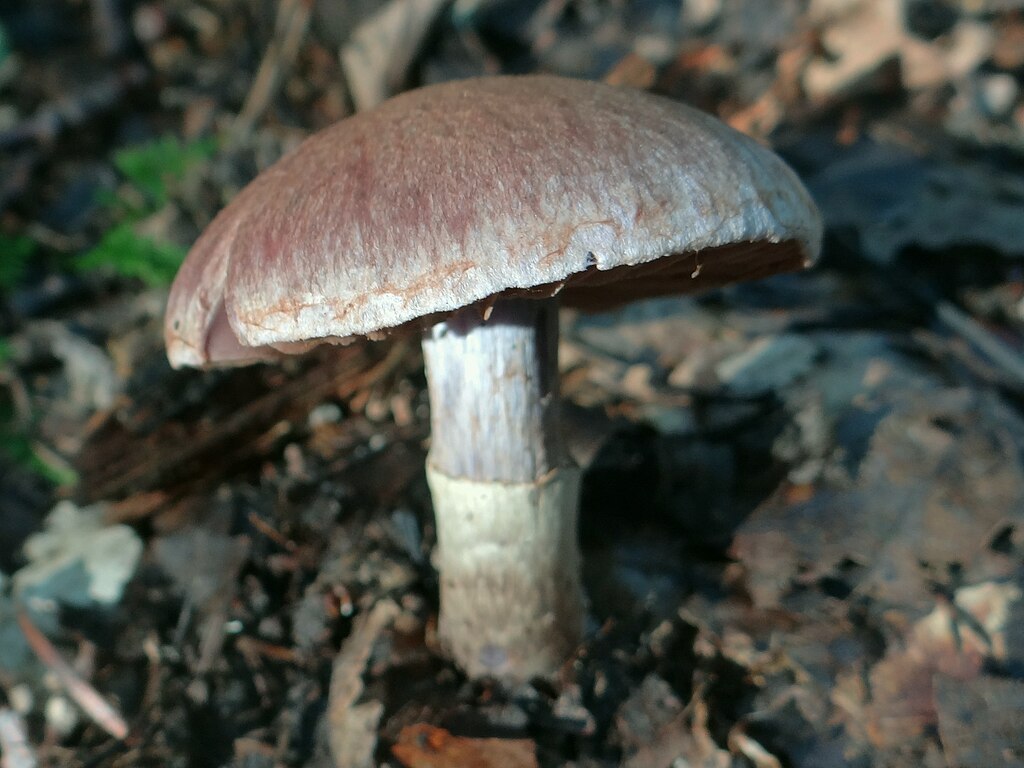
- Measuring 3 to 10 cm across, starting hemispherical to convex and becoming flatter with a slight central bump. The surface is initially smooth but becomes finely scaly or marbled, and the color fades as it dries. The edge remains rolled inward for a long time.
- Stem
- 4 to 9 cm long, varying from equal width to tapering downward with a slightly swollen base. It is dry and fibrous, featuring a significant white veil that forms irregular bands and a persistent, sheath-like ring.
- Gills
- Widely spaced and attached to the stem with a small notch and a slight downward tooth. Color transitions from a violet-buff to reddish-brown.
- Flesh
- Cream to buff colored, often showing a violet tint particularly at the top of the stem.
- Spore print
- Dark brown.
Sporecast is better in the app
Plan ahead with 10-day forecasts, see what people are finding nearby, get photo IDs, and track your finds.
Edibility
Not edible
This species has a strong, unpleasant, sweet scent of camphor and a faint but disagreeable taste.
Misidentification can be fatal. Never eat a mushroom unless you're 100% sure. This information may be inaccurate. Always consult multiple sources.
Nutrient Source
EctomycorrhizalIt forms a symbiotic relationship with trees, exchanging nutrients by connecting to their root systems.
Common Names
- Danish
- Champignonagtig slørhat
- Dutch
- Gelaarsde gordijnzwam
- English
- Stocking Webcap
- Finnish
- sukkaseitikki
- French
- Cortinaire farouche
- Norwegian Bokmål
- bøkeringslørsopp
- Norwegian Nynorsk
- bøkeringslørsopp
- Swedish
- strumpspindling
- Welsh
- Cap Gweog Hosan
Synonyms
- Agaricus torvus
- Agaricus torvus
- Cortinarius subamethysteus
- Cortinarius torvovelatus
- Gomphos torvus
- Hydrocybe torva
- Telamonia torva
- Telamonia torva