
Habitat
This species grows on the ground in leaf litter or humus within deciduous and broad-leaved woodlands, as well as conifer forests. It is frequently found in old beech woods, especially on acidic sites or slopes. Often associated with mosses, it typically fruits in large groups, clusters, or troops.
Photos
Appearance
- Fruit body
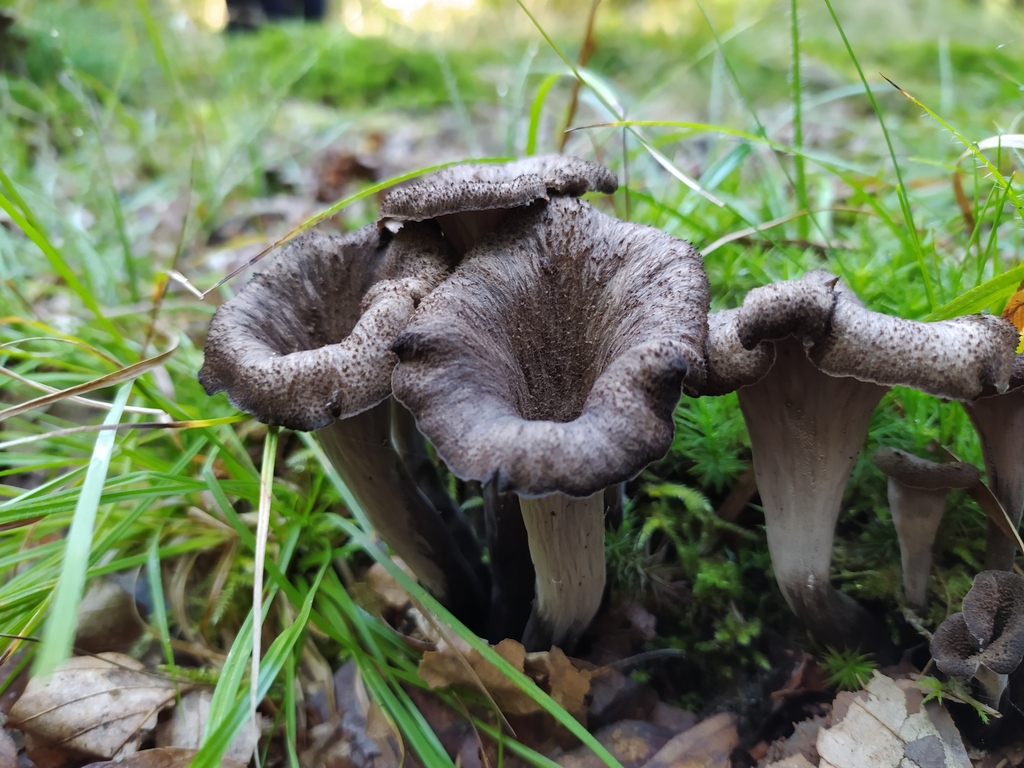
- Funnel-shaped to tubular or trumpet-like, measuring 2–15 cm tall. The overall structure is hollow to the base and often has an irregularly wavy, crisped, or grooved margin.
- Cap
- Deeply depressed or hollow in the center, 2–10 cm across. The inner surface is dark brown to black and can be finely scaly or scurfy; it dries to a paler grayish-brown.
- Spore-bearing surface
- Located on the exterior of the funnel; it is initially smooth but becomes undulating, wavy, or shallowly wrinkled with age. Color ranges from ashy gray to gray-black, sometimes developing salmon, orange, or yellowish tints as it matures.
- Stem
- Generally absent or not distinct from the rest of the fruit body; the narrowed lower portion is often dark brown to black.
- Flesh
- Thin, grayish, and range from tough or leathery to fibrous.
- Spore print
- Variable, ranging from white to pale brown, ochraceous orange, or buff.
Sporecast is better in the app
Plan ahead with 10-day forecasts, see what people are finding nearby, get photo IDs, and track your finds.
Edibility
The flavor is mild with a pleasant, fruity aroma, though the scent can become unpleasant as the mushroom ages. The texture is thin, leathery, or somewhat fibrous, and fruit bodies should be split open and cleaned thoroughly to remove hidden debris or insects. While visually distinct, beginners may mistake it for decomposing blackening brittlegills, and it should be distinguished from smaller, similar species like Pseudocraterellus calyculus or Craterellus dubius.
Misidentification can be fatal. Never eat a mushroom unless you're 100% sure. This information may be inaccurate. Always consult multiple sources.
Nutrient Source
EctomycorrhizalIt is ectomycorrhizal, meaning it forms a symbiotic relationship with trees, exchanging nutrients with them through its fungal network.
Common Names
- Basque
- saltsa-perretxiko beltza, saltsa-perretxiko beltz, saltsa-perretxiko belz
- Catalan
- trompetes, rossinyols negres, trompeta, trompet
- Danish
- Trompetsvamp
- Dutch
- Hoorn-van-overvloed
- English
- Black Trumpet, Horn Of Plenty
- Finnish
- Mustatorvisieni
- French
- Trompette jaune, Trompette de la Mort, Trompette des morts
- Georgian
- Dzabra Soko
- German
- Totentrompete
- Italian
- Trombetta dei Morti
- Latvian
- Rudens Taurene
- Norwegian
- fyllhorn, svarthorn
- Norwegian Bokmål
- svart trompetsopp
- Norwegian Nynorsk
- svart trompetsopp
- Polish
- Lejkowiec Dęty
- Slovak
- Lievik Trúbkovitý
- Spanish
- Trompeta de los muertos, Cuerno de la abundancia, negritos, trompeta
- Swedish
- svart trumpetsvamp
- Welsh
- Corn Llawnder
Synonyms
- Agaricus cinereus
- Cantharellus cornucopiae
- Cantharellus cornucopioides
- Cantharellus cornucopioides
- Cantharellus konradii
- Craterella cornucopioides
- Craterella nigrescens
- Craterellus fallax — Black Trumpet
- Craterellus konradii
- Craterellus ochrosporus
- Dendrosarcus cornucopioides
- Helvella cornucopioides
- Helvella cornucopioides
- Helvella punctata
- Merulius cornucopioides
- Merulius cornucopioides
- Merulius pezizoides
- Merulius purpureus
- Octospora cornucopioides
- Pezicula cornucopioides
- Peziza cornucopioides
- Pleurotus cornucopioides
- Sterbeeckia cornucopioides
- Trombetta cornucopioides