
Habitat
This species is found in large, gregarious clusters or tufted groups growing on a wide variety of organic debris. It primarily colonizes woody materials such as twigs, dead branches, fallen logs, sticks, bark, and wood chip mulch. It also grows on herbaceous plant stems, nut shells, and vegetable remains. While most common on wood, it occasionally occurs on rich soil, compost, or manure, but is generally absent from large logs. Typical locations include woodlands, gardens, parks, and dunes.
Photos
Appearance
- Fruit body
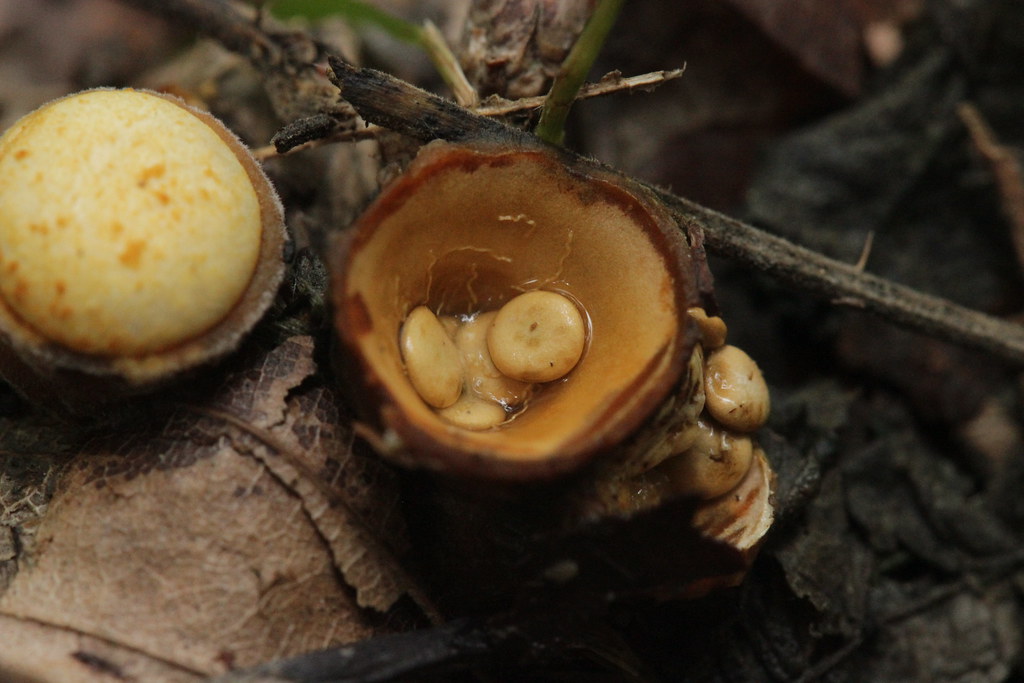
- Small bird's nest-shaped fungus, 3–12 mm high and 4–10 mm wide. Initially globose or cylindrical, becoming deeply cup-shaped as it matures. The structure is sessile and tough.
- Outer surface
- Yellowish to cinnamon-brown or ochraceous. The texture is velvety, shaggy, or scurfy when young, often becoming smoother with age.
- Inner surface
- Smooth and shiny; colored whitish, silvery-gray, pale beige, or light brown. The interior walls are not grooved.
- Lid
- A hairy or velvety membrane (epiphragm) covering the top of the young fruit body. It is yellowish-orange to ochraceous, eventually rupturing and sloughing off to reveal the eggs.
- Eggs
- Lens-shaped or flattened circular discs (peridioles), 1–2 mm in diameter. They are dirty white to cream-buff or pale gray. Multiple eggs (up to 15) are found in each cup, each attached to the inner wall by a thin, white, elastic cord, sometimes showing a nipple-like bump at the attachment point.
- Spore print
- White to yellowish.
Sporecast is better in the app
Plan ahead with 10-day forecasts, see what people are finding nearby, get photo IDs, and track your finds.
Edibility
Crucibulum laeve is generally considered not edible due to its small size and tough, leathery texture. It has no distinctive taste or odor. This species can be distinguished from Cyathus and Nidula species, which typically have darker gray, black, or reddish-brown eggs; notably, Nidula species also lack the thin cords used to attach the eggs to the inner cup. Other Cyathus species can also be identified by their distinctly grooved or hairy inner surfaces, whereas this species is smooth inside.
Misidentification can be fatal. Never eat a mushroom unless you're 100% sure. This information may be inaccurate. Always consult multiple sources.
Nutrient Source
SaprotrophicIt obtains nutrients by decomposing dead organic matter, such as wood and dead plant material.
Common Names
- English
- White-Egg Bird's Nest, Common Bird's Nest Fungus, Common Bird's Nest
- Finnish
- leipäkorisieni
- French
- Crucibule lisse
- German
- Tiegelteuerling
- Norwegian Bokmål
- vanlig brødkorg, brødkorg
- Norwegian Nynorsk
- brødkorg, vanleg brødkorg
- Swedish
- brödkorgsvamp, vanlig brödkorgsvamp, gul brödkorgssvamp
- Welsh
- Nyth Aderyn
Synonyms
- Crucibulum crucibuliforme
- Crucibulum levis
- Crucibulum vulgare
- Cyathella laevis
- Cyathodes scutellare
- Cyathus crucibuliformis
- Cyathus crucibulum
- Cyathus crucibulum
- Cyathus cylindricus
- Cyathus laevis
- Cyathus scutellaris
- Nidularia crucibulum
- Nidularia laevis
- Peziza crucibuliformis
- Peziza laevis
- Peziza lentifera