
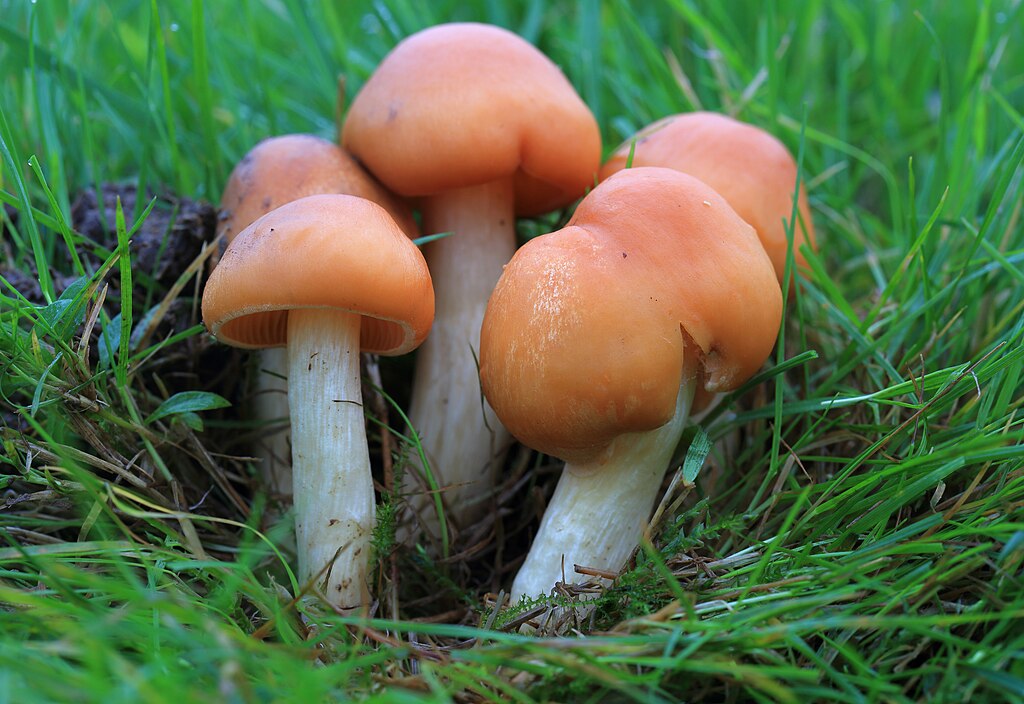
Habitat
This mushroom is typically found in unimproved grasslands, pastures, and short turf, but it also occurs in woodland settings. In forest environments, it grows on the ground, often among moss or leaf litter (duff). It shows a preference for mixed forests, including areas with California Bay Laurel, oak, redwood, and western redcedar. The species may grow individually, in scattered groups, or in small clusters.
Photos
Appearance
- Cap
- 2 to 12 cm wide; initially convex or bell-shaped, maturing to flat or slightly upturned with a broad central bump. The surface is smooth and moist to dry, sometimes cracking at the center. Color ranges from yellow-brown and salmon-orange to pale brownish-orange, often fading to ochre-buff or apricot-buff with age. The margin may be inrolled or ribbed when young.
- Gills
- Widely spaced and thick with a soft, greasy texture, often featuring crossveins. They are attached with a slightly to deeply decurrent descent. Color is initially similar to the cap (salmon-orange or buff) but may fade to pale pinkish beige or brownish-white.
- Stem
- 2 to 10 cm long and 0.5 to 2 cm thick; shape is equal, club-like, or tapering toward the base. The surface is smooth and moist to dry, ranging in color from pale cap-colored to white, often with a white base.
- Flesh
- Moderately thick in the cap and fibrous in the stem. Color varies from pale orangish-buff to nearly white.
- Spore print
- White.
Sporecast is better in the app
Plan ahead with 10-day forecasts, see what people are finding nearby, get photo IDs, and track your finds.
Edibility
The Meadow Waxcap has a mild, sweet, or mushroomy flavor, though some find it flavorless. Foragers must carefully distinguish it from the toxic Fool's Funnel (Clitocybe rivulosa), which is less waxy and smells mealy. Large specimens may also be confused with edible chanterelles or the similar Cuphophyllus graveolens, which is distinguished by a strong, sickly-sweet fragrance.
Misidentification can be fatal. Never eat a mushroom unless you're 100% sure. This information may be inaccurate. Always consult multiple sources.
Nutrient Source
otherIt obtains nutrients parasitically by colonizing the roots of plants, acting as an endophyte.
Common Names
- Basque
- belardi-ezco
- Danish
- Bleg vokshat, Eng-vokshat
- Dutch
- Weidewasplaat
- English
- Meadow Waxcap
- Finnish
- niittyvahakas, keltahelttavahakas
- French
- Hygrophore des prés
- German
- Weißer Wiesenellerling, Orange-Ellerling
- Norwegian Bokmål
- gulskivevokssopp, blek engvokssopp
- Norwegian Nynorsk
- bleik engvokssopp, gulskivevokssopp
- Spanish
- Higroforo de los prados
- Swedish
- äggvaxskivling, äggvaxing, blek ängsvaxskivling, blek ängsvaxing, ängsvaxing
Synonyms
- Agaricus ficoides
- Agaricus pratensis
- Agaricus vitulinus
- Camarophyllus berkeleyanus
- Camarophyllus berkeleyi
- Camarophyllus berkeleyi
- Camarophyllus bicolor
- Camarophyllus ficoides
- Camarophyllus ficoroides
- Camarophyllus ortonii
- Camarophyllus pratensis
- Cuphophyllus berkeleyi
- Cuphophyllus pratensis
- Hydrocybe pratensis
- Hygrocybe berkeleyana
- Hygrocybe berkeleyi
- Hygrocybe ortonii
- Hygrocybe pallida
- Hygrocybe pratensis
- Hygrocybe pratensis
- Hygrocybe pratensis
- Hygrophorus berkeleyi
- Hygrophorus bicolor
- Hygrophorus ficoides
- Hygrophorus ficoroides
- Hygrophorus karstenii
- Hygrophorus ortonii
- Hygrophorus pratensis
- Limacium karstenii
- Psalliota pratensis