
Habitat
This mushroom is found on soil among short grass in both semi- and unimproved grasslands, as well as in various forest environments. It grows solitarily or in groups among moss and litter, specifically showing a preference for western redcedar duff. It is typically found at lower elevations.
Photos
Appearance
- Cap
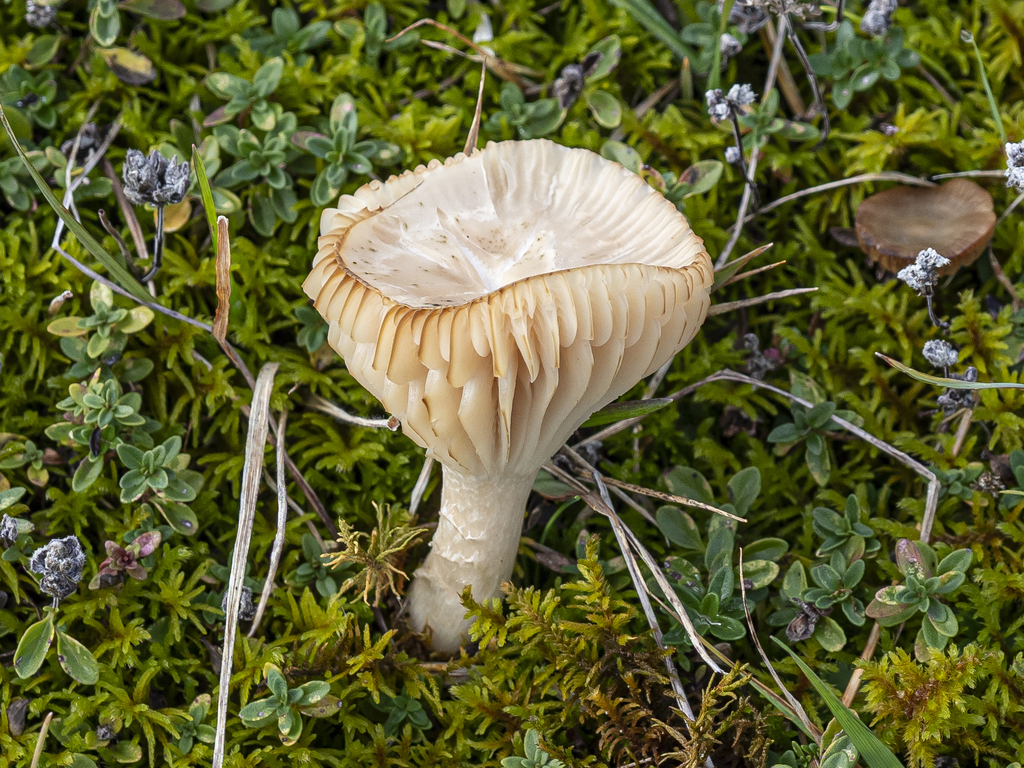
- 0.7 to 4.5 cm in diameter; initially hemispherical or convex, becoming flat or depressed with age, sometimes having a slight central bump. The surface is smooth, moist to dry, and can be slightly sticky when wet. Colors range from white to ivory or creamy yellow; the margin is often lined and can be ribbed or uplifted in older specimens.
- Stem
- 3 to 10 cm tall and 0.2 to 1 cm thick; slender and often wavy, shape is equal or slightly tapering. The surface is smooth to vertically fibrous, white to cream in color, sometimes developing pinkish tones at the base as it matures.
- Gills
- White to cream-colored and decurrent, running down the stem. They are widely spaced, sometimes branched or veined with ridges, and have a soft, greasy texture.
- Flesh
- White to yellowish, varying from thin to relatively thick; fibrous within the stem.
- Odor
- Very distinctive and strong, resembling cedar wood or Russian leather.
- Taste
- Varies from mild to unpleasant, often described as medicinal, metallic, or bitter.
- Spore print
- White.
Sporecast is better in the app
Plan ahead with 10-day forecasts, see what people are finding nearby, get photo IDs, and track your finds.
Edibility
This mushroom has a very distinctive strong odor resembling cedar wood or Russian leather. While the smell is sometimes described as pleasant, the taste is often reported as disagreeable, metallic, bitter, or medicinal. It may be confused with the similar-looking Cuphophyllus virgineus, which is typically whiter and larger but lacks the cedar scent and possesses a mild taste.
Misidentification can be fatal. Never eat a mushroom unless you're 100% sure. This information may be inaccurate. Always consult multiple sources.
Nutrient Source
SaprotrophicIt obtains nutrients by decomposing dead organic matter, primarily from dead grasses and other grassland plants.
Common Names
- Dutch
- Geurende wasplaat
- English
- Cedarwood Waxcap
- Welsh
- Cap Cŵyr Cedrwydd
Synonyms
- Camarophyllus russocoriaceus
- Hygrocybe russocoriacea — Cedarwood Waxcap
- Hygrophorus russocoriaceus