
Habitat
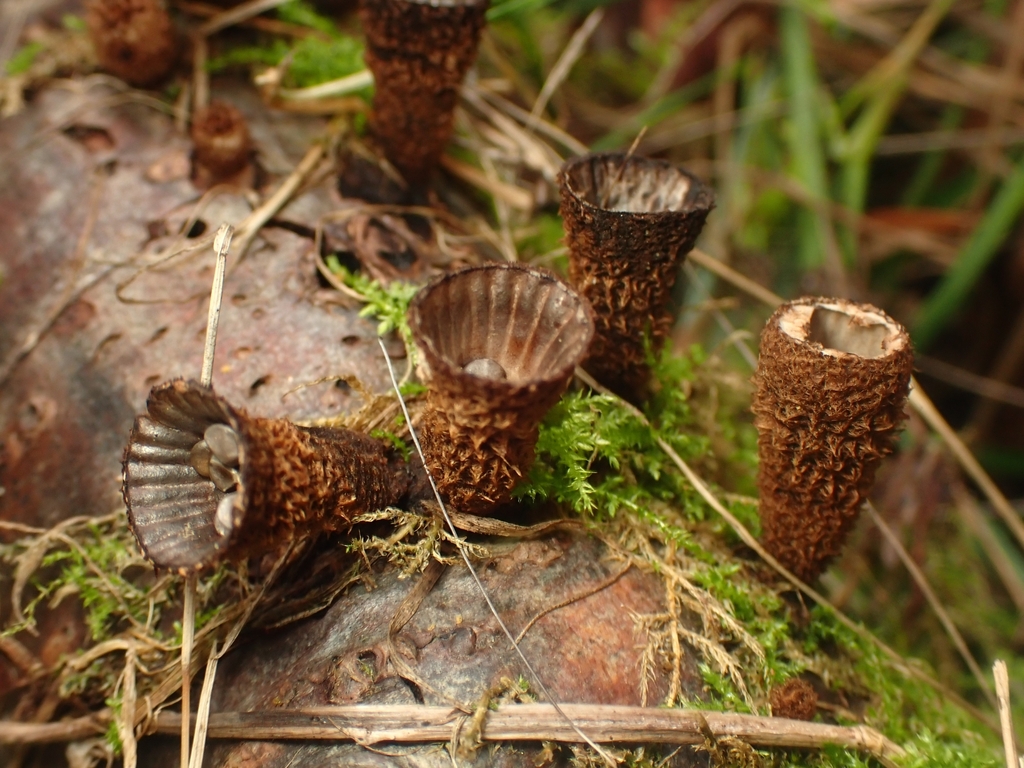
This species is a wood decomposer found on various types of organic debris, including twigs, small branches, conifer needles, cones, stumps, and bark. It is particularly common on wood chip mulch in gardens, landscaped areas, and urban environments, but it also occurs in broadleaf or conifer forests. It grows on soil, humus, and woody materials, typically appearing in scattered groups, dense clusters, or large troops.
Photos
Appearance
- Fruit body
- Vase-like or inverted bell-shaped, 6–15 mm wide and 7–20 mm high, often tapering toward the base and lacking a distinct stem.
- Outer surface
- Tawny to chocolate brown or grayish brown, densely covered in shaggy, coarse tufts of hair.
- Inner surface
- Distinctly grooved or fluted with vertical parallel lines; color ranges from light to dark metallic gray or silvery brown; smooth and shiny.
- Lid
- A whitish, scurfy membrane that initially covers the opening of the fruit body before withering or rupturing at maturity.
- Peridioles
- Often called 'eggs,' these are lens-shaped or disc-shaped spore packets, 1–2 mm wide, grayish to tan or brown in color, and attached to the base of the cup by a fine, coiled cord or thread.
- Spore print
- White to yellowish.
Sporecast is better in the app
Plan ahead with 10-day forecasts, see what people are finding nearby, get photo IDs, and track your finds.
Edibility
This species is considered inedible. It may be confused with Cyathus stercoreus, which lacks the vertical grooves inside the cups and typically grows on dung, or Cyathus olla, which has a different cup lining. It can also be distinguished from Nidula species, which have paler velvety exteriors and eggs embedded in a gel-like matrix.
Misidentification can be fatal. Never eat a mushroom unless you're 100% sure. This information may be inaccurate. Always consult multiple sources.
Nutrient Source
SaprotrophicIt obtains nutrients by feeding on decomposing organic matter such as dead wood, leaves, and mulch.
Common Names
- Danish
- Stribet redesvamp
- Dutch
- Gestreept nestzwammetje
- English
- Fluted Bird's Nest Fungus, Fluted Bird's Nest
- Finnish
- uurrepesäsieni
- French
- Cyathe strié
- German
- Gestreifter Teuerling
- Norwegian Bokmål
- stripebrødkorg
- Norwegian Nynorsk
- stripebrødkorg
- Swedish
- strimmig brödkorgssvamp
- Welsh
- Nyth Aderyn Rhesog
Synonyms
- Cyathella striata
- Cyathus hirsutus
- Cyathus hirsutus
- Nidularia striata
- Peziza striata