
Habitat
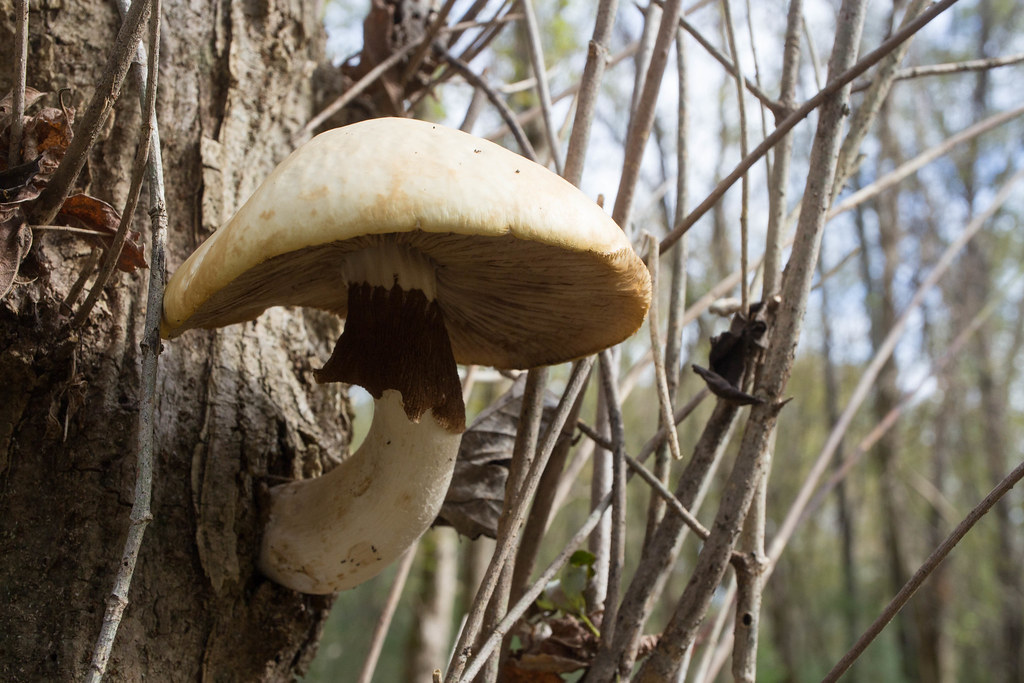
This species grows in dense tufts on the wood of broad-leaved trees, specifically on stumps, buried roots, or in the cracks of old, living trunks and branches. It shows a strong preference for willow and poplar, particularly black poplar, but can also be found on sycamore and elder.
Photos
Appearance
- Cap
- 2.5 to 15 cm across; initially hemispherical or convex, eventually flattening and often becoming wavy, distorted, or depressed at the center. The surface transitions from silky smooth to wrinkled or cracked with age, ranging in color from pale buff or cream to darker brown, sometimes favoring a rusty flush at the center.
- Stem
- 5 to 15 cm long and 10 to 15 mm thick; fibrous and cylindrical, though sometimes tapering downwards or appearing wavy. It is initially cream but darkens toward the base. Features a superior, persistent ring that may become dusted with brown spores.
- Gills
- Crowded and adnate or slightly decurrent, sometimes with a small tooth. They start as cream or buff and turn tobacco-brown as spores mature.
- Flesh
- Firm and white, becoming brown at the extreme base of the stem or occasionally brownish at the cap center. Noted for a nutty taste and a pleasant smell often compared to meal or old wine casks.
- Spore print
- Tobacco-brown.
Sporecast is better in the app
Plan ahead with 10-day forecasts, see what people are finding nearby, get photo IDs, and track your finds.
Edibility
This species has a pleasant mealy or wine-like scent and a rich, nutty flavor. While the caps have firm flesh that is typically free of larvae, the stems are often tough and should be discarded before eating. There are no known poisonous lookalikes, making it one of the easier species in its group to identify.
Misidentification can be fatal. Never eat a mushroom unless you're 100% sure. This information may be inaccurate. Always consult multiple sources.
Nutrient Source
SaprotrophicIt gets nutrients by decomposing dead organic matter, such as wood and plant material, in its environment.
Common Names
- Basque
- mazai-ziza
- Catalan
- bolet de saule
- Danish
- Poppel-agerhat
- English
- Poplar Fieldcap
- French
- Pholiote du peuplier
- German
- Südlicher Ackerling
- Norwegian Bokmål
- poppelåkersopp
- Norwegian Nynorsk
- poppelåkersopp
- Spanish
- seta de chopo, pollancó
- Swedish
- pioppino, poppelsvamp, tuvad åkerskivling
- Welsh
- Cap Maes y Poplys
Synonyms
- Agaricus attenuatus
- Agaricus capistratus
- Agaricus cylindraceus
- Agaricus cylindricus
- Agaricus cylindricus
- Agaricus leochromus
- Agaricus strobiloides
- Agrocybe cylindracea — Poplar Fieldcap
- Pholiota aegerita
- Pholiota capistrata
- Pholiota cylindracea
- Pholiota leochroma
- Togaria cylindracea