
Habitat
This common species grows on various types of decaying hardwood. It is frequently found on willow, birch, and beech, appearing as solitary specimens or in small, overlapping clusters on logs and dead wood.
Photos
Appearance
- Fruit body
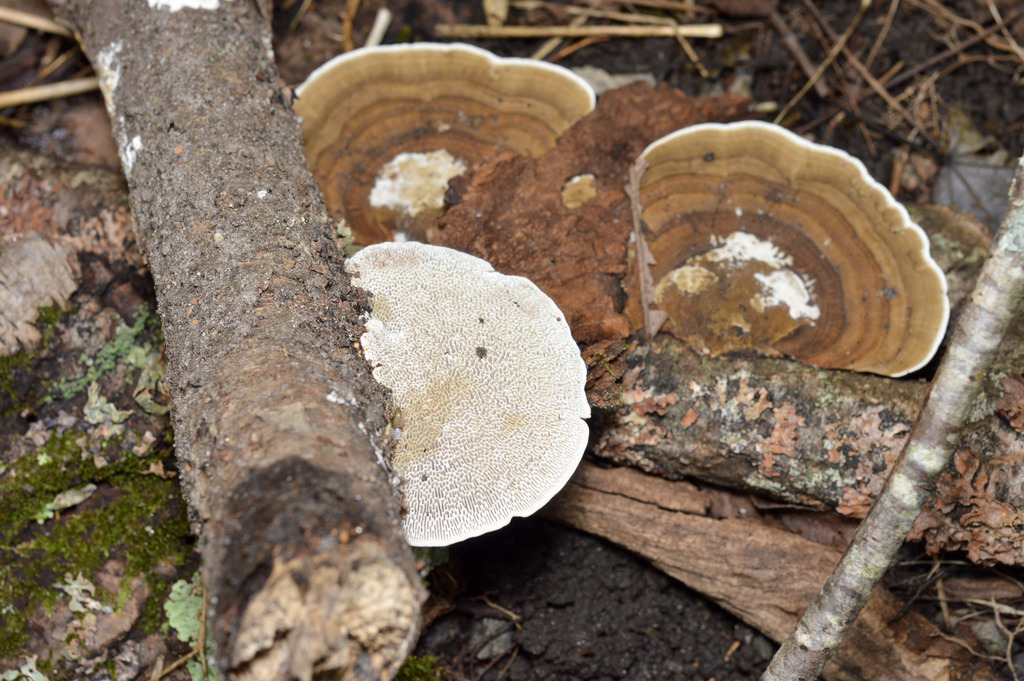
- A bracket-shaped or fan-shaped structure, measuring 8 to 22 cm across. It is flat or slightly humped at the base, typically kidney-shaped and broadly attached to its substrate.
- Cap surface
- Smooth to finely velvety or matted with hairs. It is marked by concentric grooves and zones of obscure brown colors, with a sharp and wavy margin.
- Pores
- The pore surface is initially white to ochre, staining salmon-pink or reddish when bruised. The pores are variable in shape, ranging from elongated to maze-like (labyrinthine).
- Tubes
- 5 to 10 mm deep, colored white to ochre.
- Flesh
- Tough and corky texture. It is initially ochre but darkens with age.
- Spore print
- White.
Sporecast is better in the app
Plan ahead with 10-day forecasts, see what people are finding nearby, get photo IDs, and track your finds.
Edibility
The flesh of this mushroom is tough and corky. It can be distinguished from the similar Lenzites betulina, which has a more velvety cap, white flesh, and gill-like structures that do not turn salmon-pink when bruised.
Misidentification can be fatal. Never eat a mushroom unless you're 100% sure. This information may be inaccurate. Always consult multiple sources.
Nutrient Source
facultativeIt obtains nutrients by decaying dead wood, often causing white rot in hardwoods, but can also act as a parasite on living trees, particularly willows.
Common Names
- Basque
- ardagai gorrikor
- Danish
- Rødmende læderporesvamp
- Dutch
- Roodporiehoutzwam
- English
- Blushing Bracket, Thin-walled Maze Polypore
- Finnish
- etelänsärmäkääpä
- French
- Tramète rougissante
- German
- Rötende Tramete
- Norwegian Bokmål
- teglkjuke
- Norwegian Nynorsk
- teglkjuke
- Spanish
- políporo tricolor
- Swedish
- tegelticka
- Welsh
- Ysgwydd Helyg
Synonyms
- Agaricus confragosus
- Amauroderma confragosum
- Boletus angustatus
- Boletus confragosus
- Boletus labyrinthiformis
- Daedalea angustata
- Daedalea candicans
- Daedalea confragosa
- Daedalea intermedia
- Daedalea ochracea
- Daedalea pruinata
- Daedalea rubescens
- Daedalea rubescens
- Daedalea suaveolens
- Daedalea variegata
- Daedalea zonata
- Daedaleopsis intermedia
- Daedaleopsis rubescens
- Ischnoderma confragosum
- Lenzites confragosus
- Lenzites sibiricus
- Polyporus confragosus
- Polyporus confragosus
- Polyporus rubescens
- Striglia confragosa
- Striglia intermedia
- Trametes confragosa
- Trametes confragosa
- Trametes erubescens
- Trametes rubescens