
Habitat
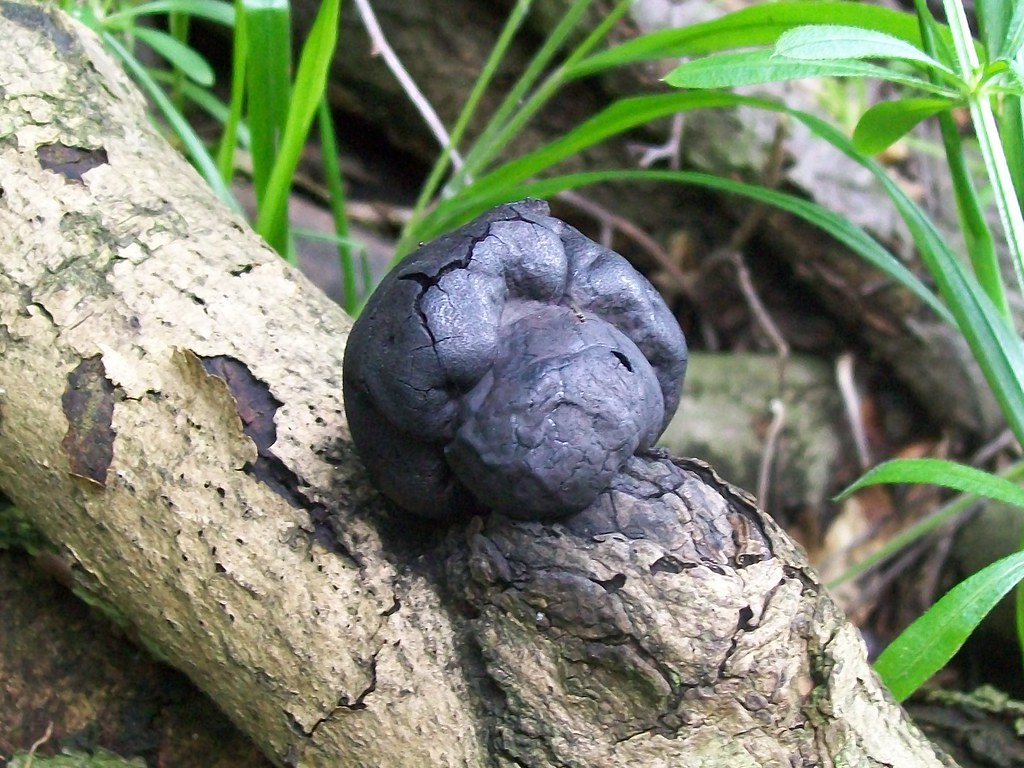
This species grows on dead or dying broadleaf wood, including downed logs, stumps, and fallen branches. It is found solitary or in clusters, showing a strong preference for ash trees (Fraxinus), though it is also known to occur on beech.
Photos
Appearance
- Fruit body
- Hard, brittle, carbon-like structure measuring 1–10 cm across. It is hemispherical, globose, or roughly pear-shaped, often with an incurved base. Initially reddish-brown to pinkish-gray, it eventually turns shiny black.
- Surface
- Smooth or slightly bumpy/nobbly, dotted with tiny pores or minute openings where spores are released.
- Flesh
- Fibrous and tough, characterized by distinct concentric silver-grey, dark purple, or blackish bands.
- Spore print
- Black or very dark brown.
Sporecast is better in the app
Plan ahead with 10-day forecasts, see what people are finding nearby, get photo IDs, and track your finds.
Edibility
This mushroom is inedible. It is easily recognized by its hard, brittle, carbon-like texture and its fibrous interior, which features distinct silver-grey, dark purple, or blackish concentric zones. While not for consumption, the dry fruit bodies are used as tinder for fire-starting or as coal extenders.
Misidentification can be fatal. Never eat a mushroom unless you're 100% sure. This information may be inaccurate. Always consult multiple sources.
Nutrient Source
SaprotrophicIt obtains nutrients by breaking down and absorbing nutrients from dead and decaying wood.
Common Names
- Basque
- kimomamizebratua, kimo mamizebratu
- Danish
- Aske-bæltekugle
- Dutch
- Kogelhoutskoolzwam
- English
- King Alfred's Cakes, Cramp Balls, Cramp-Ball
- French
- Daldinie concentrique
- German
- Kohliger Kugelpilz
- Spanish
- Daldinia de carne cebrada
- Swedish
- äkta skiktdyna
- Welsh
- Pelen Ddu
Synonyms
- Daldinia atra
- Daldinia tuberosa
- Fungus fraxineus
- Gamosphaera concentrica
- Hemisphaeria concentrica
- Hemisphaeria tuberosa
- Hypoxylon concentricum
- Hypoxylon tuberosum
- Lycoperdon atrum
- Lycoperdon fraxineum
- Peripherostoma concentricum
- Sphaeria concentrica
- Sphaeria fraxinea
- Sphaeria fraxinea
- Sphaeria tuberosa
- Sphaeria tunicata
- Stromatosphaeria concentrica
- Valsa tuberosa