
Habitat
This mushroom typically grows in deciduous or broad-leaved forests, specifically favoring rich humus or soil conditions. It is frequently associated with trees like beech, ash, or hazel, particularly in calcareous locations. Beyond wild habitats, it is also found in urban and landscaped environments such as parks and gardens. It has been observed growing on rotting wood occasionally and usually appears in small groups, loose clumps, or troops.
Photos
Appearance
- Cap
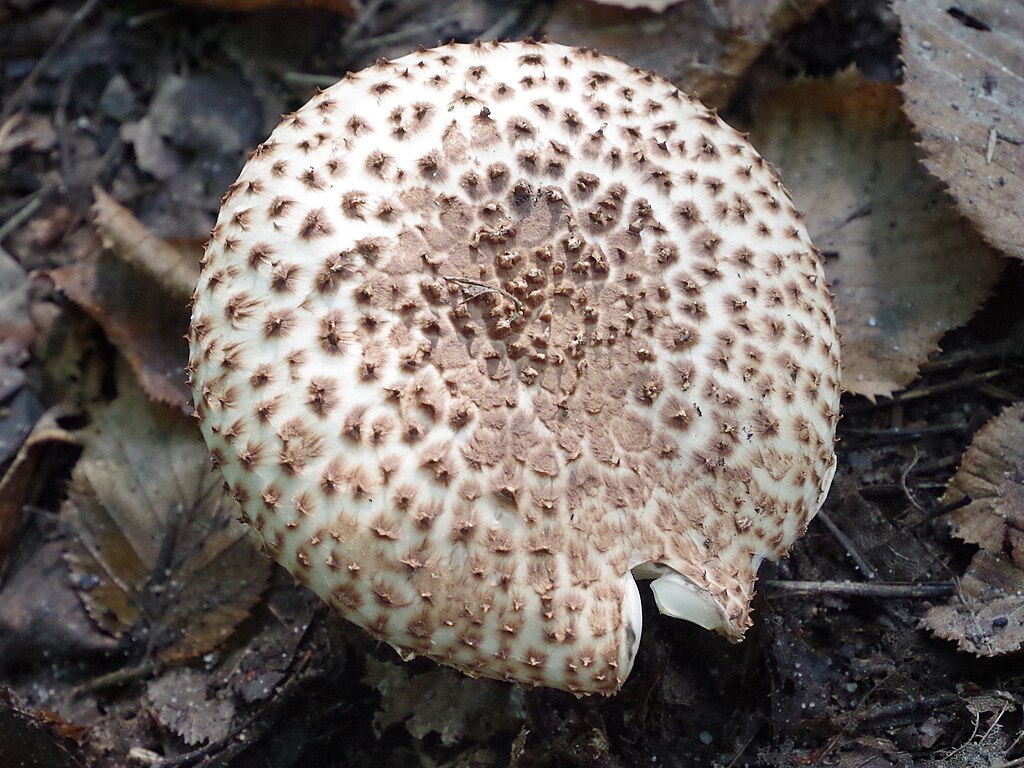
- 4–10 cm across; initially spherical or egg-shaped, becoming broad, bell-shaped, or convex to nearly flat. The surface is dry and densely covered with dark brown to orangish-tan, pointed or pyramidal scales that reveal a whitish to cream-colored background as the cap expands.
- Stem
- 3–12 cm long and 0.5–1.5 cm thick; cylindrical with an enlarged or slightly bulbous base. The portion above the ring is pale and smooth, while the lower portion is whitish to beige with brownish scales or flaky rings of tissue.
- Ring
- A prominent, white, cottony or cobwebby membrane that often persists as a large, drooping skirt. The underside is typically beige-tan and patterned with brownish scales, and its edges may initially adhere to the cap margin.
- Gills
- White to pale cream, becoming grayish in age; free from the stem and extremely crowded. Many gills are notably forked near the stem.
- Flesh
- White to beige, occasionally turning slightly yellow; fibrous in the stem and moderately thick in the cap.
- Spore print
- White.
- Odor and Taste
- Odor is strong and unpleasant, described as rubbery, metallic, or pungent. The taste is bitter and unpleasant.
Sporecast is better in the app
Plan ahead with 10-day forecasts, see what people are finding nearby, get photo IDs, and track your finds.
Edibility
The edibility of this species is unknown, but it is recommended to avoid it due to its similarity to poisonous mushrooms. It has a strong, unpleasant, and bitter taste, accompanied by an odor described as pungent-metallic, rubber-like, or plasticky. This mushroom is easily confused with other similar spiny species.
Misidentification can be fatal. Never eat a mushroom unless you're 100% sure. This information may be inaccurate. Always consult multiple sources.
Nutrient Source
EctomycorrhizalThis mushroom is ectomycorrhizal, meaning it forms a symbiotic relationship with tree roots, exchanging nutrients and water with the tree.
Common Names
- Basque
- galanperna exkatazorrotza, galanperna ezkatazorrotz, galanperna ezkatozorrotz
- Danish
- Pigget parasolhat
- Dutch
- Spitsschubbige parasolzwam
- English
- Freckled Dapperling
- Finnish
- piikkiukonsieni
- German
- Spitzschuppiger Schirmling
- Norwegian Bokmål
- stor skjellparasollsopp
- Norwegian Nynorsk
- stor skjelparasollsopp
- Spanish
- Lepiota de escamas agudas, lepiota de Fries, lepiota de escamas puntiagudas
- Swedish
- spärrfjällskivling
- Welsh
- Pertyn Brych
Synonyms
- Agaricus acutesquamosus
- Agaricus asper
- Agaricus elvensis
- Agaricus friesii
- Agaricus mariae
- Amanita aspera
- Amplariella aspera
- Cystolepiota acutesquamosa
- Cystolepiota aspera
- Cystolepiota friesii
- Echinoderma acutesquamosum
- Echinoderma acutisquamosum
- Echinoderma asperum
- Echinoderma friesii
- Fungus elvensis
- Lepiota acutesquamosa
- Lepiota acutesquamosa
- Lepiota aspera
- Lepiota friesii
- Lepiota priesii
- Mastocephalus friesii
- Psalliota elvensis